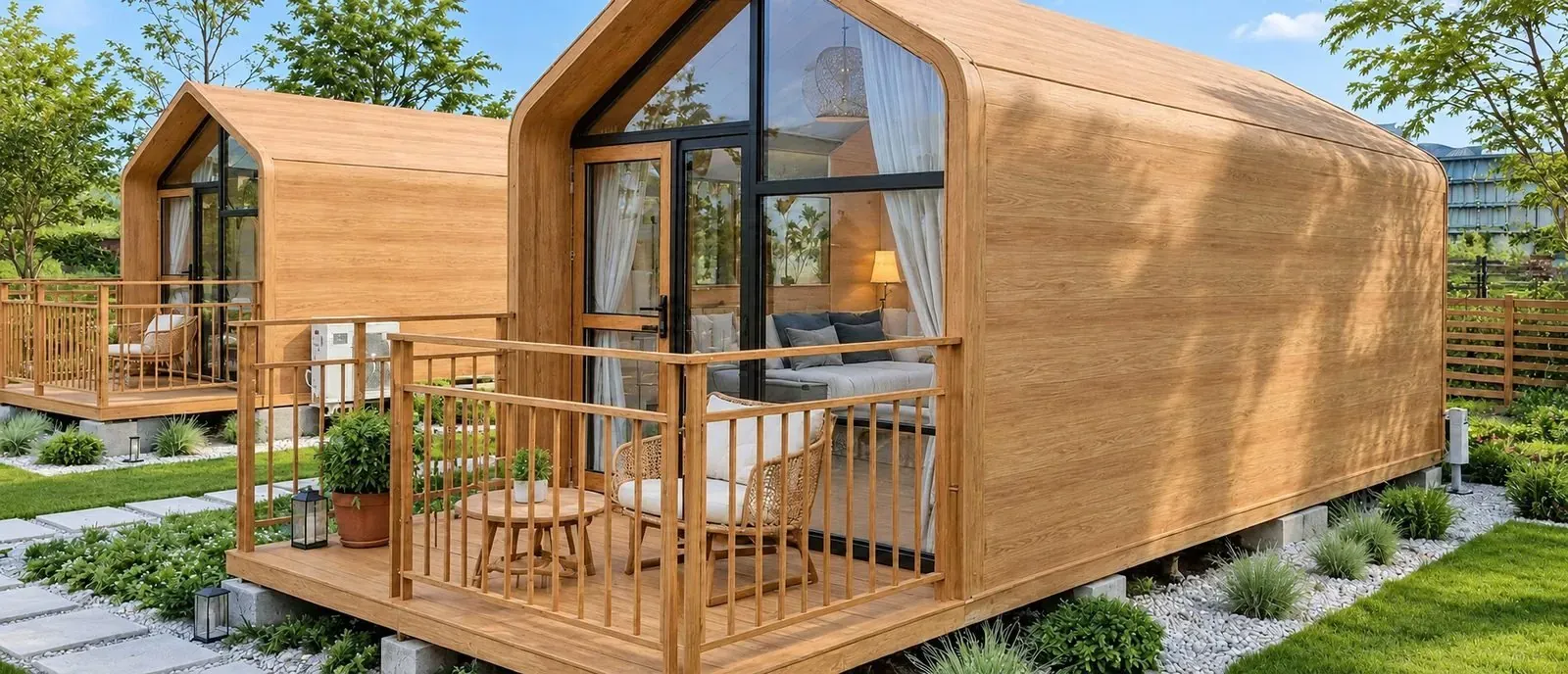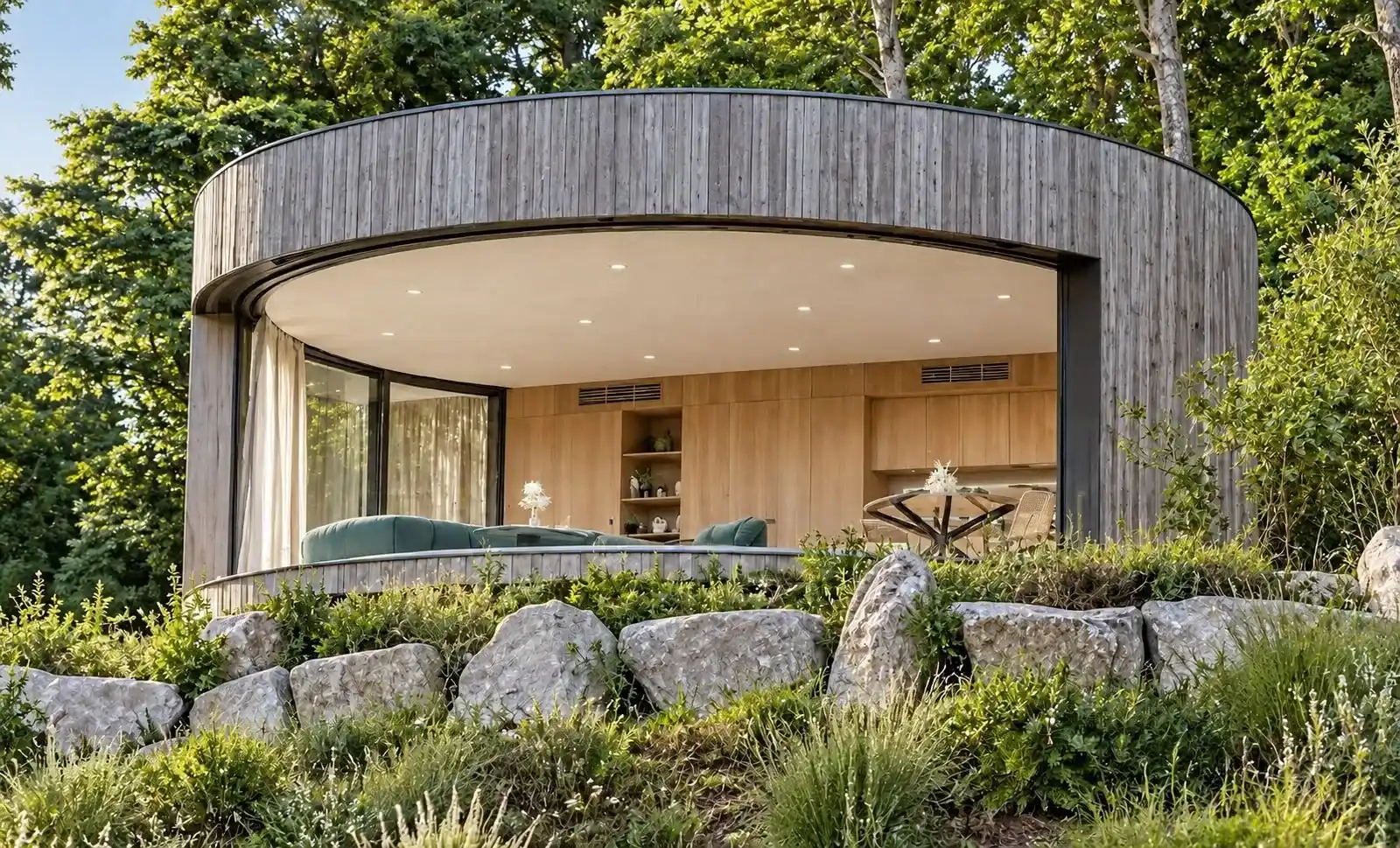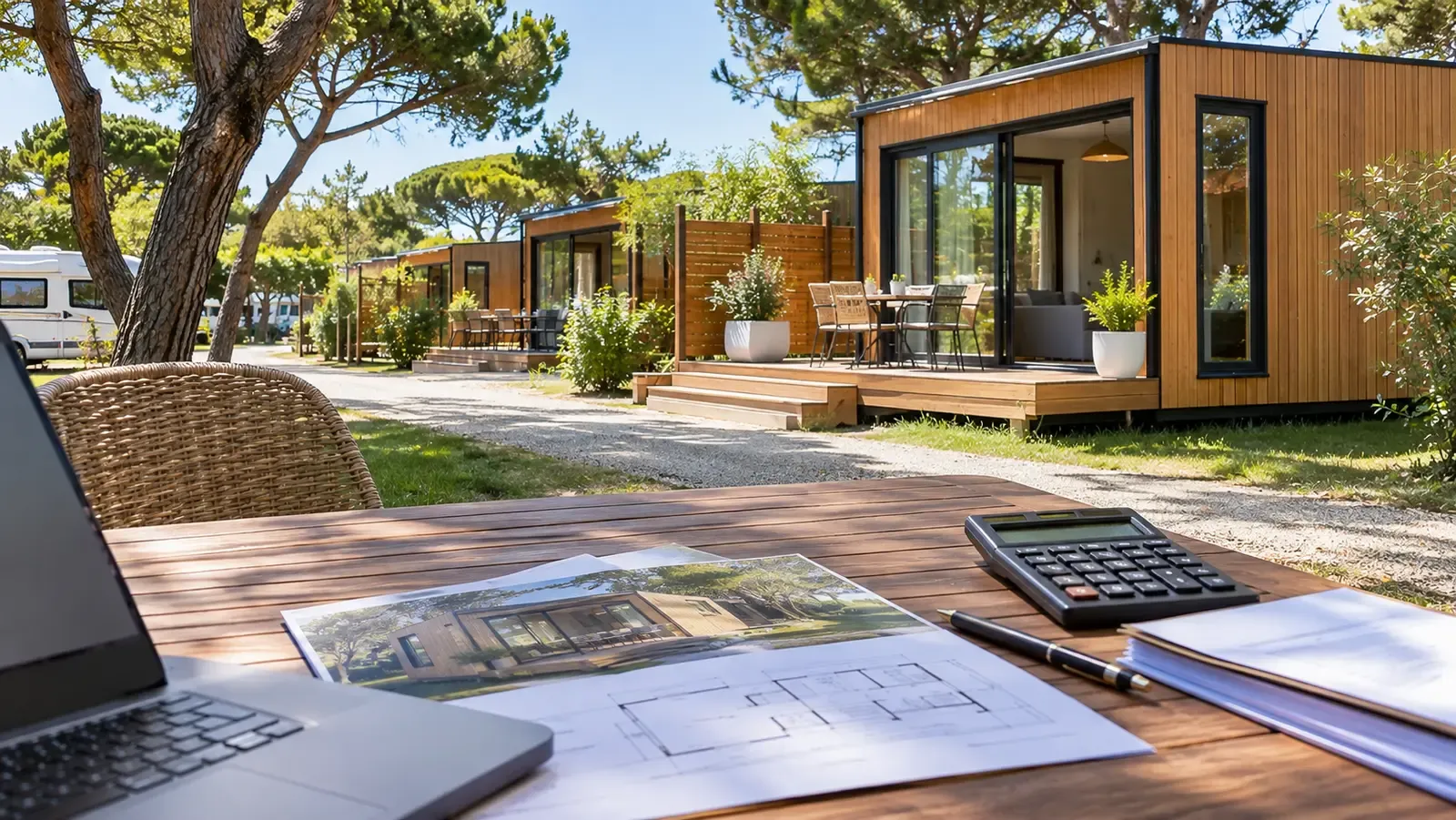
In shortTo finance modular units on a campsite, three levers combine: a bank loan, a lease or leasing and, depending on the region, a grant. Before the rate, settle how the units are classified: it drives the permission, the depreciation and the lender. A regional grant is applied for before any quote is signed.
Key figures
- €41,000*: 2026 catalogue starting price for Span (27 m²), standard finish, excluding land, connections and options
- 20% of expenditure, capped at €150,000 (3-star campsite) or €250,000 (4 or 5 stars): Grand Est Region grant for campsites (page updated 31 August 2025)
- €50,000 to €2,000,000, over 3 to 10 years: Bpifrance Prêt Tourisme 3, for renovation and fitting out, excluding new creations (presentation of 10 March 2026)
- 35 m² of floor area at most: threshold for exemption from formalities for a leisure cottage on a lawfully created campsite (article R. 421-2, Atout France guide)
- 6 to 8 weeks: factory manufacture before delivery to the site
*By Yannick Akoka, co-founder of AIIA · published 10 November 2026*
You run a campsite and want to add durable rental units without tying up all your cash before the season. The real question is how to finance modular units: with a loan, a lease, a grant, or a mix of the three.
The answer depends less on the rate than on three prior points: the legal classification of the units, the full budget beyond the purchase price and the form of the contract. This article goes through them, with dated official sources, figures labelled as assumptions, and the limits to confirm with your town hall, your bank and your accountant.
What budget should you plan to finance modular units?
You must finance the whole operation, not only the units. The starting price of an AIIA model covers turnkey delivery to the site.
It includes a galvanised steel structure, high-performance insulation, aluminium joinery with double glazing, and interior electrical and plumbing work. It excludes the land, connections, administrative procedures and options.
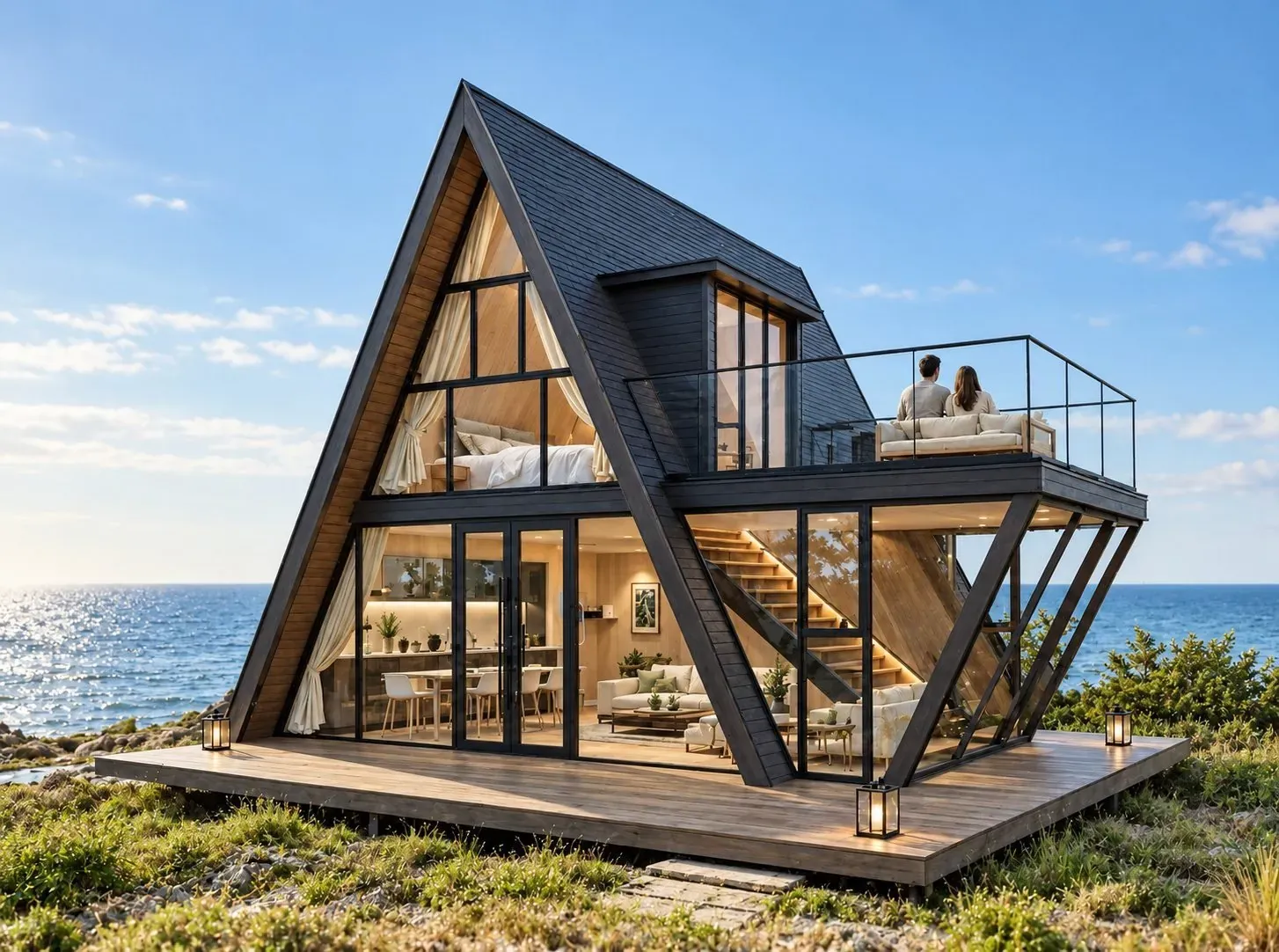
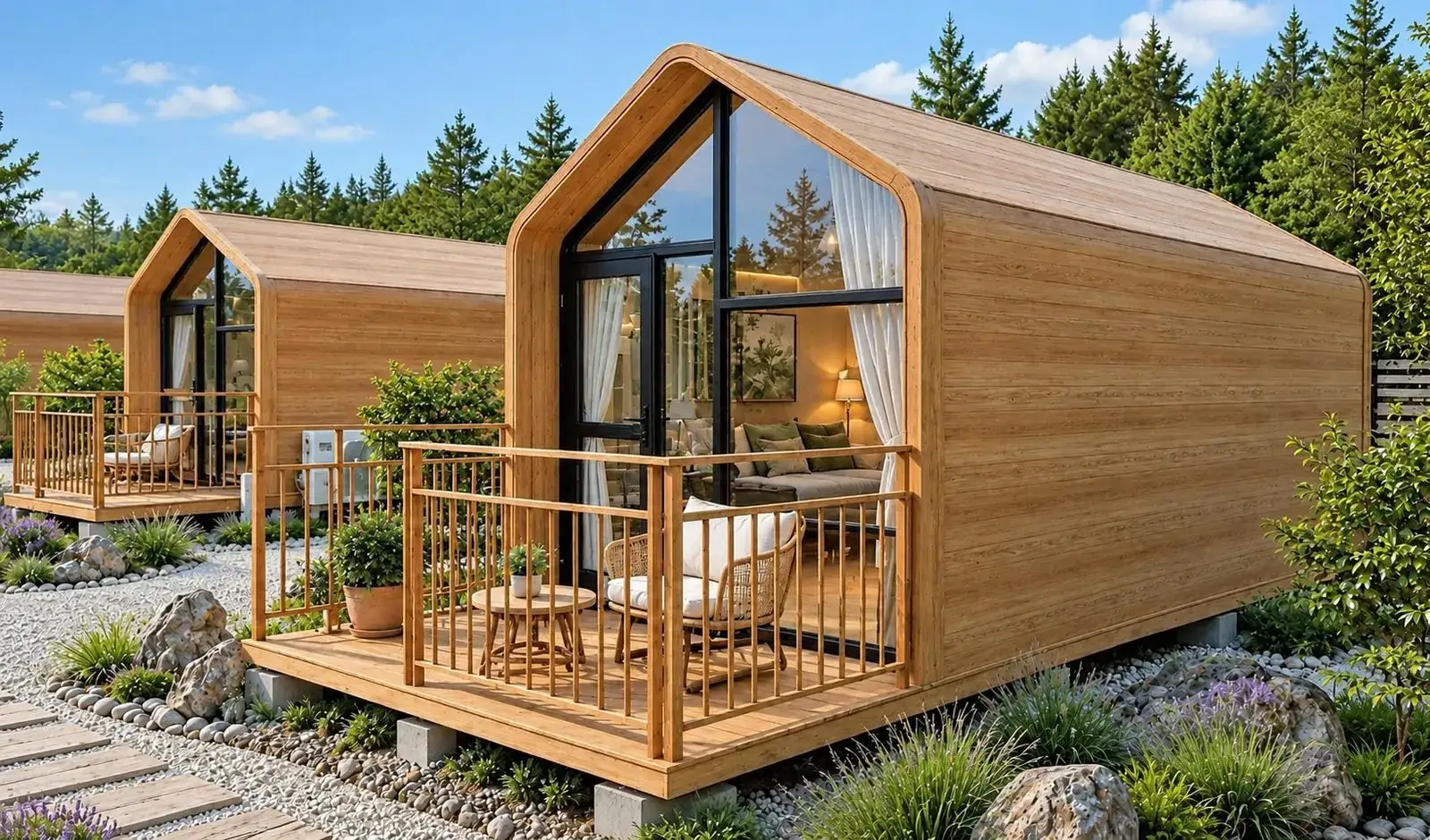
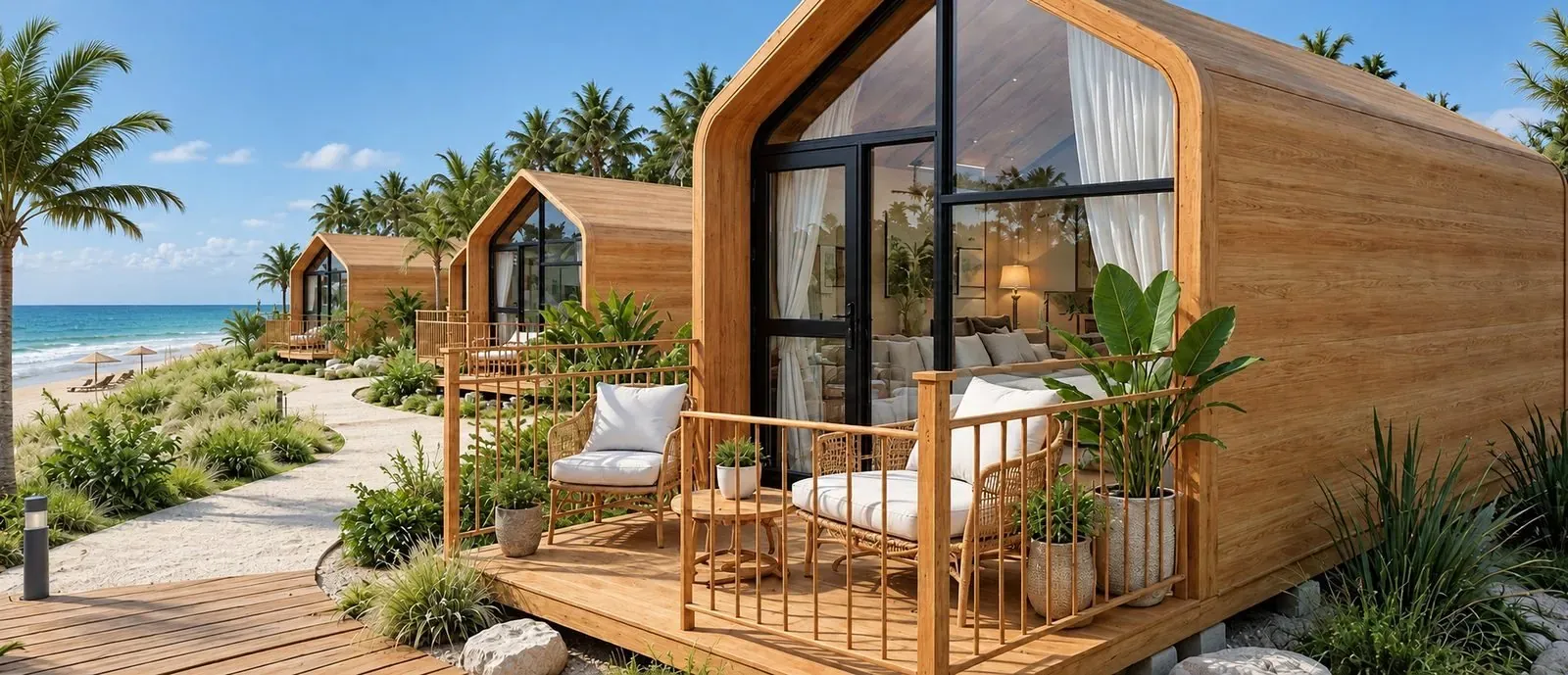
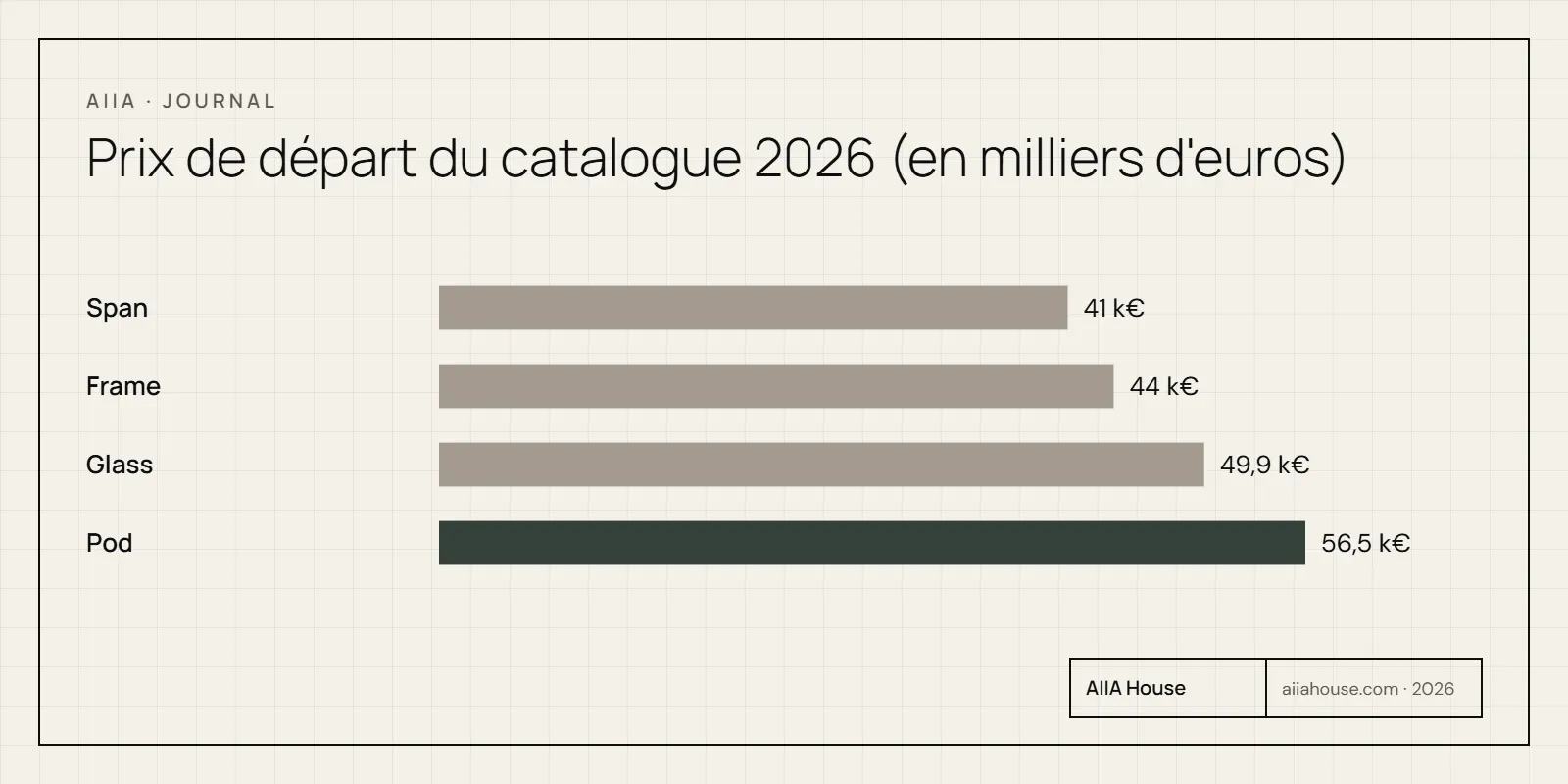
For a campsite, AIIA's Resort Collection offers several entry points. The prices below are 2026 catalogue starting prices, standard finish.
| Model | Surface | 2026 catalogue starting price |
|---|---|---|
| Span | 27 m² | €41,000* |
| Frame | 30 m² | €44,000* |
| Glass | 25 m² | €49,900* |
| Pod | 28 m² | €56,500* |
\* Prices exclude tax, standard finish, excluding land, connections, procedures and options.
As a worked example, ten Span units at the starting price come to €410,000*. That figure is a base, never a final budget.
Add installation by your installer, water and electricity connections made with a local professional, terraces and other options, furniture and fees. Finally, add the cash needed between the order and the first night invoiced.
Your lender will look at the whole picture. A plan that forgets connections or start-up cash risks falling short when the season opens.
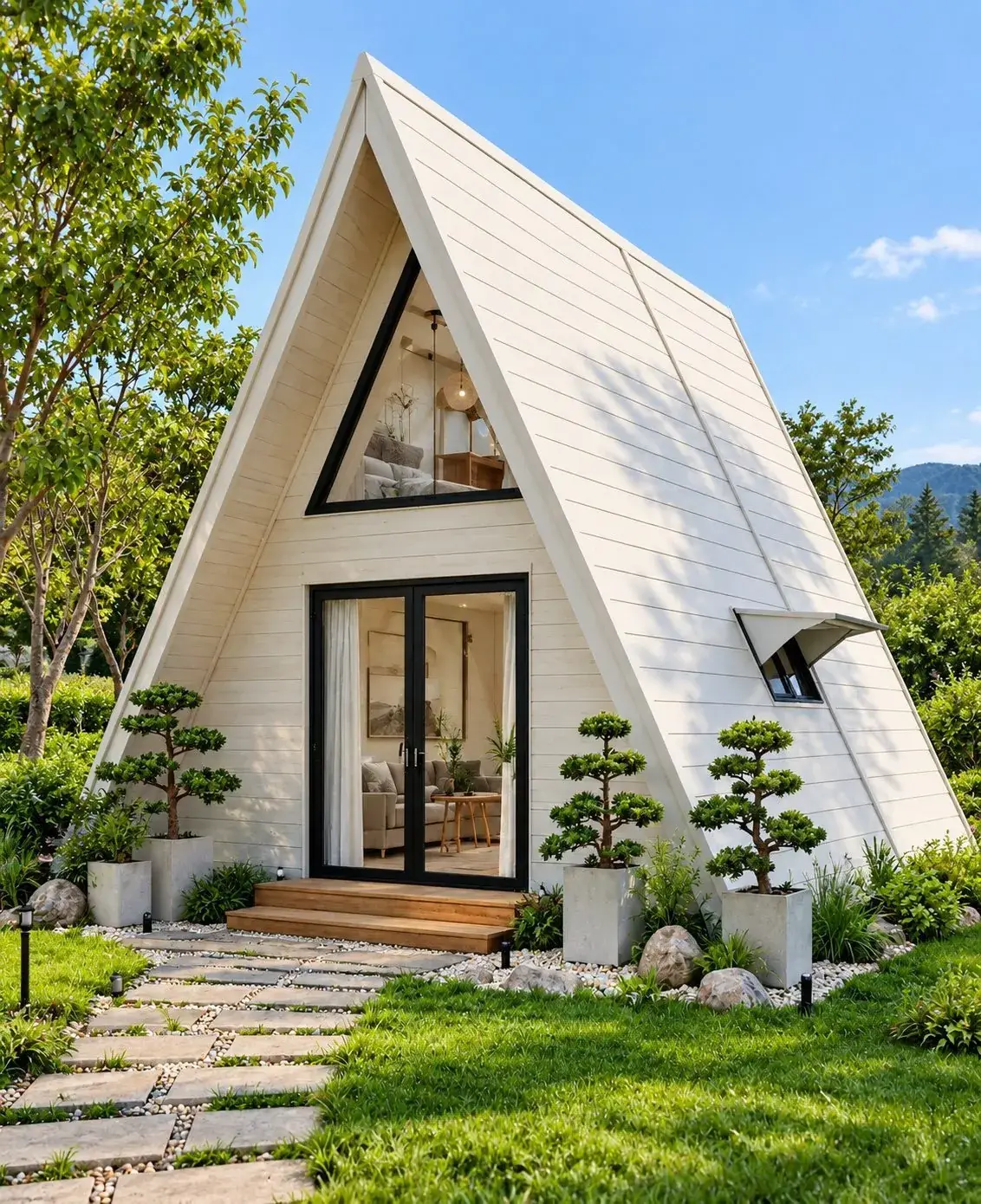
Which planning permission conditions financing leisure cottages and modules on a campsite?
Planning permission depends on how the units are classified, and a lender may ask for it before committing. Atout France's guide to campsite rating (revision in force since 1 July 2021) defines leisure cottages (HLL, from the French "habitations légères de loisirs") as demountable and transportable constructions, citing article R. 111-37 of the French planning code. It states that "bungalows and chalets without foundations" fall within it.
On a lawfully created campsite, a leisure cottage with a floor area of 35 m² or less is exempt from formalities (article R. 421-2). Above that, a prior declaration is required (article R. 421-9), with exceptions for remarkable heritage sites, the surroundings of listed monuments and classified sites. On sites created before 1 October 2007 by simple declaration, the number of leisure cottages must stay below 35 if the site has fewer than 175 pitches, or below 20% of pitches otherwise (article R. 111-38).
Two other rules weigh on the budget. A development permit is required for more than 20 people or more than 6 units (Bpifrance Création, sheet updated 28 May 2026). The number of pitches must match that permit, with a 10% tolerance; beyond that, the rating must be applied for again and a new development permit is needed.
These texts concern leisure cottages as defined by the planning code. A unit placed on foundations may fall under another regime, which the sources reviewed do not settle.
The town hall confirms the regime that applies to your project, and your financing file should include its written answer. For thresholds and rating details, read How do you install tiny houses on a campsite?.
Bank loan, lease or leasing: which should you choose?
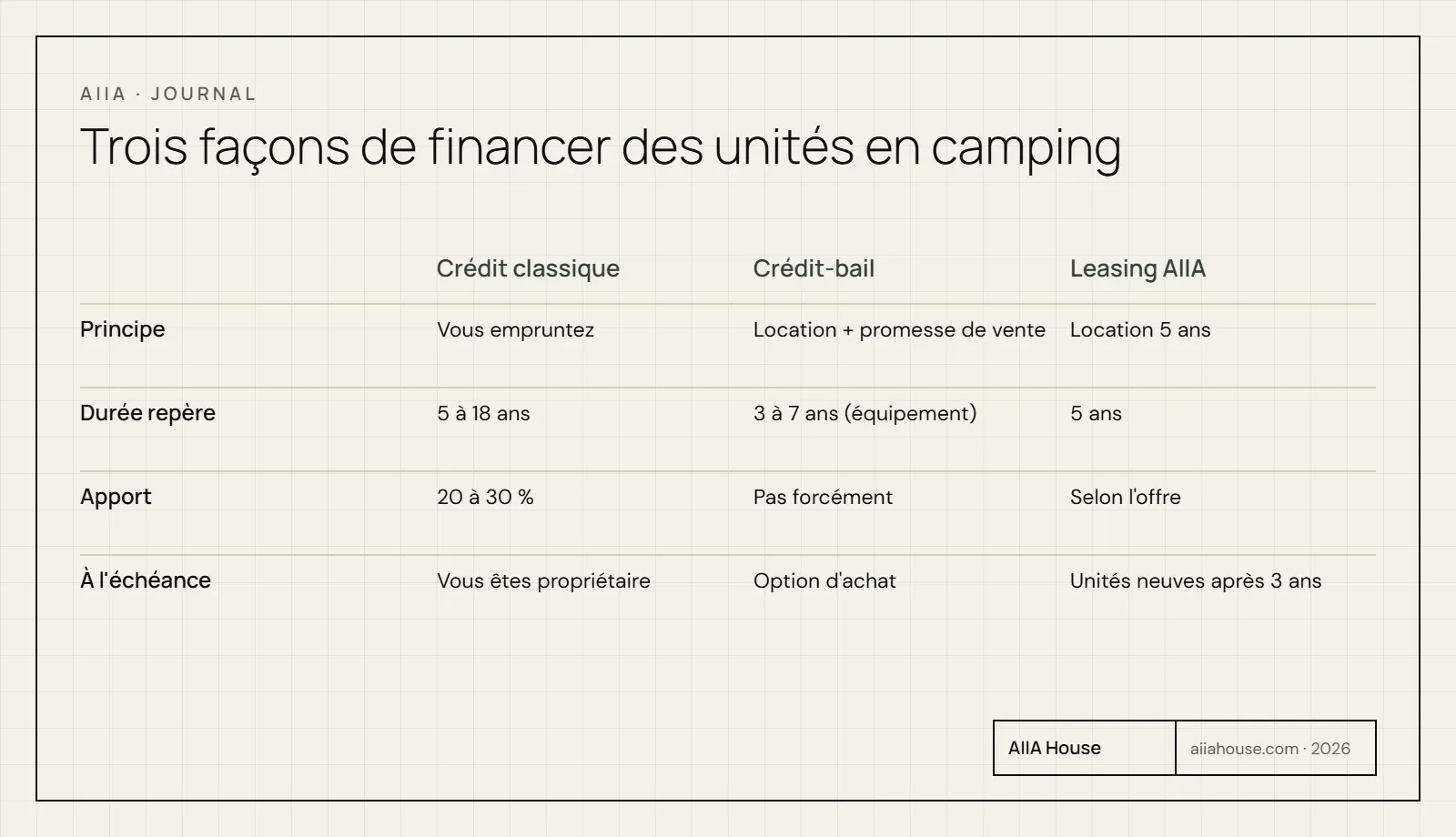
The choice depends on how long you want to use the units, the deposit available and who owns them at the end. A lease is a fixed-term rental with a promise to sell at maturity. The three options compare as follows, with benchmarks to confirm with each lender.
| Criterion | Standard bank loan | Lease with purchase option | AIIA leasing (professionals) |
|---|---|---|---|
| Principle | You borrow and become the owner | Rental with a unilateral promise to sell at term | Five-year rental, new units after three years |
| Benchmark term | 5 to 18 years according to a specialist broker (2021) | 3 to 7 years for equipment, 12 to 15 for property (Banque de France, 2021) | 5 years |
| Deposit | 20 to 30% of the price according to the same broker | Not necessarily required according to that broker | Set in the financing offer |
| Lender | Credit institution | Approved credit institution | Terms on quotation |
The Banque de France defines the lease as a fixed-term, irrevocable rental contract with a unilateral promise to sell at maturity. It distinguishes equipment leasing, for capital goods, from property leasing, which generally runs for 10 to 20 years. The choice between them depends on how your units are classified, to be validated by the lender and your accountant.
The broker's term and deposit figures date from 2021 and are commercial in nature: treat them as an order of magnitude, never as an offer. The five-year leasing offered by AIIA, with new units after three years, is reserved for professionals.
To decide, a simple rule of thumb. If you want lasting ownership, compare a standard loan and a property lease.
If you want to renew the units, look at five-year leasing. In every case, compare total cost on written offers.
What should you expect from a five-year lease on ten units?
Under the assumptions of AIIA's leasing simulator, ten Span units mean roughly €7,400* a month over 60 months. This calculation is an illustration: the real financing offer replaces each of these values.
| Assumption | Value used |
|---|---|
| Value of the units | €410,000* (ten Span at the starting price) |
| Term | 60 monthly payments |
| Annual rate | 3.71% |
| Residual value | 1% of the value of the units |
| Simulator occupancy | 65% by default |
| Simulator costs | 30% of rental income |
The simulator presents the 3.71% rate as the average rate on new loans to SMEs in August 2026 (Banque de France), to be treated as a floor, since a lease usually costs more than a loan. The 1% residual value is at the low end of a 1 to 6% range quoted for equipment leasing (CCI Paris Île-de-France, June 2026).
On this assumption, the 60 payments plus the residual value total about €450,000*, close to €40,000* of cumulative financing cost. That cost is not a promise: it varies with the rate, the operator's profile and the option chosen.
The 65% occupancy rate is a simulator default, not an observed average. Replace it with your own attendance data before presenting a plan to your bank. You can test your figures on the Invest page or request a study on the Professionals page.
Which public grants and guarantees exist for a campsite?
Grants exist, but they are conditional, regional and never automatic. Two schemes serve as examples, to be checked for your area.
Bpifrance, Prêt Tourisme 3. According to Bpifrance's presentation of 10 March 2026, it targets tourism SMEs active for more than 3 years. It runs from €50,000 to €2,000,000, over 3 to 10 years, with a capital repayment deferral of up to 24 months. It covers renovation, fitting out and modernisation.
New creations are excluded: have Bpifrance confirm whether adding units counts as an extension or a creation. It must be matched by external financing of at least the same amount, obtained less than 6 months earlier. It requires no security on company assets or the manager's personal assets, apart from a 5% guarantee retention.
Grand Est Region, outdoor hospitality. The scheme page, updated on 31 August 2025, states a grant of up to 20% of expenditure. The cap is €150,000 for a 3-star campsite or leisure park and €250,000 for a 4 or 5-star one. A supplementary strand supports permanent leisure cottages and unusual accommodation, with a minimum of 2 units.
Furniture, land purchases, mere compliance works and mobile homes are excluded. The application is made online before quotes are signed and before works begin, and awards remain subject to regional priorities.
If your campsite is in another region, ask your regional council's tourism department and your chamber of commerce before ordering anything.
How do depreciation and tax weigh on the financing plan?
The depreciation period and the VAT regime change real profitability, and you set them with your accountant. The BOFiP (BOI-BIC-AMT-10-40-30, in force since 23 September 2013) gives purely indicative depreciation rates.
They run from 2 to 5% for commercial buildings, 5 to 10% for fittings and installations, and 10% for furniture. It does not deal with campsites or leisure cottages.
AIIA's simulator uses a 30-year depreciation period, as an indication. This is not a rule: the period that applies to your units depends on their nature and use, and an accounting firm covering campsites mentions shorter periods for light accommodation, without a verifiable official reference.
VAT deserves the same caution. The simulator specifies that it is recoverable only if the activity is subject to it (article 261 D of the French general tax code), to be checked with an accountant.
Finally, follow the 2027 finance bill. On 10 November 2026, according to NosParlementaires, its first part had been rejected at first reading in the National Assembly. A secondary source mentions discussions on depreciation of tourist furnished lets.
According to that source, these discussions target furnished-let landlords subject to income tax. No measure is in force: do not build it into your plan.
For individual landlords' tax, see Tiny house as a furnished let: what tax regime?.
How do you build a solid financing file?
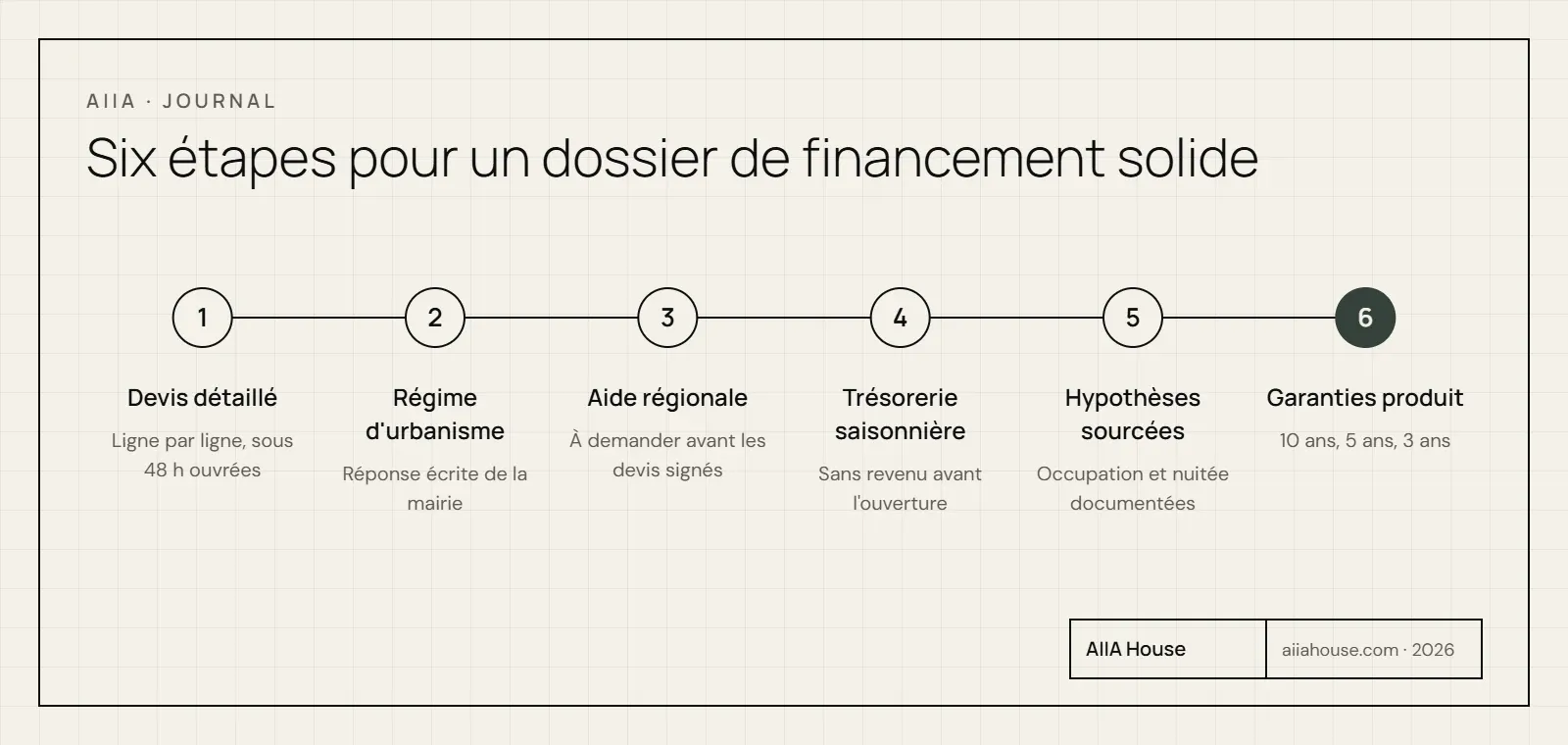
A solid file aligns the quote, the permission, the timetable and the seasonal cash plan. This order limits unpleasant surprises.
- Get the detailed quote. AIIA sends a line-by-line quote within 48 working hours of your request, to attach to the file.
- Have the planning regime confirmed. Ask the town hall for a written answer on the classification of the units and the permission required.
- Apply for the grant before signing quotes. A scheme such as the Grand Est Region's requires the application before quotes are signed and before works start.
- Build the seasonal cash plan. Between the order, the 6 to 8 weeks of manufacture, delivery and installation by your installer, no revenue comes in.
- Document the assumptions. Occupancy and nightly rate are assumptions, not proof: state where they come from.
- Present the product guarantees. The manufacturer provides a 10-year guarantee on the structure, 5 years on waterproofing and 3 years on installations, relayed by AIIA.
Traditional construction takes several months according to AIIA's Invest page, against 6 to 8 weeks of factory manufacture. That time saving shortens the period without revenue, but it does not replace the time needed for permissions and installation.
To size the project, see How many units on a tourist site? and What return can a modular accommodation unit offer?.
What is the next step to finance modular units?
The next step is to cost your whole project, then compare at least two financing options using written offers. Start by fixing the number of units, the model and the opening date, then ask your town hall for the planning classification.
Next, approach your bank and, if eligible, your region's grant before signing. Compare the total cost, not only the monthly payment: term, residual value, arrangement fees and guarantees required.
AIIA helps on the product side: a detailed professional quote within 48 working hours, a one-hour video or phone appointment, and introductions to installers. Leasing terms are set out on the quote. Request your study on the Professionals page or write to contact@aiiahouse.com.
Think about operations after opening too: What maintenance does a modular accommodation park need?. The Frame and Span models are two good starting points for a first costing.
AIIA's view
AIIA designs tiny houses and modular homes, manufactured in a workshop and delivered to the client's land; AIIA is neither a builder nor an installer. We are not your financial adviser: we promise no rate, no grant and no permission. What we can give you is a detailed quote within 48 working hours, manufacturing times of 6 to 8 weeks and clear guarantees. Five-year leasing, with new units after three years, is reserved for professionals, and its terms are set out on the quote. Before ordering, have your town hall confirm the permission and your lender confirm the financing in writing.
Sources
- https://www.atout-france.fr/sites/default/files/2026-06/Guide%20de%20contr%C3%B4le%20-%20Campings%20et%20PRL.pdf
- https://www.banque-france.fr/system/files/2024-04/823415%20Fiche-415.pdf
- https://bofip.impots.gouv.fr/bofip/4520-PGP.html/identifiant=BOI-BIC-AMT-10-40-30-20130923
- https://bpifrance-creation.fr/activites-reglementees/camping
- https://pro.auvergnerhonealpes-tourisme.com/wp-content/uploads/2026/03/Presentation-Bpifrance-Dispositifs-tourisme-10-MARS.pdf
- https://mesaidespubliques.infogreffe.fr/aides/grand-est-soutien-hebergement-touristique-hotellerie-plein-air
- https://nosparlementaires.fr/lois/pour-2027
- https://www.aiiahouse.com/fr/professionnels
- https://www.aiiahouse.com/fr/investir
- https://www.aiiahouse.com/fr/tarifs
- atout-france.fr/sites/default/files/2026-06/Guide%20de%20con…
- banque-france.fr/system/files/2024-04/823415%20Fiche-415.pdf
- bofip.impots.gouv.fr/bofip/4520-PGP.html/identifiant=BOI-BIC-AMT-…
- bpifrance-creation.fr/activites-reglementees/camping
- pro.auvergnerhonealpes-tourisme.com/wp-content/uploads/2026/03/Presentation-Bpif…
- mesaidespubliques.infogreffe.fr/aides/grand-est-soutien-hebergement-touristi…
- nosparlementaires.fr/lois/pour-2027
- aiiahouse.com/fr/professionnels
- aiiahouse.com/fr/investir
- aiiahouse.com/fr/tarifs
Frequently asked questions
Can modular units be financed without a deposit?
Sometimes, but it is never a given. A specialist broker says a lease does not necessarily require a deposit, and Bpifrance cites loans with no security on company assets. The lender decides on the strength of your file.
Is AIIA leasing open to private individuals?
No. The five-year leasing offered by AIIA, with new units after three years, is reserved for professionals. Private buyers mostly pay cash.
Is a regional grant automatic?
No. The Grand Est Region's page states that awards are not automatic and depend on regional priorities. The application is filed before quotes are signed and works begin.
Do you need the town hall's permission before signing the financing?
It is the prudent course. A lender may want to know the siting is authorised, and the town hall confirms the regime that applies to your project. Get that answer in writing.
Are connections financed with the units?
No. Water, electricity and drainage connections are never included in AIIA's offer; they are done with a local professional. Include them in your budget and in your financing request.
How long does delivery take?
Factory manufacture takes 6 to 8 weeks, excluding delivery and installation. Add the time to obtain permissions and your installer's lead time.