In shortTiny house on wheels or fixed? A tiny house on wheels remains a vehicle: no planning authorisation under 3 months a year (local rules apply), but not for living in. A fixed tiny house is a building: it needs planning authorisation and can become a main home. Choose according to use, land and financing.
Key figures
- 3 months a year: maximum time a caravan can be parked without authorisation, and without living in it (Service-Public.fr, 8 April 2026)
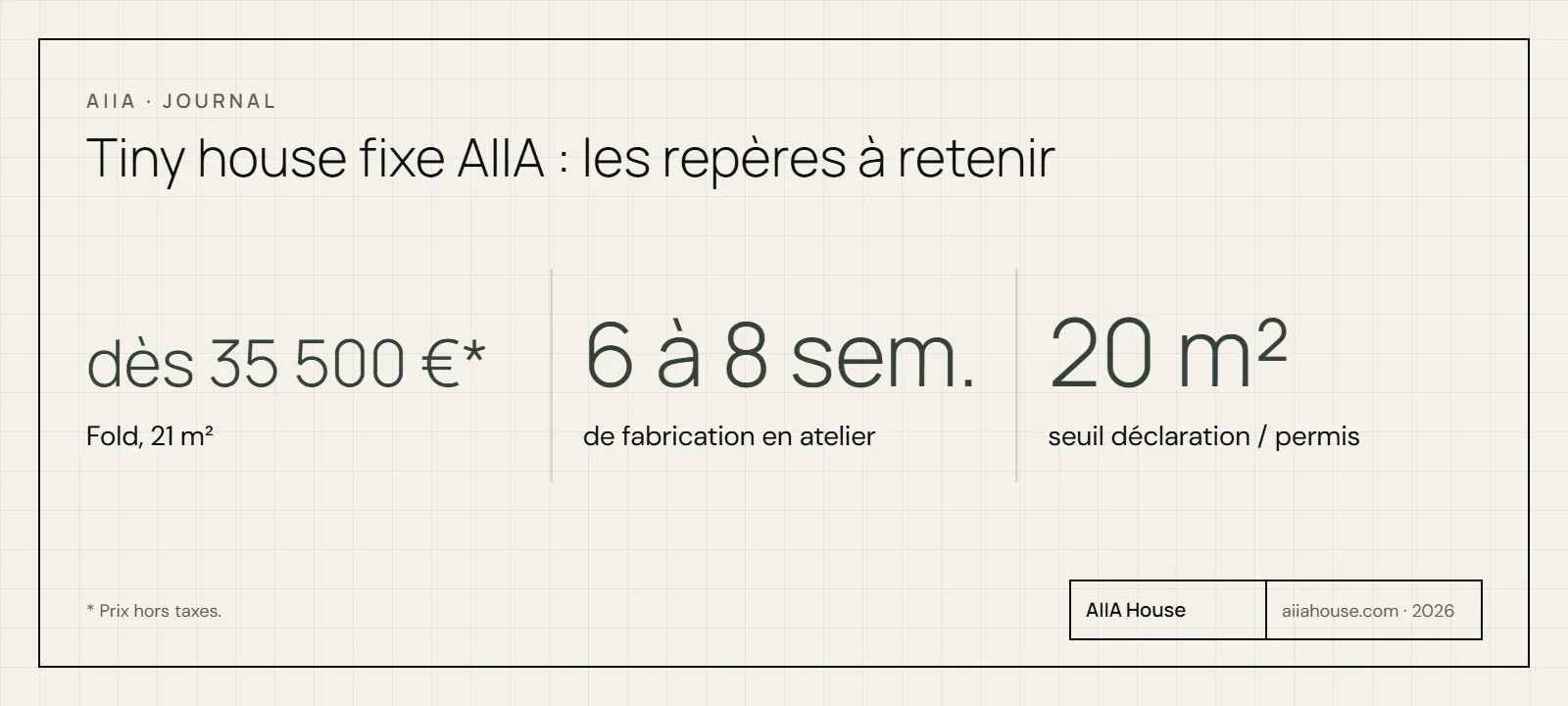
- 20 m²: threshold between a prior declaration and a building permit for a home without wheels (Service-Public.fr, 8 April 2026)
- 8 months a year: minimum occupation of a demountable residence used as permanent housing (decree no. 2015-482)
- from €35,500*: starting price of the AIIA Fold tiny house, 21 m²
- 6 to 8 weeks: workshop manufacture of an AIIA tiny house
*By Yannick Akoka, co-founder of AIIA · 1 November 2026*
Tiny house on wheels or fixed: are you torn between a house you can tow and one placed permanently? This choice decides the planning regime, the insurance, the financing and how long you may live in it.
We consulted official texts and trade press on 1 November 2026. Sourced facts, points under discussion and our recommendations are flagged as such. By the end you will know what to ask the town hall, the insurer and the bank.
This article extends our pillar guide to buying a modular home or tiny house.
Tiny house on wheels or fixed: which to choose in 30 seconds?
Choose the tiny house on wheels for short stays, without living in it, under 3 months a year in one place. Choose the fixed tiny house for a main residence, steady rental or a lasting project. The town hall always has the final say: confirm the status before you buy.
| Your situation | Suitable option | Point to check |
|---|---|---|
| Short stays, not lived in | On wheels | Under 3 months a year in one place |
| Main residence | Fixed | Land where housing is allowed |
| Long stays or second home | Fixed | The caravan regime excludes dwelling use |
| Steady tourist rental | Fixed (hypothesis) | Municipal approval, insurance, tax |
| Campsite or leisure park | Depends on the site | The operator says if wheels or fixed are allowed |
This grid is an AIIA recommendation, not a rule of law.
At AIIA the question does not arise: all our tiny houses are fixed. The tiny house on wheels suits a nomadic way of life. We favour a traditional way of life.
What is the difference between a tiny house on wheels and a fixed one?
A tiny house is a compact small house; at AIIA, the Tiny Collection runs from 21 to 32 m².
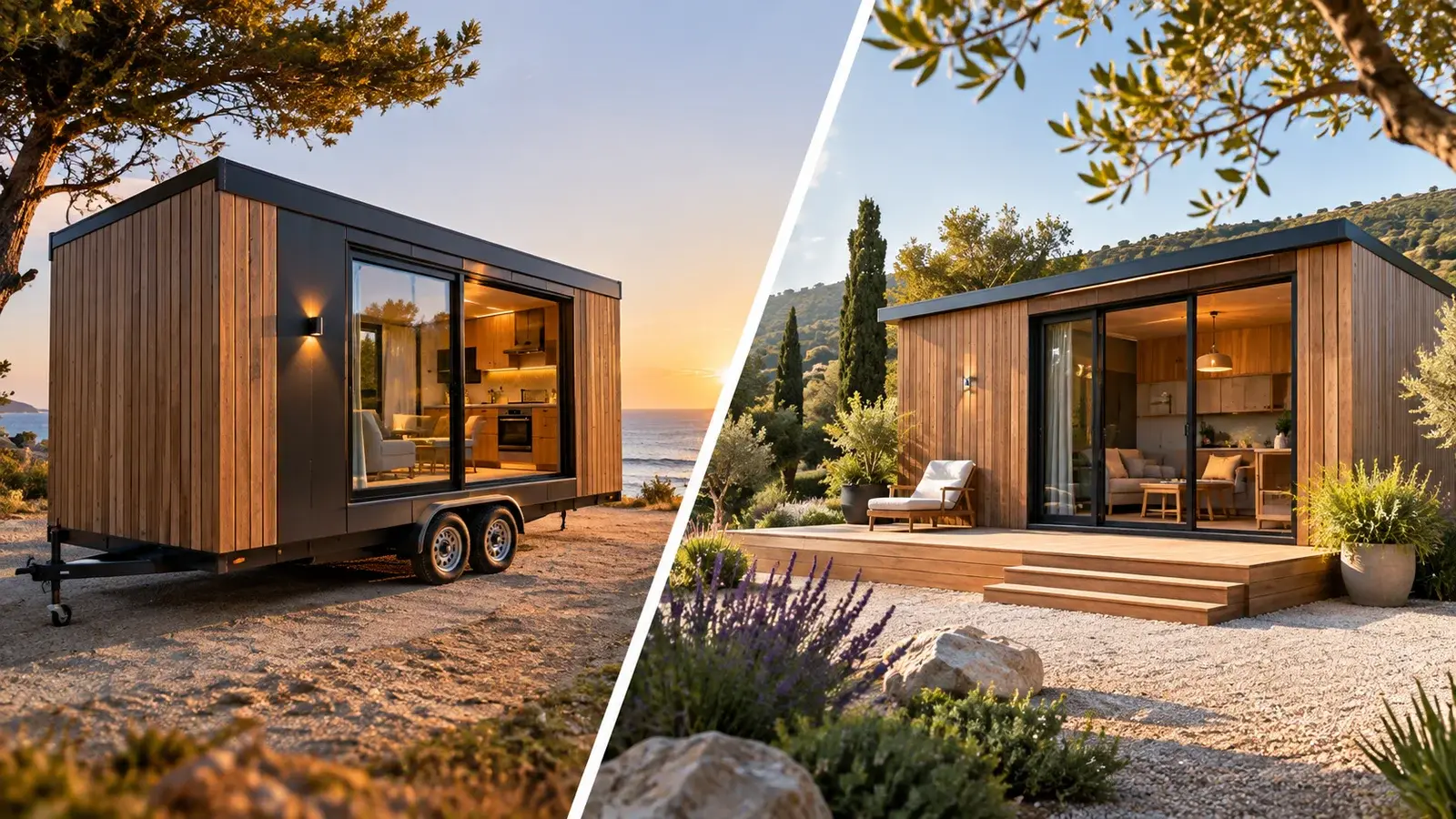
On wheels, or on a trailer, it keeps its mobility, so the law treats it like a caravan. A fixed tiny house is placed permanently and becomes a building. Actual use decides the status, not the marketing name.
- Service-Public.fr: a caravan without wheels and towbar is treated as a building. A prior declaration or a permit then becomes necessary.
- FFB (Bâtiment Actualité, July 2024): a mobile house can remain movable property. A house anchored to the ground can become a structure.
- Grey area: according to habitat-pc-sos.fr (2 August 2026), the tiny house has no legal category of its own. A Senate question (no. 06279, October 2025) was unanswered.
A structure is the result of construction work. This can trigger ten-year liability.
Where does AIIA stand?
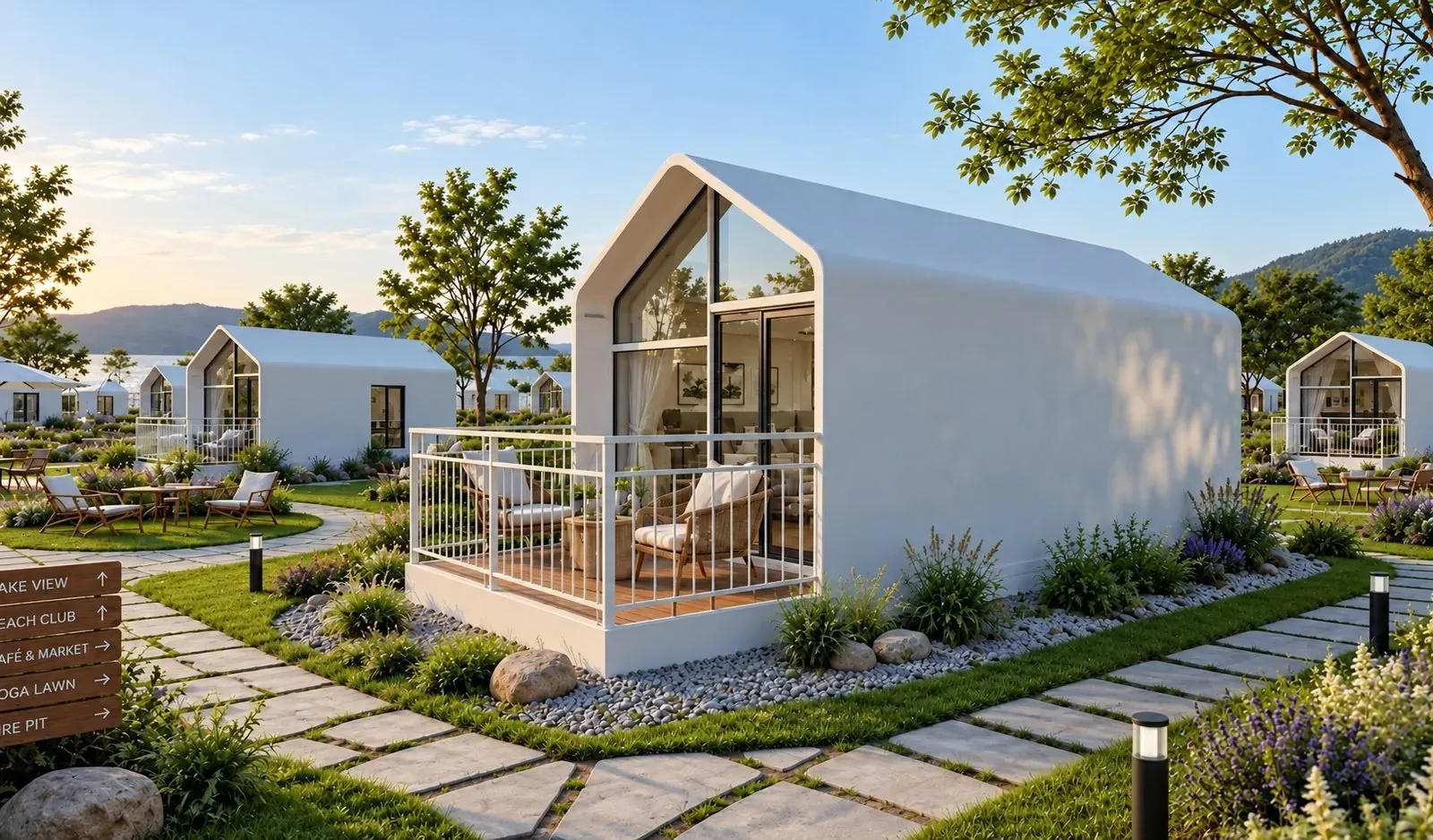
AIIA tiny houses have a fixed galvanised-steel structure. They are made in a workshop, delivered to your land, then installed by your installer.
What do planning rules say for each type?
On wheels, parking needs no planning authorisation for under 3 months a year, subject to local rules. The caravan regime excludes dwelling use. Ask the town hall what is tolerated for a holiday stay.
Fixed, it needs a prior declaration up to 20 m² of created floor area, then a building permit. The town hall decides which area applies.
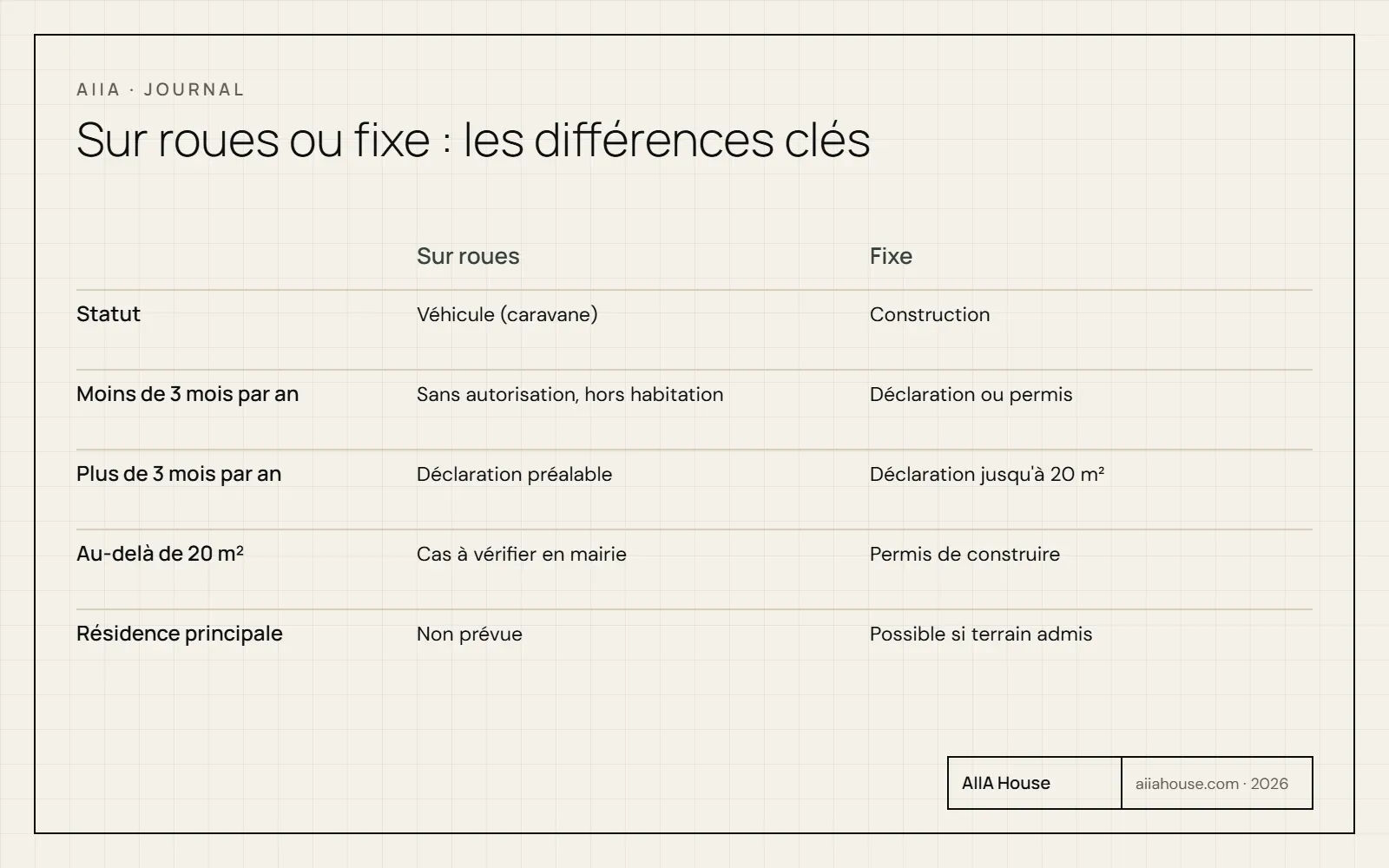
| Criterion | On wheels (caravan) | Fixed (building) |
|---|---|---|
| Status | Vehicle (wheels and towbar in place) | Building (wheels removed) |
| Under 3 months a year | No authorisation, no dwelling use | Declaration or permit by area |
| Over 3 months a year | Prior declaration, no dwelling use | Declaration up to 20 m², permit above |
| Main residence | Not provided for | Possible if the land allows it |
| Watch point | Municipal rules possible | The PLU sets the siting |
Source: Service-Public.fr, "Caravan or mobile home in your garden" (8 April 2026); FFB, July 2024. The local urban plan (PLU) is your municipality's rulebook.
All AIIA tiny houses measure 21 m² or more. In principle they therefore fall under the permit, depending on the area the town hall applies.
A mobile home with wheels cannot be set up in a garden. It is reserved for residential leisure parks, classified holiday villages and campsites.
Is your land compatible? AIIA offers a land study on request: it checks PLU zoning and access. Our article on planning steps and land regulations details the process, and the regulations page summarises the framework.
Can you live all year round in a tiny house on wheels?
In principle no, under the caravan regime. Under 3 months a year, it must not be used as a dwelling. Beyond that, a prior declaration is required. The caravan regime still does not allow living there: you must move to a fixed house or a demountable residence.
A status for light permanent housing exists: the demountable residence. It was created by decree no. 2015-482 of 27 April 2015, codified in article R111-51 of the urban planning code. This status is separate from the caravan regime. It requires three conditions:
- be an installation without foundations, intended for housing;
- serve as a main residence at least 8 months a year;
- be removable at any time, easily and quickly.
Without a connection to public networks, the applicant provides a statement on hygiene, safety, water, sanitation and electricity. The PLU can set conditions, which vary by municipality. Have the town hall confirm this status before you buy.
Our recommendation. Never assume a tiny house on wheels will be accepted as a main residence. Ask the town hall for the status in writing, before any purchase. Our article tiny house: where to start walks through the process.
Which insurance for a tiny house on wheels or a fixed one?
On wheels, the tiny house must be insured for the road and for damage caused in transit. Fixed, it falls under home insurance and may count as a structure. Declare it to your insurer before delivery.
- FFB: a house towed or moved by lorry needs cover for its own damage and for damage it may cause in transit.
- Structure: a house anchored to the ground may be one. Ten-year liability and construction-damage insurance may then be mandatory. Confirm this with the insurer.
- MAIF (page of 21 July 2025): third-party liability under a car policy covers others. It does not cover damage suffered by the tiny house.
For a fixed tiny house, MAIF recommends multi-risk home insurance.
On the AIIA side, the warranties cover the structure (10 years), waterproofing (5 years) and installations (3 years). They are backed by the manufacturer and relayed by AIIA. They do not replace your home insurance. Details: modular home warranties.
Can you finance a tiny house on wheels or a fixed one?
Financing depends on the nature of the asset. A tiny house on wheels is often movable property: an object that can be moved, not real estate. A bank therefore tends to consider consumer credit.
A small fixed house that counts as real estate may qualify for a mortgage, depending on the project and the bank's agreement.
Infosimmo (25 October 2026) notes that the obstacle is not necessarily repayment risk. It is the nature of the asset, the lack of a suitable guarantee and the status of the land. Movable property does not automatically qualify for the zero-rate loan.
Consumer credit does not carry the terms of a mortgage. Compare term, rate and total cost in writing.
At AIIA, professionals can use 5-year leasing, with new units after 3 years. See the price of a turnkey modular home and the professionals page.
What budget should you compare between wheels and fixed?
Compare the total cost, not the price of the shell. No reliable public figure gives an average price for a tiny house on wheels: ask for comparable quotes.
On wheels, you avoid foundations but add a chassis, road insurance and a regulated host site. Fixed, you add foundations, utility connections and planning authorisation.
| Cost item | On wheels | Fixed (AIIA) |
|---|---|---|
| Dwelling | To be quoted | From €35,500* (Fold, 21 m²) |
| Chassis or trailer | Yes | Fixed structure, no wheels |
| Foundations | No | To be studied per land |
| Utility connections | If the site is serviced | To plan for, not in AIIA's price |
| Planning authorisation | Depends on duration | Permit in principle (21 m² and over) |
| Registration | Registration certificate above 500 kg | Not applicable |
| Insurance | Road and transit (to confirm) | Home, sometimes structure |
Glass (25 m²) starts at €49,900*. Workshop manufacture takes 6 to 8 weeks.
\* AIIA price: water, electricity and wastewater connections not included.
For a rental, set out the calculation before you buy: gross income = nightly rate × nights occupied. Then deduct commissions, cleaning, insurance, maintenance, taxes and any loan repayments. No figure is given here for lack of a source.
Going for a fixed one? Compare Fold, Glass and Mono in the collection, price with the configurator, then request a land study.
Which choice suits your use: main home, second home or rental?
For a main residence, the fixed tiny house is the soundest route. For short stays without living in it, a tiny house on wheels fits better. For rental, first check that the land and the municipality allow the activity.
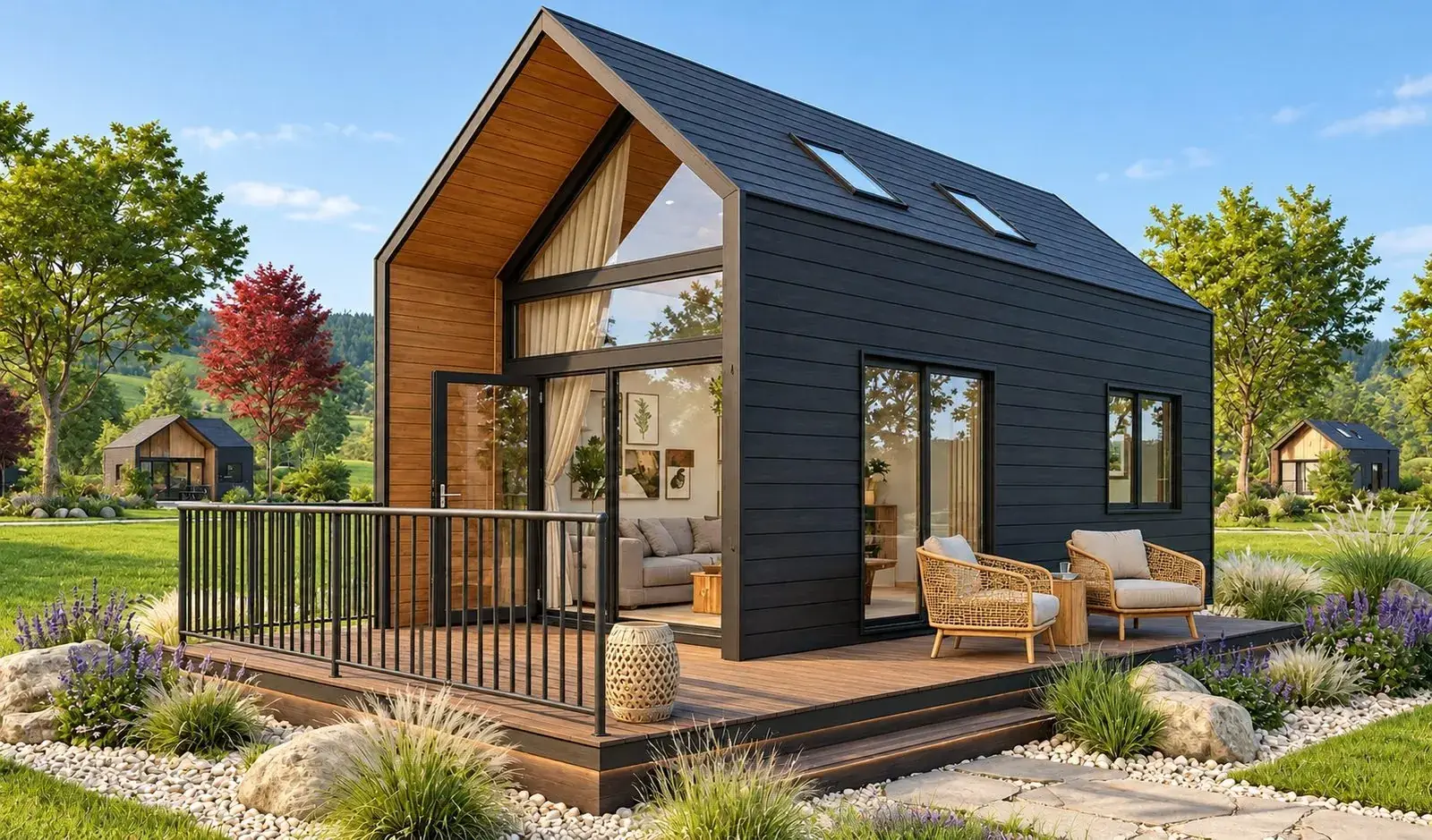
- Main residence. You need land where housing is allowed and, in principle, a permit above 20 m². A fixed tiny house of 25 to 32 m², such as Glass or Mono, fits this framework. Check the land with our article on land for a tiny house.
- Second home. The caravan regime excludes dwelling use: ask the town hall what is tolerated for a holiday stay. To stay there, the fixed tiny house remains the safer route. Also consider the foundations of a modular home.
- Rental. A fixed, well-located unit lends itself better to steady operation. Profitability remains a hypothesis until you have estimated the nightly rate, occupancy and costs.
For the method, read long-term or seasonal rental or the invest page.
What should you do now to decide?
Decide in five steps: use, land, status, insurance and financing, then quotes. Each step produces a written answer that avoids unpleasant surprises. Sources last checked: 1 November 2026.
- Define the use: occupation per year, main or second home, rental.
- Choose the land: buildable or not, reading the PLU, access for delivery.
- Ask the town hall for the status: in writing, stating the floor area and duration. Beyond 3 months a year, a declaration is required and the caravan regime still does not allow living there: choose the fixed one.
- Have insurance and financing confirmed: a written answer from the insurer and the bank.
- Compare two full quotes: dwelling, installation, connections, authorisations.
For step 3, send this question to the town hall:
"Which status and authorisation apply to a tiny house of [area] m², installed [duration] a year on parcel [reference]?"
What AIIA does, and does not do
- AIIA does: offer fixed-structure tiny houses, made in a workshop then delivered to your land. AIIA offers a land study and can point you to installers.
- AIIA does not: install them itself, include utility connections, or promise planning authorisation.
Your next step
- Private buyer: request a land study or try your model in the configurator.
- Investor: start by pricing with the invest page.
- Professional: see the professionals page for leasing and multi-unit projects.
Going further
- the guide to buying a modular home or tiny house;
- prefabricated or traditional house to compare building methods;
- installing tiny houses in a campsite for a professional project;
- tiny house for a family of four to choose the area;
- tiny house interior layout to make the most of the space.
Yannick Akoka, co-founder of AIIA, written and signed on 1 November 2026.
The AIIA view
Clients contact us because AIIA does not offer tiny houses on wheels. We receive 3 to 4 calls a month. They are about the difference in way of life between the two types. One is nomadic; at AIIA, we favour a traditional way of life. Our tiny houses are fixed-structure houses, delivered to your land.
Utility connections are never included in our prices. Installation and foundations are settled with a local installer. We promise no authorisation: the town hall decides. A land study is available on request, before any commitment.
- service-public.gouv.fr/particuliers/vosdroits/F620
- entreprises.gouv.fr/files/files/directions_services/tourisme/heb…
- legifrance.gouv.fr/codes/article_lc/LEGIARTI000031721187
- service-public.gouv.fr/particuliers/vosdroits/F21112
- senat.fr/questions/base/2025/qSEQ251006279.html
- ffbatiment.fr/actualites-batiment/actualite-ba/tiny-houses…
- infosimmo.com/tiny-house-credit-immobilier-refus-banque-fi…
- maif.fr/habitation/guide-assurance-habitation/tiny-h…
- habitat-pc-sos.fr/blog/reglementation-habitat-leger-hno-2026
Frequently asked questions
Do you need a permit for a tiny house on wheels?
No planning authorisation for under 3 months a year, outside dwelling use and subject to municipal rules. Beyond that, Service-Public.fr requires a prior declaration, without allowing dwelling use. Without wheels and towbar, it is treated as a building.
Is a tiny house without foundations exempt from authorisation?
No. The FFB reminds readers that the absence of foundations does not automatically exempt a house from authorisation. A lasting installation or created floor area can be enough to require a declaration or a permit.
Can you put a tiny house on wheels in a campsite?
Campsites, residential leisure parks and classified holiday villages are the places provided for mobile leisure homes. Each operator sets its own conditions: ask before buying. See also our article on installing tiny houses in a campsite.
How much does a fixed AIIA tiny house cost?
AIIA tiny houses start at €35,500* for Fold (21 m²); Glass (25 m²) is €49,900*. Utility connections are never included. No reliable average price exists for a tiny house on wheels: ask for comparable quotes.
Does a tiny house on wheels have a registration certificate?
If it is treated as a trailer or caravan, it depends on its maximum authorised laden weight (MAM). Above 500 kg, it has its own registration certificate. At 500 kg or less, it carries the towing vehicle's plate (Service-Public.fr, 11 March 2026).