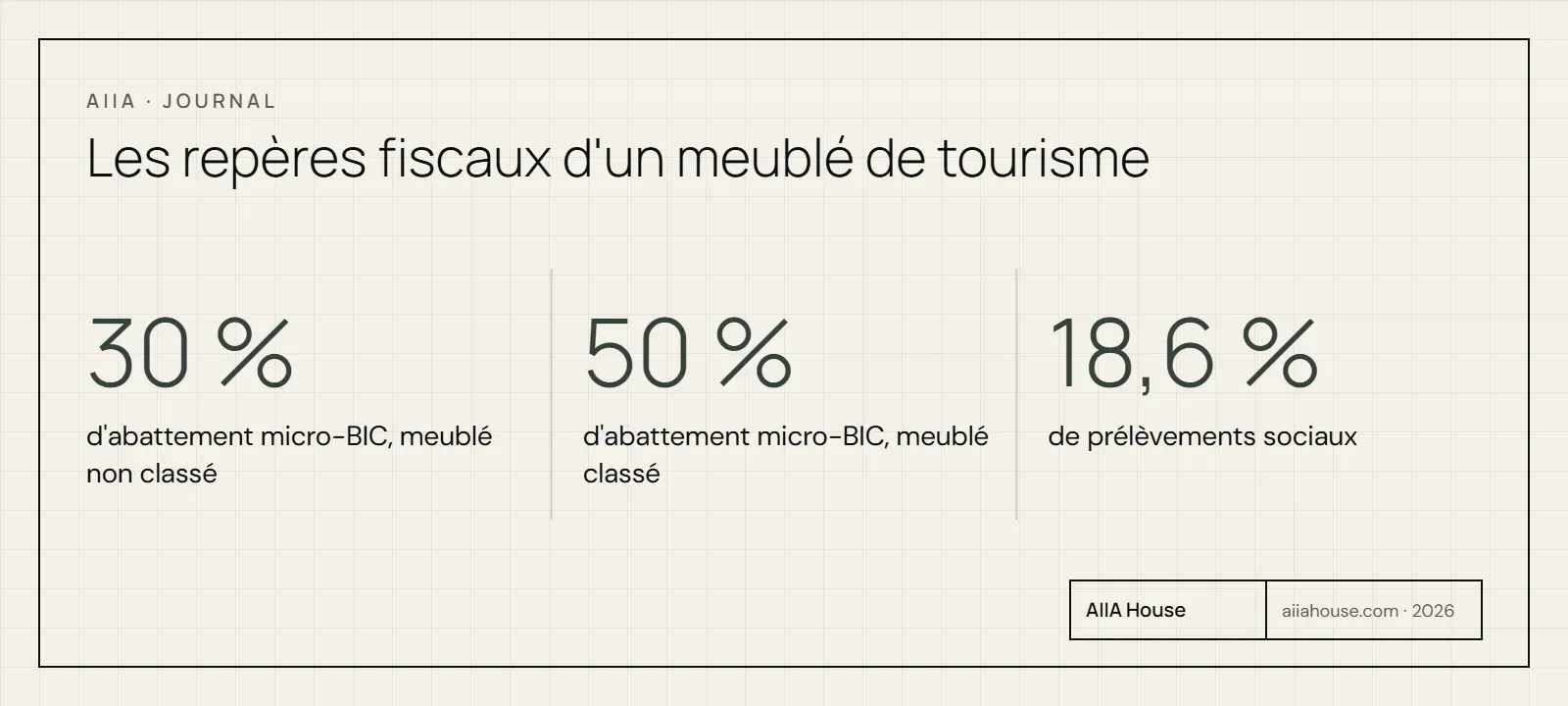
In shortThe tax treatment of a furnished tiny house let falls under industrial and commercial profits. Under micro-BIC, 30% of income is deducted automatically (unrated tourist let, up to €15,000), or 50% (rated, up to €77,700). Under the actual regime you deduct costs and depreciation. Social charges of 18.6% are added.
Key figures
- 30% or 50%: micro-BIC allowance for an unrated or rated furnished tourist let (Service-Public.fr, 27 July 2026)
- €15,000 or €77,700: micro-BIC income ceiling, unrated or rated, for 2025 income (Service-Public.fr)
- 18.6%: social charges on non-professional furnished rental income (impots.gouv.fr)
- €23,000: income level from which professional furnished-letting status may apply (impots.gouv.fr)
- 15 February 2025: date from which depreciation deducted under the actual regime is added back to the capital gain on resale (impots.gouv.fr)
You are thinking of buying a tiny house to let to holidaymakers, but one question slows down the maths: what is left after tax? The answer comes down to one choice and a few thresholds. Furnished rental income is taxed as industrial and commercial profits (BIC), either with a flat allowance (micro-BIC) or under the actual regime, which deducts costs and depreciation.
The rules below were checked on 2 November 2026 and rely on Service-Public.fr and impots.gouv.fr. The 2027 budget, still under debate, could change some of them. This article does not replace an accountant: it gives you the landmarks to ask the right questions before you buy.
What is the tax treatment of a furnished tiny house let?
Rent from a furnished tiny house is taxable as BIC, not as property income. Subject to income thresholds, you choose between micro-BIC and the actual regime. Either way, social charges and a few local taxes come on top of income tax.
Three layers stack up:
- Income tax: it applies to your taxable profit, at your marginal tax band.
- Social charges: 18.6% of the profit, even if you do not pay income tax (impots.gouv.fr).
- Local taxes: the business property contribution (CFE) and, depending on the commune, the tourist tax you collect.
A furnished tourist let is furnished accommodation let to a passing clientele. The tenant occupies it alone, for 90 consecutive days at most (Service-Public.fr, 27 July 2026). A fixed tiny house let this way fits that logic.
These rules assume a fixed home: a tiny house on wheels may be treated differently, so have it confirmed. Your plot's planning rules also decide whether you may let at all. Check them with the town hall: our article on site installation and regulations details the steps.
To see what tax takes from your income, start from a full calculation: see our profitability method for a modular rental unit.
Micro-BIC or actual regime: which one should you choose?
Micro-BIC is simpler; the actual regime pays off when your costs and depreciation exceed the flat allowance. Micro-BIC applies automatically below the income ceilings. The actual regime can be chosen by option, or is compulsory if the ceilings are exceeded.
Under micro-BIC, the tax office applies a flat allowance to your income. It replaces all your costs, loan interest included, and allows no loss. Under the actual regime you deduct real costs and depreciation, with full accounts and online filing (form 2031).
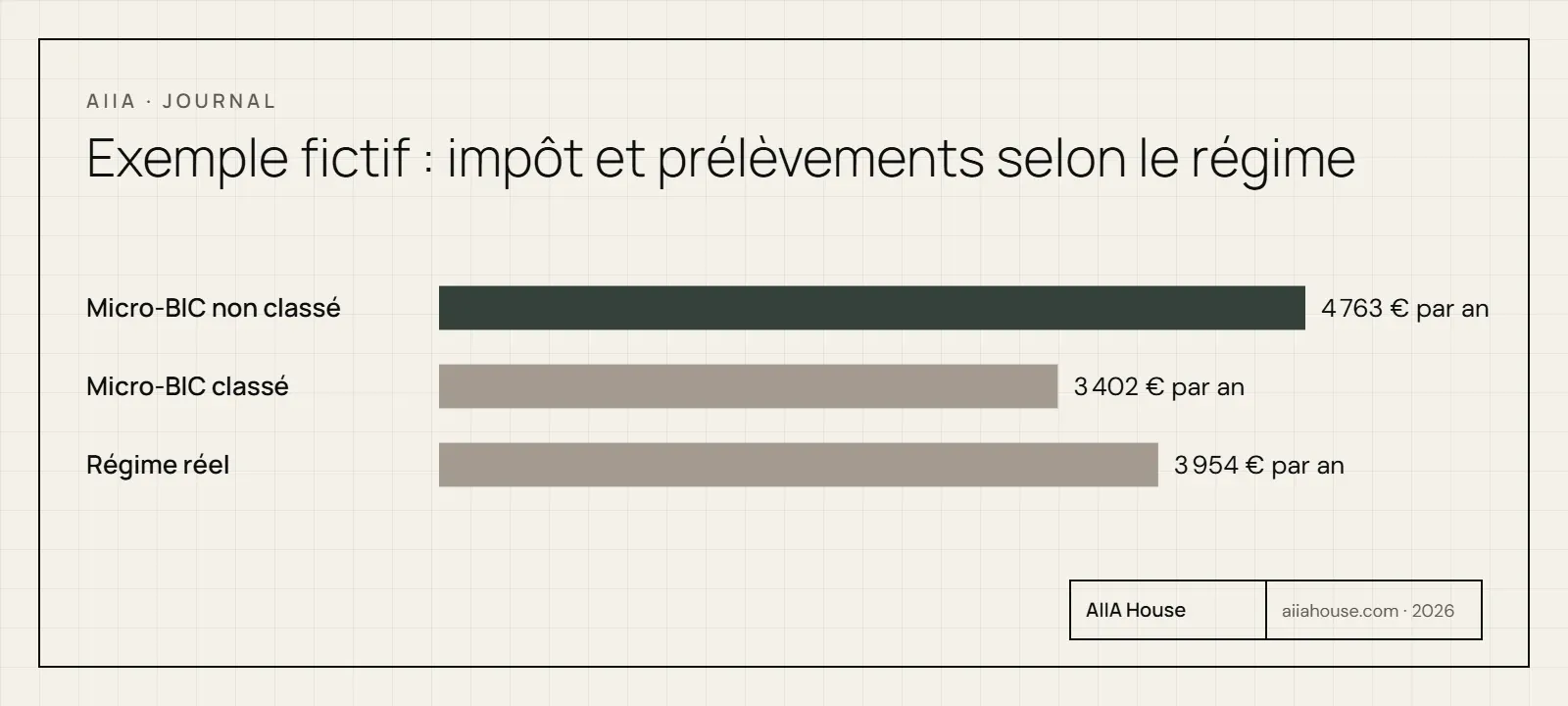
Here is a fictitious example to compare the regimes. Assumptions: an AIIA Glass tiny house at €49,900*, €14,000 of annual income, 30% costs (an assumption taken from the AIIA simulator), price depreciated over 30 years (an indicative assumption), a 30% marginal band and 18.6% social charges.
| Regime | Taxable base | Income tax | Social charges | Total |
|---|---|---|---|---|
| Micro-BIC, unrated (30%) | €9,800 | €2,940 | €1,823 | €4,763 |
| Micro-BIC, rated (50%) | €7,000 | €2,100 | €1,302 | €3,402 |
| Actual (costs and depreciation) | €8,137 | €2,441 | €1,513 | €3,954 |
In this example the actual regime saves about €809 a year against unrated micro-BIC. Accounting fees are not priced: they depend on the professional you choose.
Another set of assumptions would give another result. An accountant must therefore redo the calculation with your figures. To compare letting modes, see long-term or seasonal letting.
Does rating your tiny house change the tax?
Yes: rating as a furnished tourist let raises the micro-BIC allowance from 30% to 50%. The income ceiling rises from €15,000 to €77,700. These figures apply to 2025 income.
Above €15,000 of income for an unrated let, the actual regime applies. For 2026 income, filed in 2027, the ceiling for rated lets rises to €83,600. The unrated ceiling stays at €15,000 (Service-Public.fr, 27 July 2026).
Rating is optional. It has five categories, from one to five stars, lasts five years and rests on a 133-criteria grid (equipment, services and accessibility, sustainable development), according to entreprises.gouv.fr. After the visit, the host has 15 days to refuse the proposed rating.
In our fictitious example, rating brings total tax and social charges down from €4,763 to €3,402, about €1,361 a year. That gain is not automatic: it assumes your accommodation meets the grid, which only the assessing body can confirm. The cost of the process is not priced here; ask for it before deciding.
Does depreciation apply to a tiny house?
Under the actual regime, yes: each year you deduct a fraction of the price of the home and furniture, over the period agreed with your accountant. Land does not lose value, so it is not depreciated. Confirm this point with your accountant.
The price of an AIIA tiny house, for example €49,900* for Glass, does not include connections, to be planned in addition. For the detail of costs, see how much a modular house costs. The home, the furniture and the fittings are not all depreciated in the same way: your accountant splits them by nature.
Three rules to remember:
- Depreciation is a non-cash cost: it reduces taxable profit without reducing your cash.
- It cannot create a loss: excess depreciation carries forward against later profits, to be confirmed with your accountant. Other losses can be set only against furnished rental income, for 10 years (impots.gouv.fr).
- It comes back on resale: since 15 February 2025, depreciation deducted under the actual regime is added back when calculating the capital gain.
Which charges and taxes come on top of income tax?
Social charges come on top of tax: 18.6% of net profit, made up of 10.6% CSG, 0.5% CRDS and 7.5% solidarity levy (impots.gouv.fr). They apply even if you do not pay income tax. Part of the CSG is deductible from overall income.
Other charges depend on the commune and your activity:
- CFE: a local tax owed by furnished landlords. The amount depends on the commune. It is declared in the first year on form 1447-C-SD, by 31 December at the latest.
- Tourist tax: if the commune has introduced it, the traveller pays it. Platforms have collected it for non-professional hosts since 1 January 2019 (entreprises.gouv.fr).
- VAT: furnished letting is in principle exempt. It becomes due, at 10%, if you offer at least three hotel-type services (impots.gouv.fr).
- Property taxes: they vary by commune; ask the tax office before buying.
AIIA prices carry an asterisk: they do not include connections, to be planned in addition. VAT treatment depends on your activity: ask an accountant.
LMNP or LMP: when does your status change?
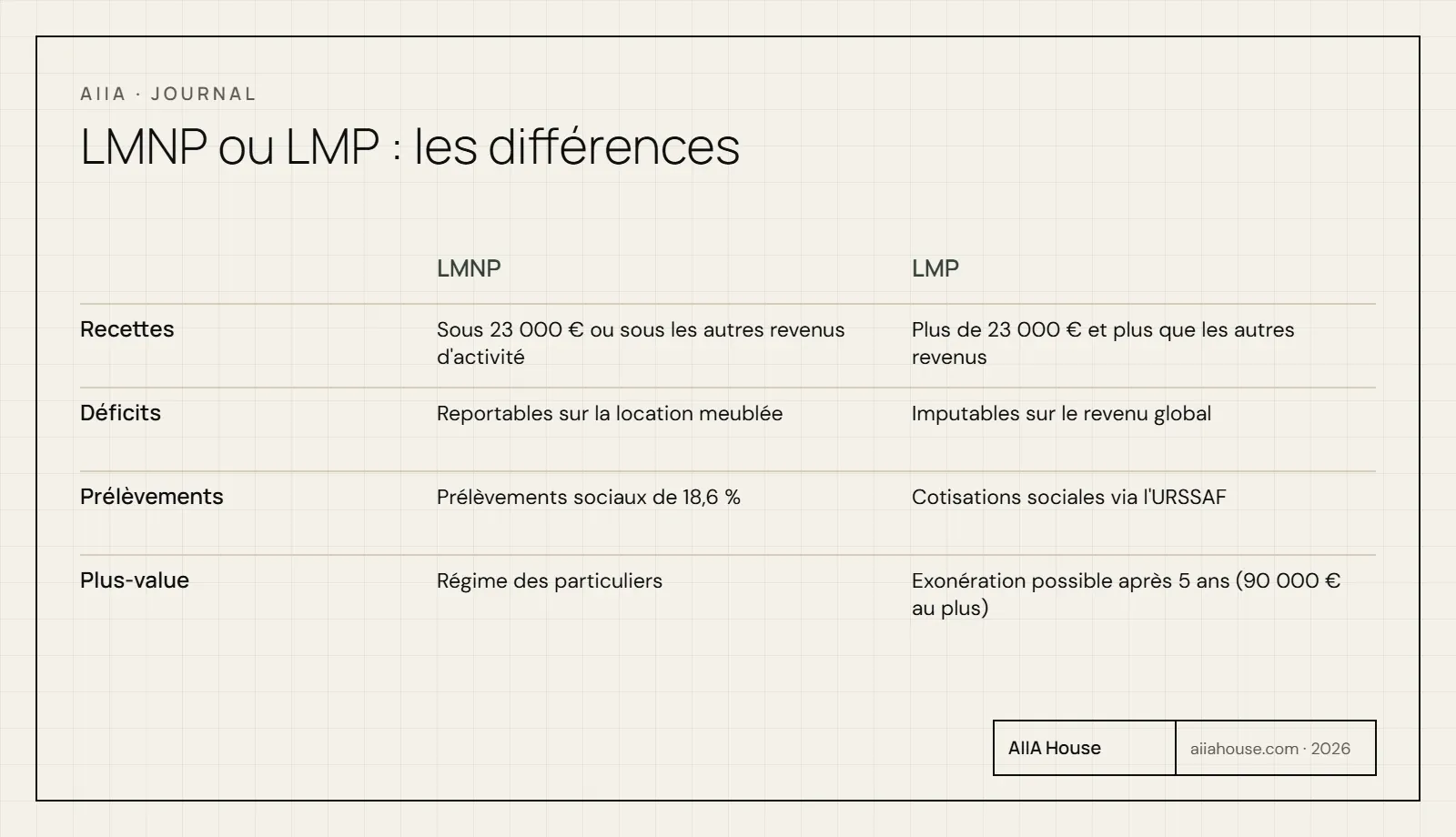
You are a non-professional furnished landlord (LMNP) as long as your income stays below €23,000 a year or below your household's other business income. Professional status (LMP) requires exceeding €23,000 of income and exceeding the household's other business income (impots.gouv.fr). From 2026 income, the comparison uses worldwide professional income.
For a single tiny house, as in our €14,000 example, the status remains LMNP in practice. An owner of several units can pass €23,000 sooner.
The status changes several rules:
- Losses: as LMP they set against overall income without limit; as LMNP only against furnished rental income.
- Charges: as LMNP, 18.6% social charges; as LMP, the social contributions of a professional activity, through URSSAF.
- Capital gain: an LMP may be exempt after more than five years of activity with annual income of €90,000 or less.
What happens when you resell the tiny house?
On resale, the capital gain of a non-professional furnished landlord is taxed like that of an unfurnished property, with the holding-period allowances of the private-individual regime (impots.gouv.fr). The rule changed for sales completed from 15 February 2025.
Since that date, if you opted for the actual regime, the depreciation you deducted is taken off the purchase price when calculating the gain. The taxable gain therefore rises: part of the tax saved during the letting is recovered at sale.
In practice, compare two scenarios before choosing the actual regime:
- You keep the property for a long time: depreciation cuts your tax every year, and the add-back weighs late.
- You resell within a few years: the add-back can wipe out much of the benefit.
The gain is declared on form 2048-IMM-SD. Have a professional simulate it. AIIA guarantees no resale price.
What does the 2027 budget plan for furnished tourist lets?
The 2027 finance bill (no. 3210) targets depreciation of furnished tourist lets, but nothing is finally adopted. Filed at the National Assembly on 1 October 2026, it is still under debate (assemblee-nationale.fr). Here is what is known, separating facts from assumptions.
The initial bill. Article 7 would cap property depreciation at 2.5% a year and €7,000 per household, or 1.5% and €5,000 for furnished tourist lets. On 8 October the finance committee adopted an amendment that would remove property depreciation for tourist lets acquired from 1 January 2027.
The plenary vote. According to the specialist press (Legifiscal, lmnp-facile.fr), the Assembly then removed the cap in plenary on 30 October. The vote was 45 to 41, at first reading only. As of 2 November 2026, the fate of the 8 October amendment on tourist lets remains to be confirmed.
What does not change. The bill does not alter the micro-BIC allowances for tourist lets. One committee amendment would only raise the guest-house allowance to 71%.
The cautious assumption. The text can still change: Senate, joint committee, Constitutional Council decision. If you buy in 2027, cost your project with and without depreciation. Under micro-BIC the question does not arise, since the flat allowance rests on no depreciation.
Before signing anything, check the state of the text on the National Assembly website.
Which steps come before the first night let?
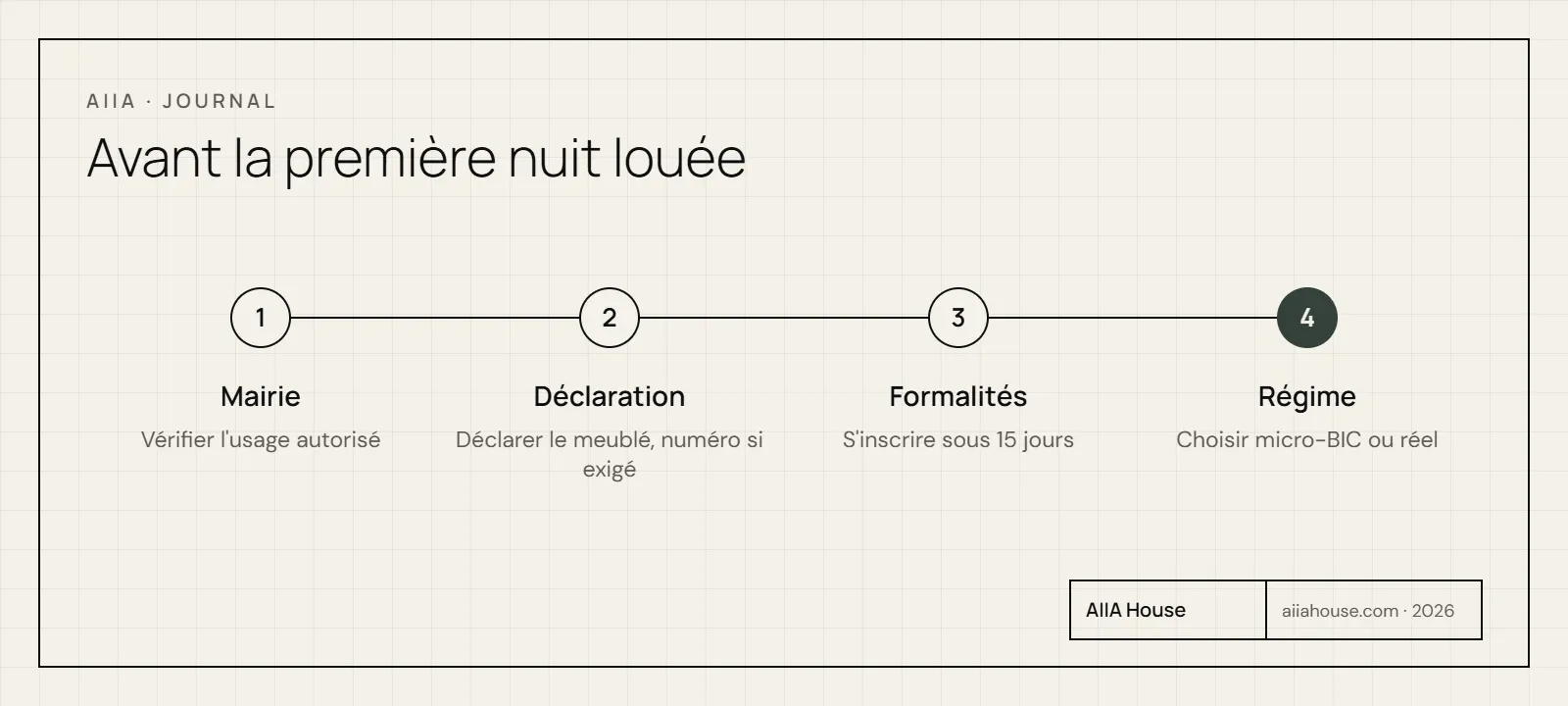
Four steps come before the first letting: check the permitted use with the town hall, register the let, sign up with the business formalities desk, then choose your tax regime. The order matters, because tax depends on the first two.
- Check planning and use with the town hall. A change-of-use authorisation is required in Paris and the inner suburbs. It is also required in communes of over 200,000 inhabitants and some high-demand communes (entreprises.gouv.fr).
- Register the let at the town hall with Cerfa form no. 14004, unless it is your main home. The registration number is required in some communes. Service-Public.fr announces its extension to all, with the national online service planned for the fourth quarter of 2026.
- Sign up with the business formalities desk within 15 days of the start of letting (DGFiP, March 2026).
- Choose micro-BIC or actual, then decide whether to apply for a rating.
Also plan for CFE, tourist tax and insurance: check that your policy covers holiday letting.
Penalties exist. Failing to register at the town hall exposes you to a fine of up to €450, and failing to request a registration number to a civil fine of up to €5,000 (entreprises.gouv.fr).
Where should you start to cost your project?
Start with three figures: the price of the home, your prudent income and the tax regime you aim for. Then have an accountant check the calculation before you order.
Five landmarks matter:
- Furnished rent falls under BIC, at micro-BIC (30% or 50% allowance) or the actual regime.
- Rating can raise the allowance from 30% to 50%, provided you meet the grid.
- Social charges of 18.6% come on top of tax.
- Depreciation under the actual regime is added back on resale since 15 February 2025.
- The 2027 budget may still change depreciation, but not micro-BIC as the bill now stands.
Cost your project with the simulator on the Invest page. For a quote or an appointment, contact us.
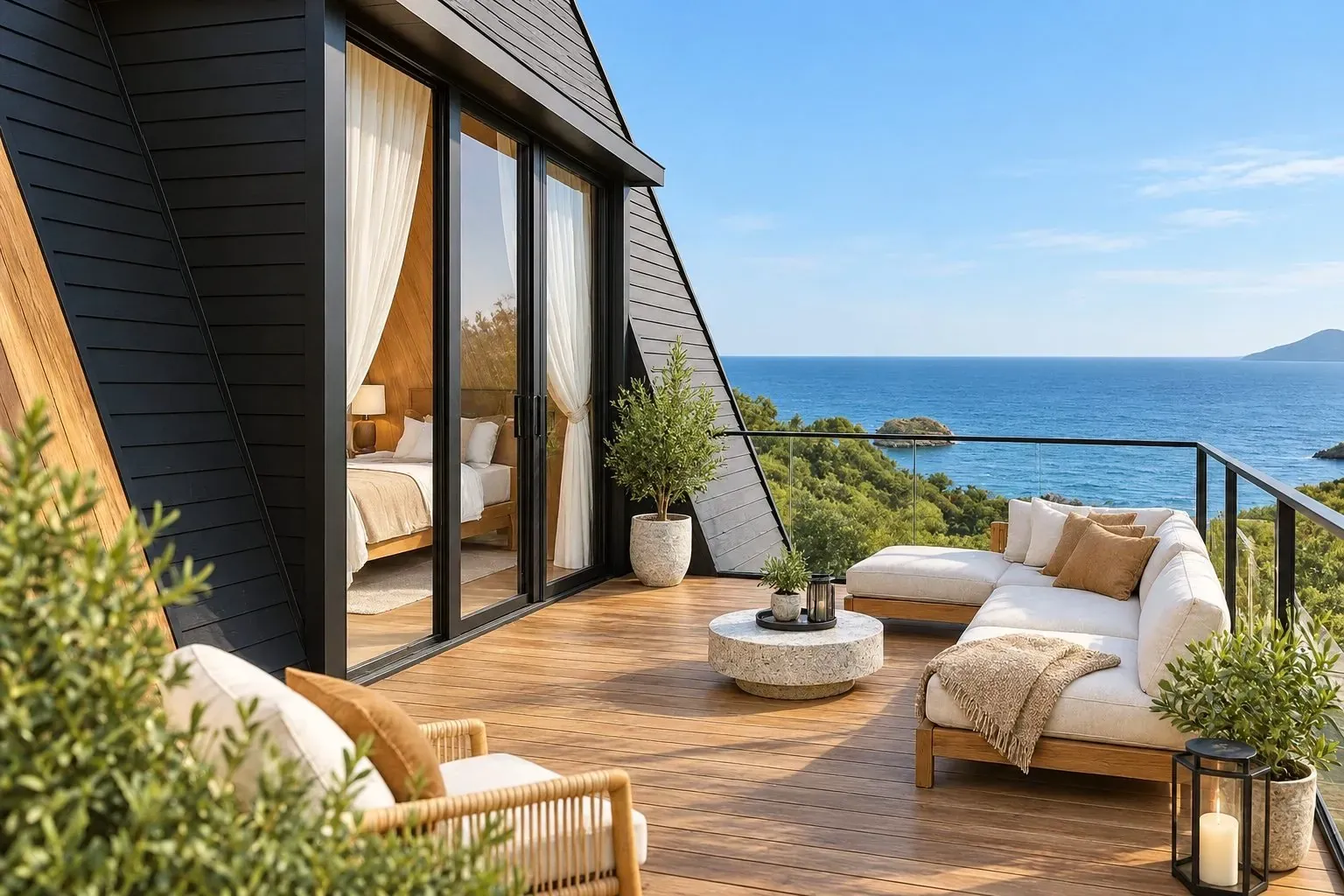
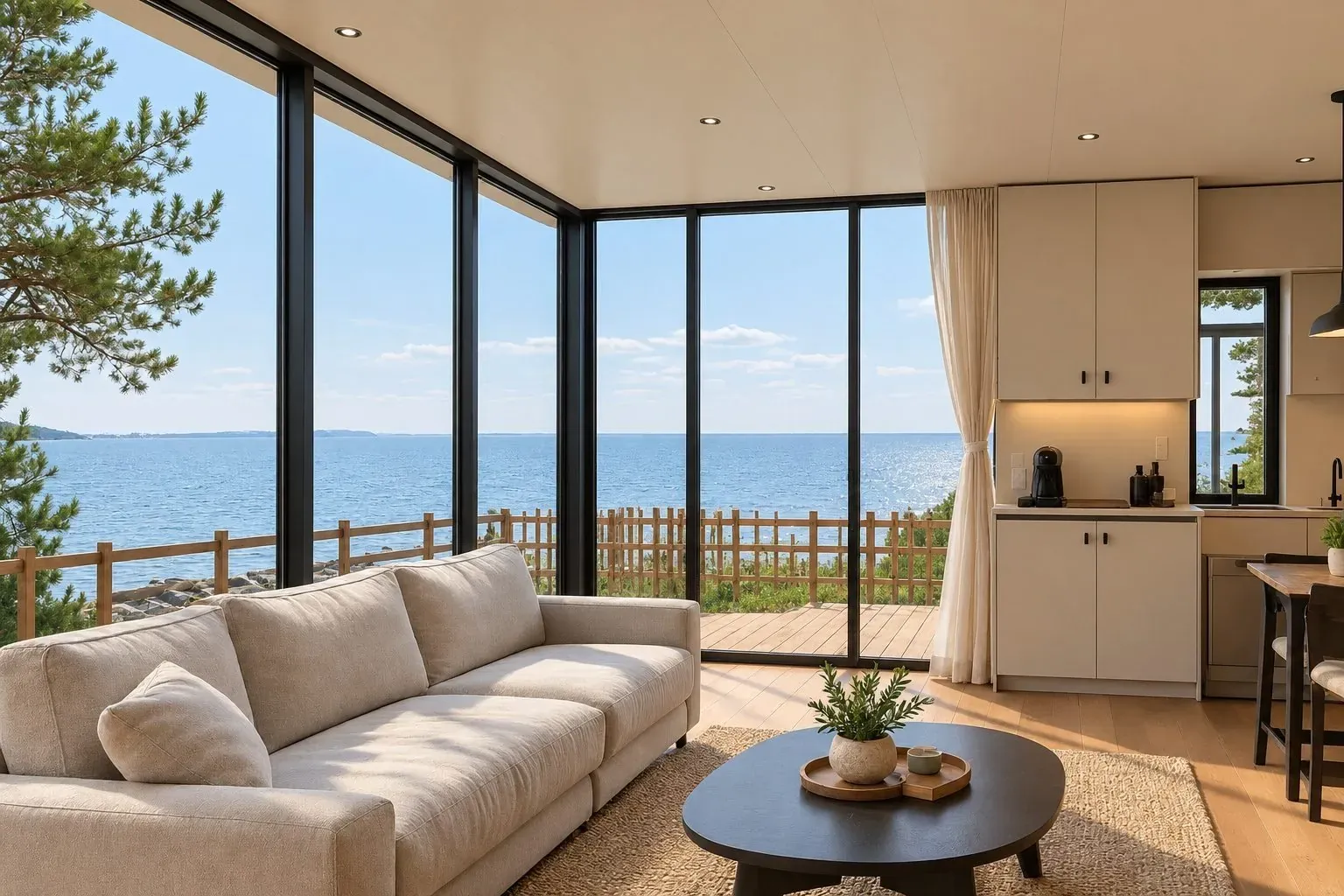
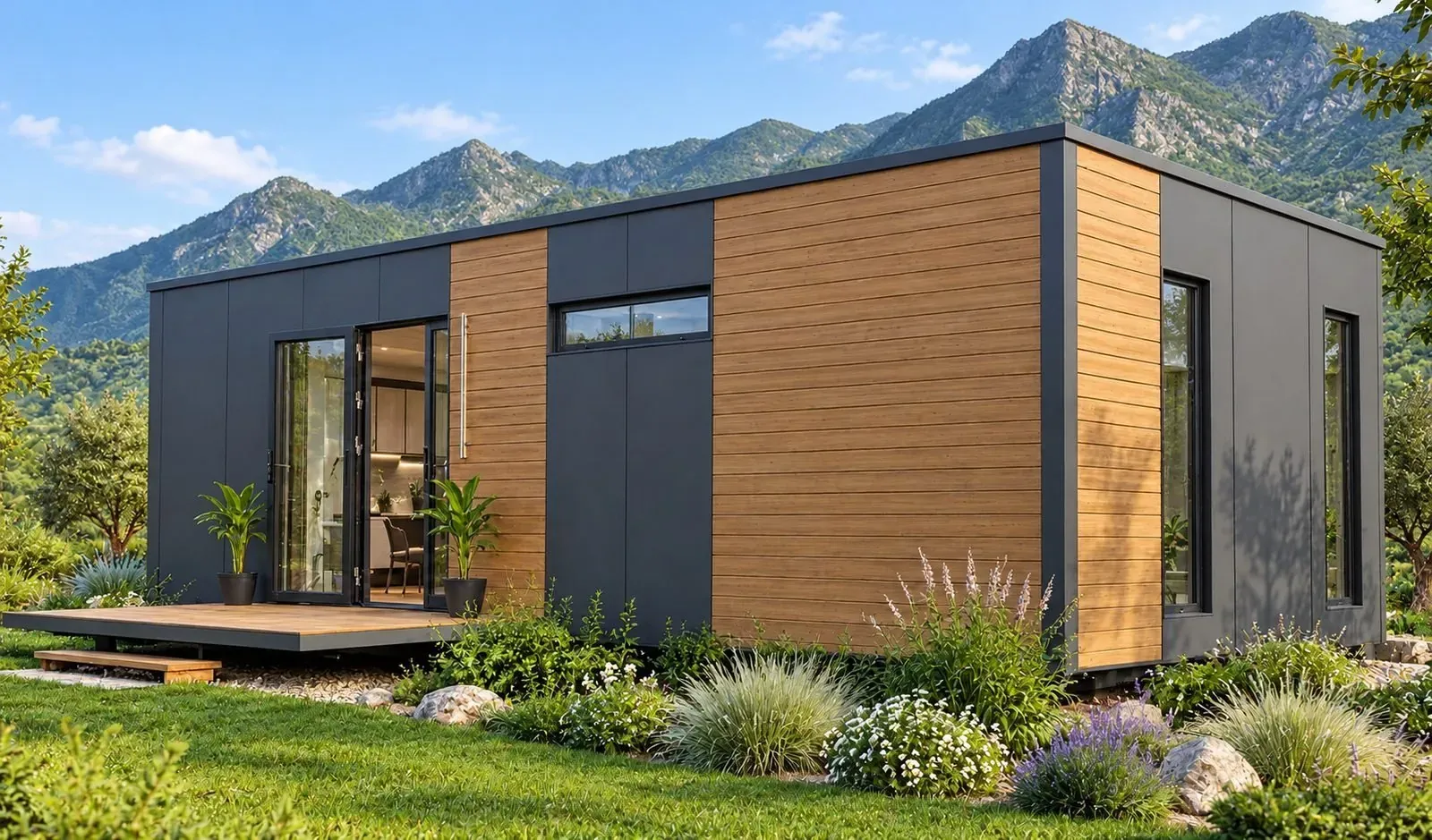
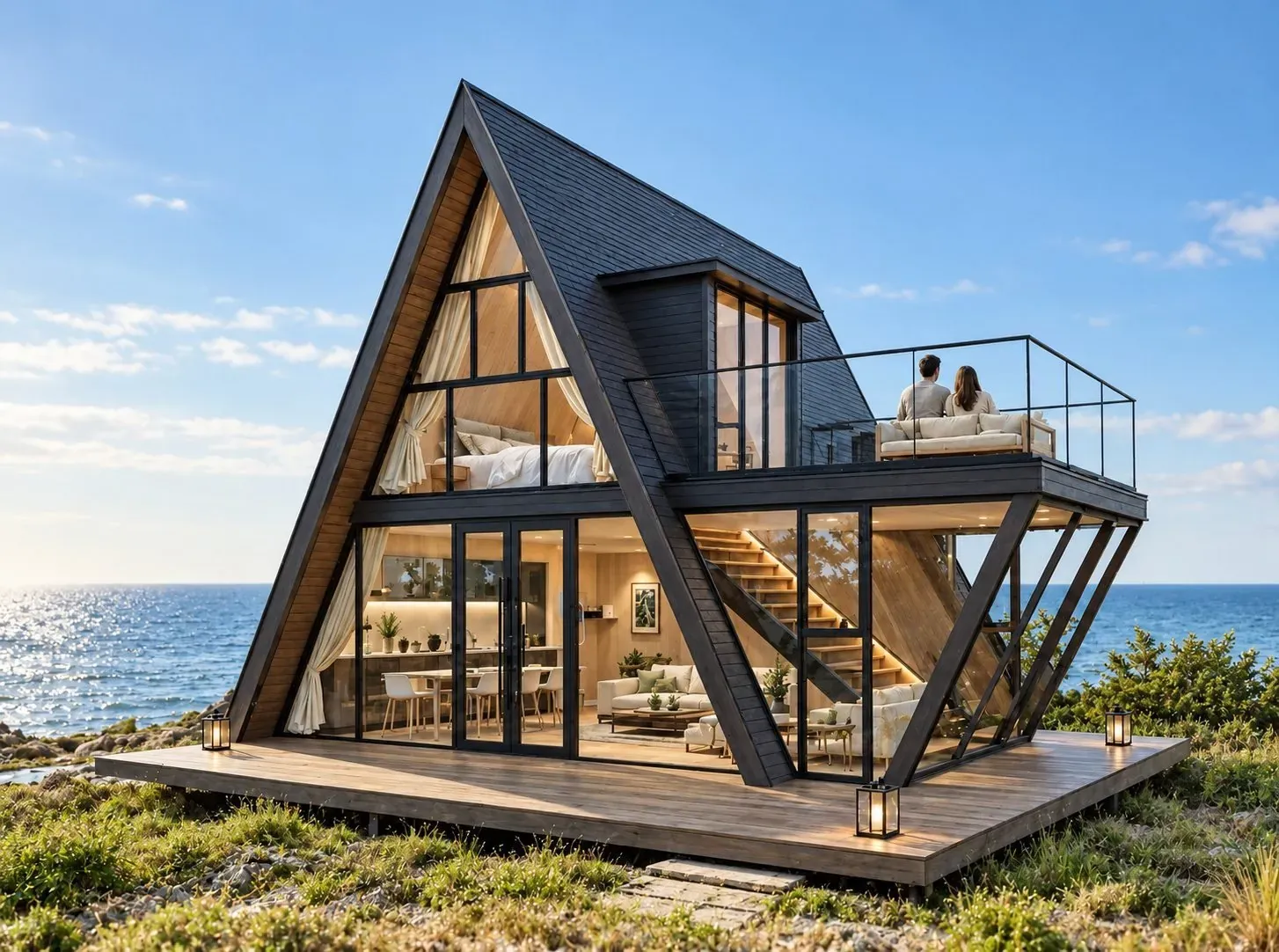
You can also discover the Glass model, compose your home in the configurator or read our guide to buying a modular house or tiny house.
AIIA builds the home in a workshop in 6 to 8 weeks. We are neither builder nor installer, and we give no tax advice.
- service-public.gouv.fr/particuliers/actualites/A18880
- impots.gouv.fr/sites/default/files/media/1_metier/5_interna…
- impots.gouv.fr/node/4011
- impots.gouv.fr/particulier/questions/je-donne-un-bien-en-lo…
- impots.gouv.fr/particulier/questions/je-vends-un-bien-immob…
- entreprises.gouv.fr/espace-entreprises/s-informer-sur-la-regleme…
- assemblee-nationale.fr/dyn/17/dossiers/plf_2027
- legifiscal.fr/actualites-fiscales/4668-plf-2027-amortissem…
- lmnp-facile.fr/guides/reforme-lmnp-2027
- aiiahouse.com/fr/investir
- aiiahouse.com/fr/tarifs
Frequently asked questions
Is Airbnb income from a tiny house taxable?
Yes. A tiny house offered on a digital platform such as Airbnb is a short-term furnished let, taxed as BIC (Service-Public.fr, 27 July 2026). Confirm the applicable regime with an accountant.
Must I declare income from a tiny house let a few weeks a year?
Yes, all furnished rental income is taxable. Under micro-BIC, no tax is due if taxable income stays below €305 (impots.gouv.fr). Social charges apply to net profit even if you pay no income tax.
Does micro-BIC let me deduct loan interest?
No. The flat allowance replaces all costs, interest included. Only the actual regime lets you deduct loan interest, insurance, management fees and depreciation.
What happens to tax if I let for more than 90 days in a row?
Beyond 90 consecutive days for one customer, it is no longer a seasonal furnished tourist let. Long-term furnished letting stays taxed as BIC, with a 50% allowance and a €77,700 ceiling for 2025 income (impots.gouv.fr).
What do AIIA prices include?
Prices, marked with an asterisk, do not include connections, to be arranged with a local professional. For VAT, ask an accountant.
Does AIIA simulate the tax on my project?
The Invest page offers an indicative simulator based on adjustable assumptions such as occupancy and costs. It replaces neither tax advice nor a loan offer, and ignores the capital gain on resale.