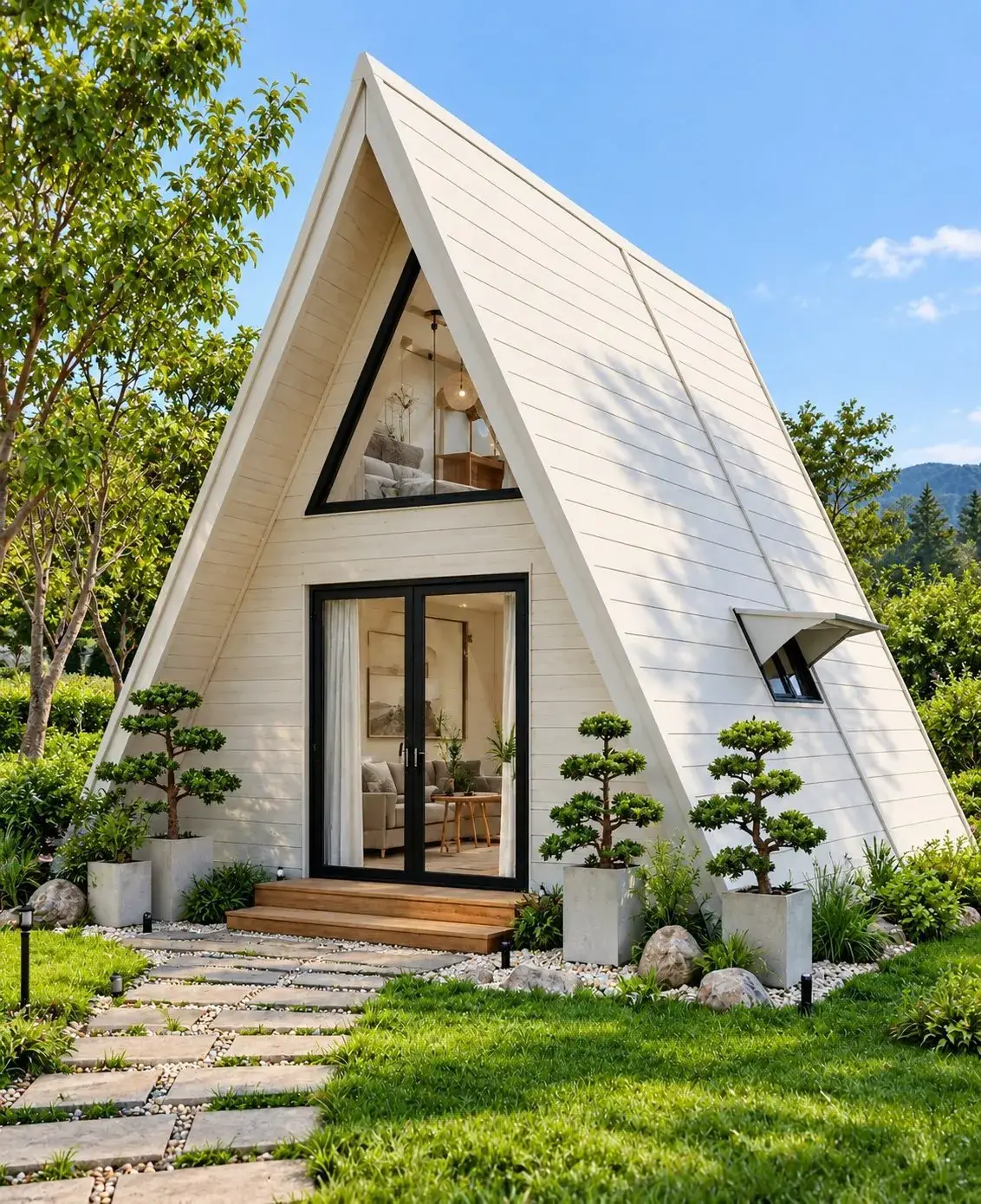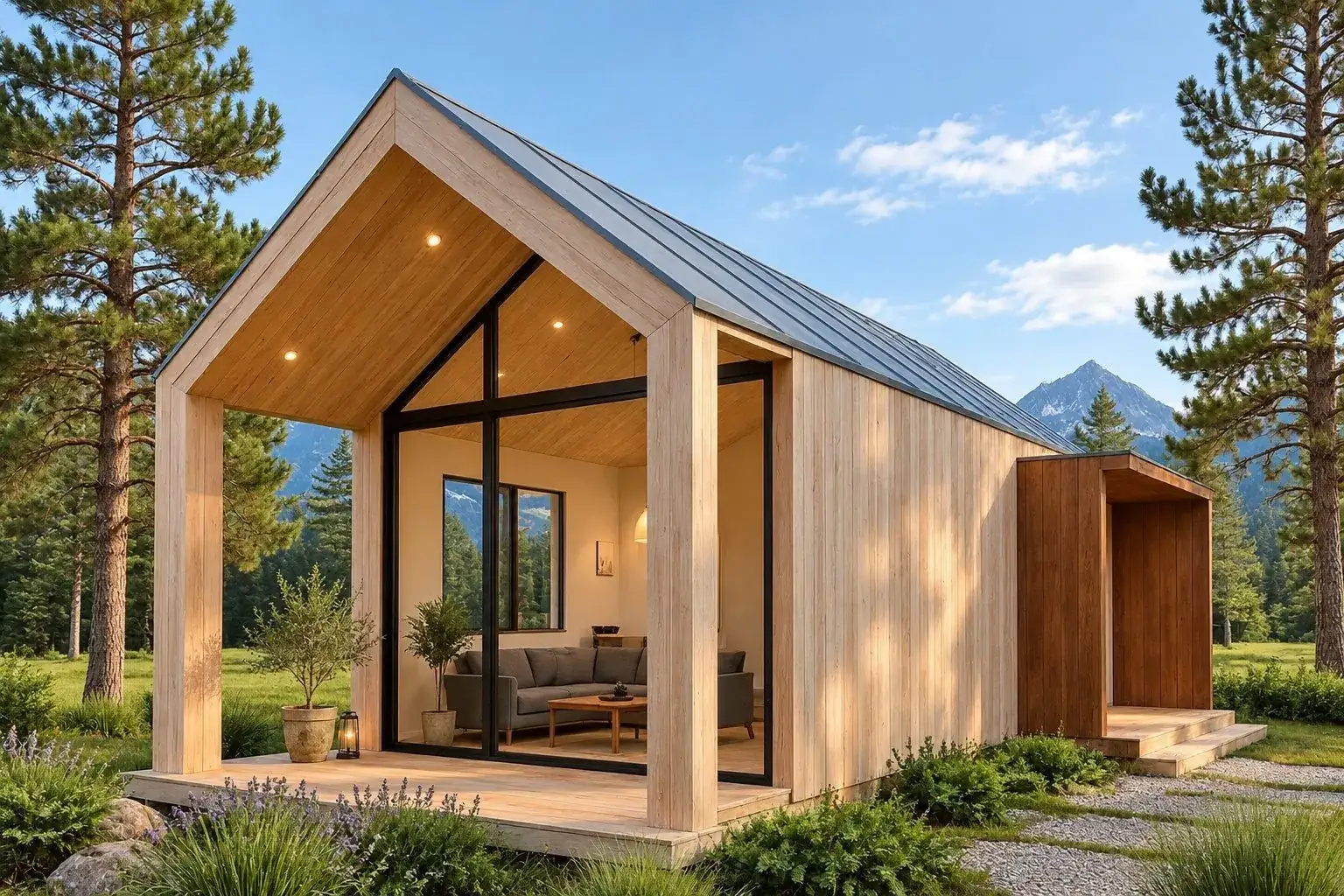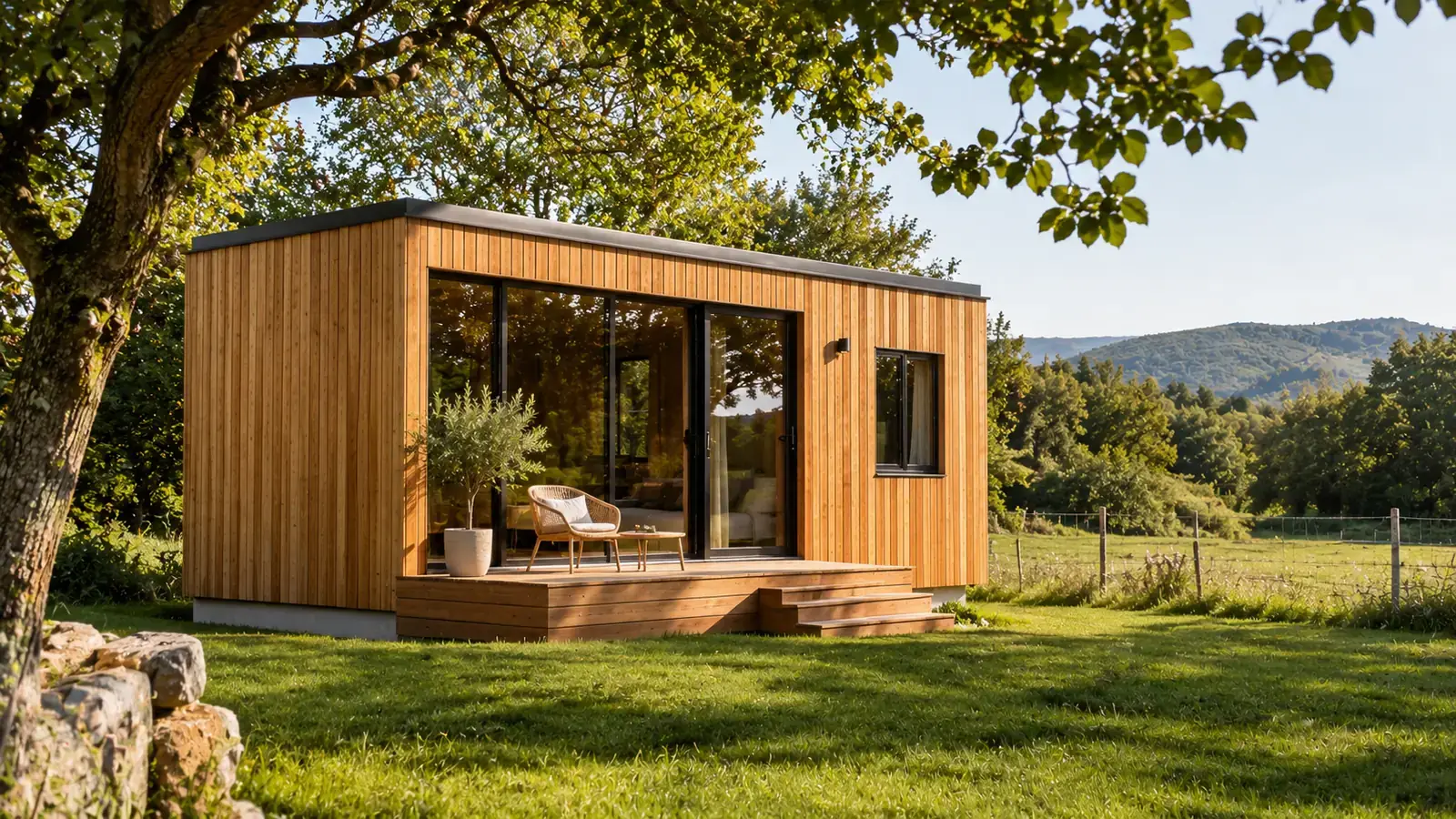
In shortA tiny house on non-buildable land is in principle not allowed in an agricultural or natural zone. The local plan (PLU) may make an exception, on an exceptional basis, through a STECAL (a sector of limited size and capacity), which may admit buildings or demountable homes lived in eight months a year. Before buying, ask the town hall for a planning certificate.
Key figures
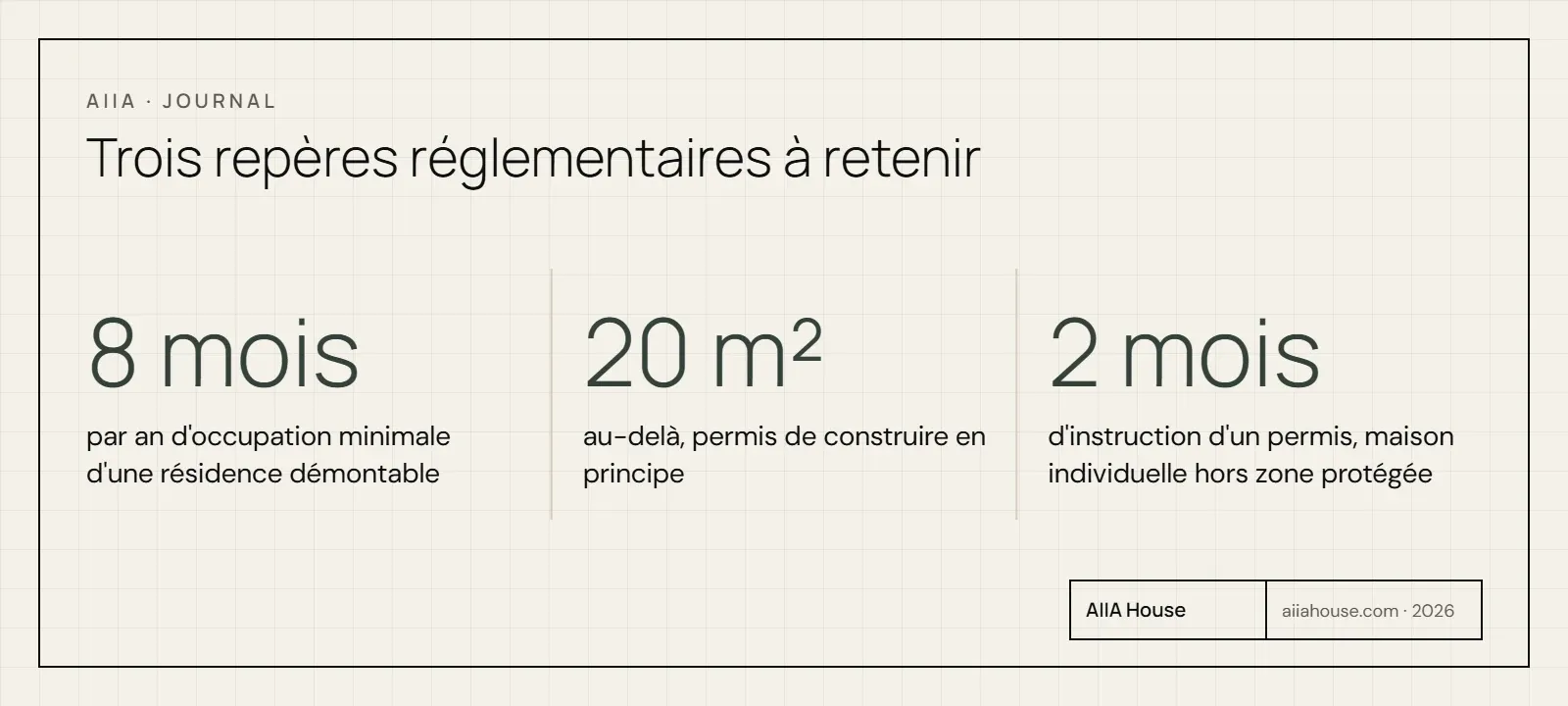
- 8 months a year: minimum occupation of a demountable home as a main residence (article R. 111-51, Légifrance)
- 1 month: town hall deadline for an information planning certificate, against 2 months for an operational one (Service-Public.fr)
- 18 months: validity of a planning certificate (Service-Public.fr)
- 20 m²: above this, a construction in principle needs a building permit (article R. 421-9, Légifrance)
- €49,900*: starting price of the AIIA Glass tiny house, 25 m² (2026 catalogue, prices exclude tax)
*By Yannick Akoka, co-founder of AIIA · published 5 November 2026*
Installing a tiny house on non-buildable land often appeals because of the price, and that is exactly what traps buyers. It is not always forbidden, but it is never free.
The answer fits in one sentence. In an agricultural or natural zone, everything depends on an exception written into the local urban plan (PLU), and the municipality decides it, not you.
This article presents the four cases to examine (STECAL, demountable home, tiny house on wheels, outbuilding), how to check a plot before paying, the risks, then the real budget. Sources are cited with their date when it is known.
What is non-buildable land?
Non-buildable land is most often land classed as agricultural (A) or natural (N) by the PLU. That classification sets what is allowed on the plot.
The national urban planning rules (RNU), the communal map or the PLU set the regulations that apply to the land (Service-Public.fr, sheet F33818, checked on 22 August 2025). The Planning Code says what the PLU may allow in agricultural, natural or forestry zones. It mentions public facilities, changes of use of designated buildings, and extensions or outbuildings of existing homes (articles L. 151-11 and L. 151-12, Légifrance).
Keep two points. First, "non-buildable" does not mean "nothing is possible": exceptions exist, written in the regulations. Second, an attractive price says nothing about what is allowed on the plot.
For an overview of the project, from permit to handover, read our complete guide to the modular home and the tiny house.
Can you place a tiny house on non-buildable land in an A or N zone?
In principle, no. A fixed tiny house, delivered to the plot, is not among the cases allowed by default in an agricultural or natural zone. Only an exception in the regulations can admit it.
In zone A, article R. 151-23 first allows buildings and installations needed for farming, then the cases provided for by articles L. 151-11 to L. 151-13 (Légifrance, in force since 1 January 2016). A new dwelling is possible there only if the farmer's presence is essential to the activity (Service-Public.fr, sheet F924, checked on 11 April 2025). This case concerns farmers, not an individual buying land to place a tiny house.
No AIIA tiny house has wheels: they are fixed homes. A specialised carrier can move them, with a crane or a forklift, but they remain fixed dwellings.
Your project is therefore judged as a fixed dwelling. To compare the two statuses, read our tiny house on wheels or fixed comparison.
Another view comes from the Parks network. The Fédération des Parcs naturels régionaux summarises it in a webinar of 25 June 2021. Light housing outside urbanised areas falls under the "principle of non-buildability" there, and the legal framework is judged difficult.
That text dates from 2021: it explains the logic, it does not replace your PLU.
What is a STECAL and how does it open the door?
A STECAL is a sector of limited size and capacity. The PLU regulations may delimit it, on an exceptional basis, in an agricultural, natural or forestry zone. It may allow buildings, reception areas for travellers or demountable homes forming a permanent dwelling (article L. 151-13, Légifrance).
The text sets safeguards. The regulations set height, siting and density, as well as connections, hygiene and safety.
The sector is delimited after the opinion of the departmental commission for the preservation of natural, agricultural and forestry areas. Its exceptional nature is judged by the territory, the type of urbanisation, the distance between buildings and the availability of networks.
In practice, the municipality decides whether to create this sector by changing its PLU. You cannot impose it. If your plot lies in a STECAL, read the regulations for that sector: they state the housing types allowed, the floor area and the connections.
| Route | What the text says | Who decides | Watch out for |
|---|---|---|---|
| STECAL | Exceptional sector delimited by the PLU regulations | The municipality, after the departmental commission's opinion | Local conditions on height, density, networks |
| Demountable home (a possible case within a STECAL) | Installation without foundations, easily demountable, lived in 8 months a year | The regulations, case by case | A fixed model on foundations is outside the definition |
| Outbuilding or extension | Possible for an existing home if the regulations provide for it | The PLU regulations | Siting, height and footprint are controlled |
What is a demountable home?
A demountable home is an installation intended for housing, with three characteristics (article R. 111-51, Légifrance, in force since 1 January 2016):
- it has no foundations, has equipment, and may be independent of public networks;
- it is occupied as a main residence at least eight months a year;
- it is easily and quickly demountable at any time.
According to the letter of the text, it targets a main residence, not a second home or leisure accommodation. It also targets installations "without foundations": a home placed on foundations does not match this definition, by its own terms.
Several demountable homes on one plot? A prior declaration is enough if the total floor area does not exceed 40 m² and no development permit is needed (article R. 421-23, l, Légifrance).
AIIA's tiny houses are fixed homes, without wheels: their case is judged as a construction, unless the town hall confirms otherwise. This route therefore does not suit every project.
It does not stop a STECAL in your municipality from admitting more conventional buildings. Ask the town hall, naming the exact model.
Your choice of foundation affects how your project is classified. The article do you need foundations for a modular home details the options.
Does a tiny house on wheels fall under the three-month rule?
A separate rule covers the caravan. Installing a caravan for more than three months a year, outside a leisure park, campsite or classified holiday village, requires a prior declaration (article R. 421-23, Légifrance, in force since 1 January 2016, consulted on 5 November 2026). For this calculation, all periods of stationing count, consecutive or not.
This rule does not cover a fixed dwelling such as AIIA's tiny houses. It gives neither a right to settle nor a right to live there: the PLU and the town hall remain decisive.
Can a tiny house be an outbuilding of an existing house?
In principle, no for a home. The route applies to an ancillary room of an existing house, and only if the PLU regulations allow it.
In these zones, existing homes may receive extensions or outbuildings. They must not compromise farming or the quality of the landscape (article L. 151-12, Légifrance, in force since 1 January 2016).
The regulations specify the siting area, height, footprint and density. These provisions are subject to the opinion of the departmental commission. An outbuilding depends on a home already on the plot: it does not replace a home you do not have.
This route mainly interests owners of an existing house in an A or N zone, to add an ancillary room. It does not solve the case of bare land.
An outbuilding separate from the building is in principle a new construction. It falls under the thresholds presented below (article R. 421-9).
For works on the existing building itself, a permit is required above 20 m² created, outside urban zones (article R. 421-14, Légifrance).
The permit rules for a modular home are detailed in our dedicated article.
How do you check what a plot allows before buying?
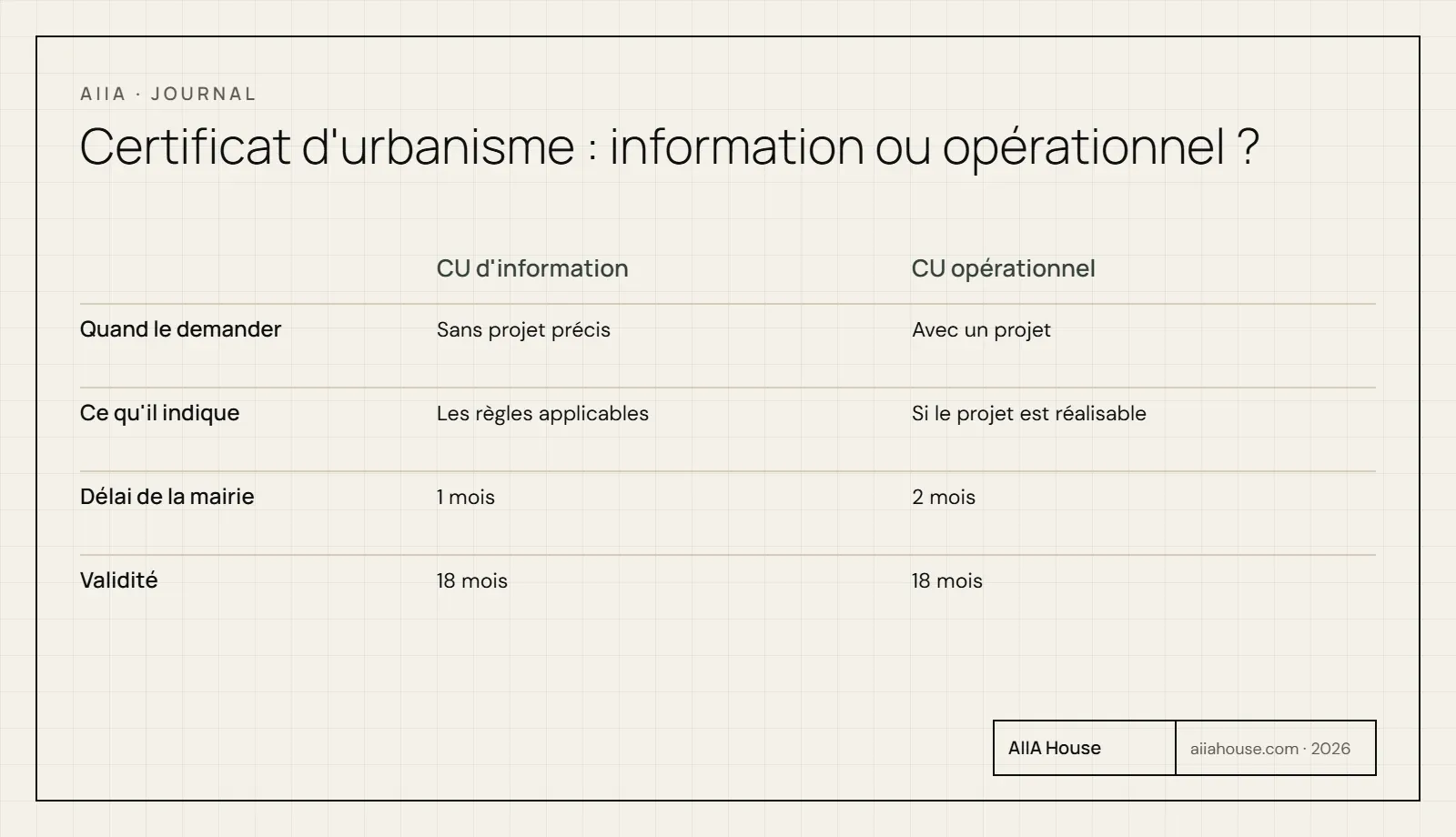
Before buying, ask the town hall for a planning certificate (CU). The information CU gives the rules that apply to the land.
The operational CU says whether your project is feasible on the plot. It is not a planning permission (Service-Public.fr, sheet F1633, checked on 2 July 2025).
The application is free. The town hall has one month for an information CU and two months for an operational CU.
A CU is valid for 18 months from issue and can be extended by a year under conditions. These are the deadlines on the sheet: confirm them with your town hall.
The Géoportail de l'urbanisme helps spot the zoning. From an address, it lets you download the documents that apply to a plot.
Its data is informative: only the documents held by the municipality, the inter-municipal body or the prefecture are authoritative. A document missing online does not prove the municipality is not covered.
Finally, a buyer of building land has no ten-day cooling-off period (Service-Public.fr, sheet F33818). Do your checks before signing.
| Check | Where | What it brings |
|---|---|---|
| Zoning (A, N, U…) | PLU, Géoportail de l'urbanisme | A first reading, informative |
| Applicable rules | Information CU (town hall) | Rules, easements, taxes, 1 month |
| Is the project feasible? | Operational CU (town hall) | Answer on your project, 2 months |
| Access to the plot | Land study on request | Access for transport and the crane |
| Connections | Local professional | Water and electricity, not by AIIA |
Before signing: request an AIIA land study. Offered on request, it covers the municipality's PLU, access to the plot and the regulations that apply to the floor area.
What permits and risks apply if you install without approval?
What are the penalties without authorisation?
A project carried out without authorisation exposes you to cumulative penalties. Service-Public.fr lists five (sheet F17578, checked on 22 October 2026):
- a criminal fine;
- an administrative fine;
- a stop to works;
- compliance work or demolition, with a daily penalty;
- work carried out by the authorities at the offender's expense.
Article L. 480-4 of the Planning Code sets the criminal fine. It runs from 1,200 to 6,000 euros per square metre built, demolished or made unusable, or 300,000 euros in other cases.
In case of repeat offence, six months' imprisonment may be added. These penalties may target the beneficiaries of the works and contractors (Légifrance, in force since 11 April 2024, consulted on 5 November 2026).
A demolition order leaves you with land you paid for, no house, and a project to start again.
Which authorisation depending on the floor area?
On the permit side, the prior declaration covers works not subject to a building permit. It is examined within one month of a complete application.
For a new building, the threshold reads as follows (article R. 421-9, in force since 16 November 2024, outside protected sites):
- from 5 to 20 m² of footprint and floor area: prior declaration;
- above 20 m²: building permit.
A 25 m² model such as Glass exceeds this 20 m² threshold: the town hall confirms the applicable regime.
The building permit is examined in two months for a detached house outside a protected area. It takes three months inside one (sheet F1986, checked on 13 February 2026). For a tiny house on non-buildable land, these deadlines only matter once the principle is secured in the PLU.
What budget should you plan for non-buildable land?
Non-buildable land only saves money if it becomes usable. A low purchase price covers neither the wait, nor the connections, nor the risk of refusal. For the same budget, serviced building land often makes the project simpler.
The items to add up are:
- the land;
- planning procedures;
- access for transport and the crane;
- water and electricity connections;
- sewage, where relevant.
The land, procedures and options are on top of the price of the house. Connections are never included.
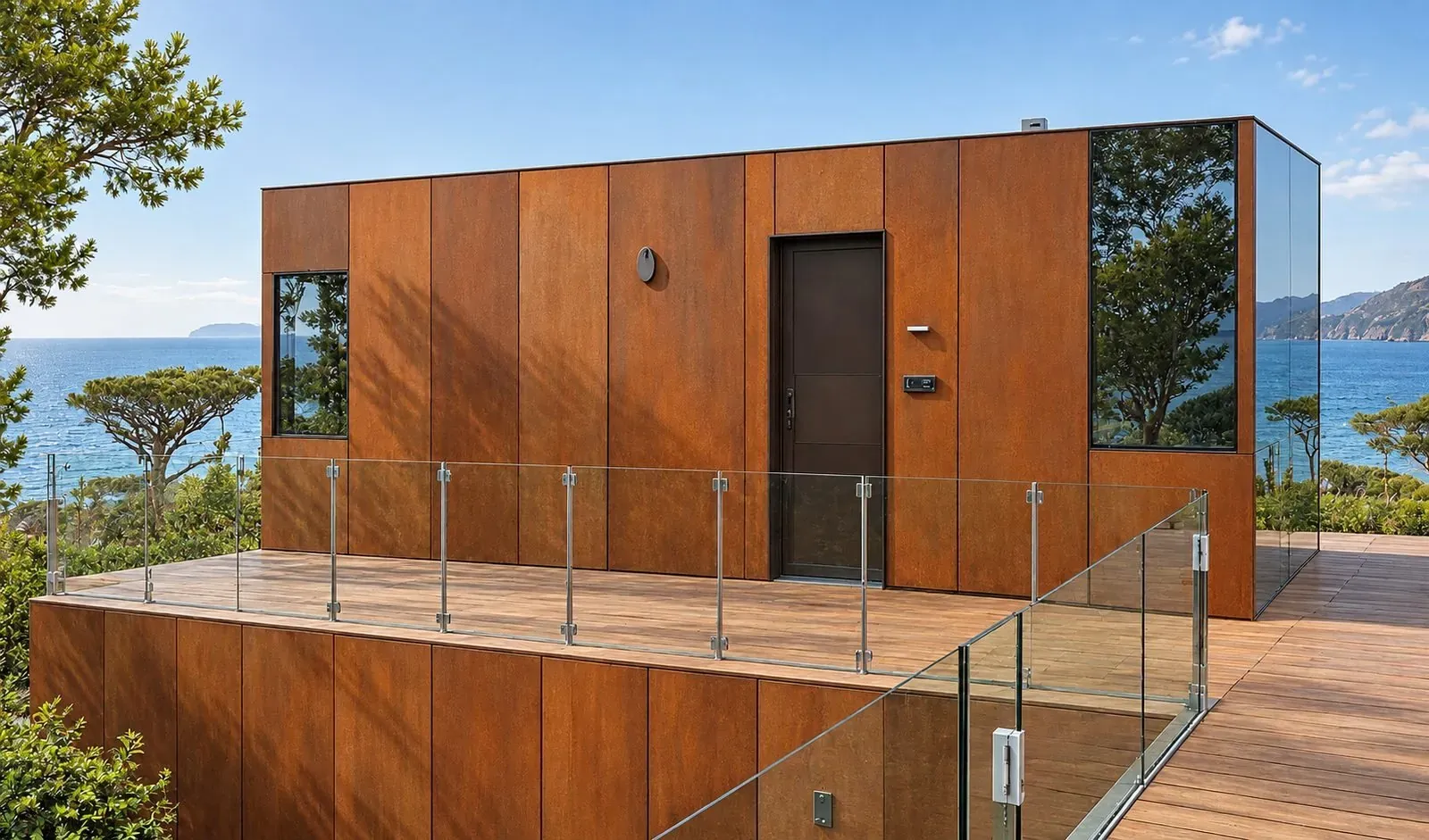
On the AIIA side, the Glass tiny house starts at €49,900* (2026 catalogue starting price, 25 m²). It is manufactured in the workshop in 6 to 8 weeks, then delivered to the plot, with turnkey delivery included in the starting price.
Connections are carried out by a local professional, never by AIIA. The Glass model page gives areas and prices.
Weigh the saving made on purchase against the cost of a refusal. Without a protective clause in the sale agreement, a refusal blocks the project without refunding the land: talk to your notary. To place the overall budget, see how much a turnkey modular home costs.
To cost your project, request a quote: AIIA answers within 48 business hours.
*Prices exclude tax.
What should you do before signing?
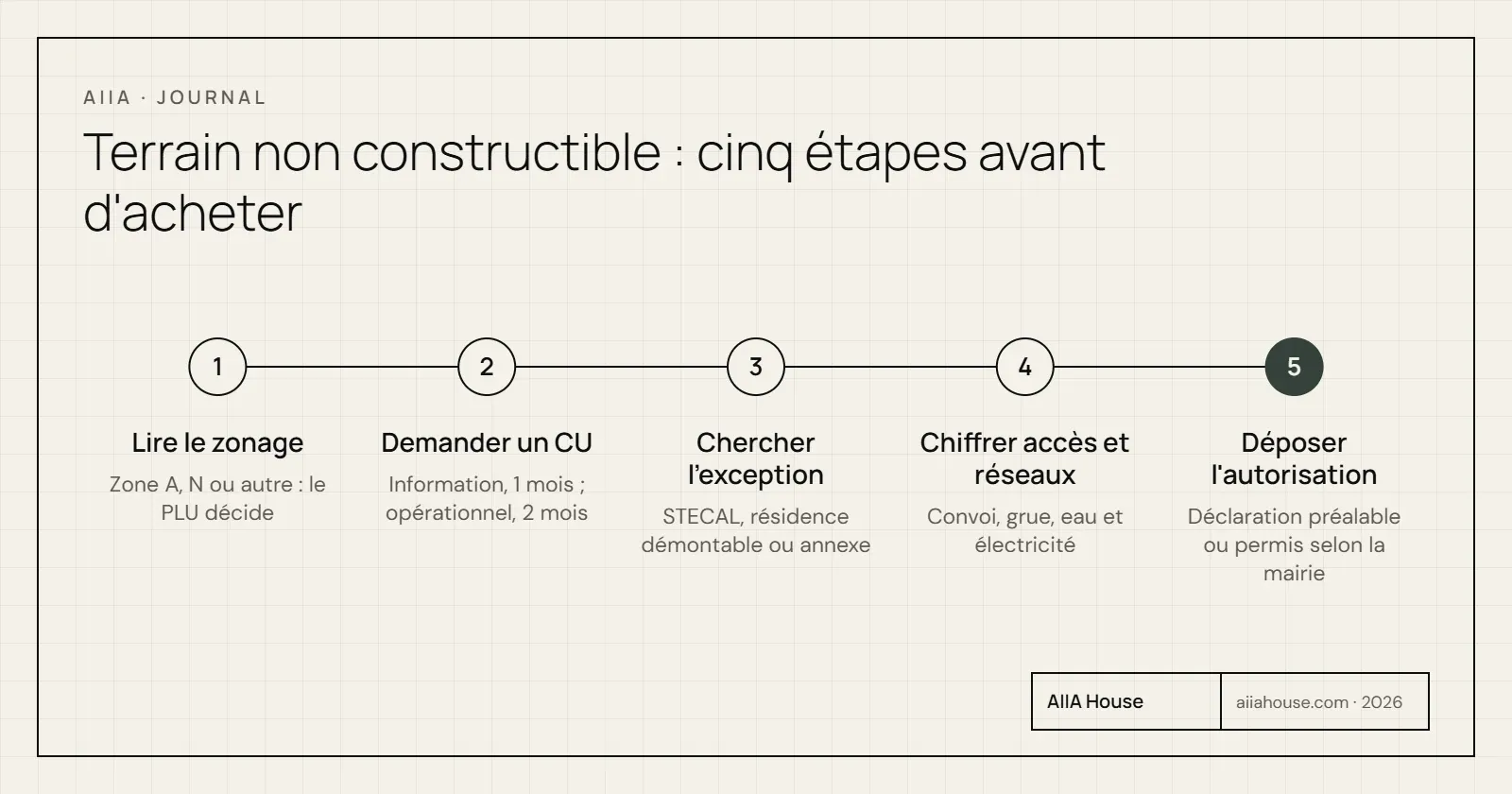
The safest path has five steps, and none can be skipped:
- read the zoning;
- ask for a planning certificate;
- look for an exception written into the regulations;
- get access and networks costed;
- file the right application.
If your plot is in an A or N zone, do not assume the tiny house will be accepted. First look for a STECAL, a possible outbuilding, or another plot that is buildable and serviced. Our guide to buying a modular home or tiny house and the article on choosing land for a tiny house help you compare.
Next step: have AIIA study your plot. A quote can follow: AIIA answers within 48 business hours, but that answer is not a planning permission.
This article is general information, not legal advice: the town hall and the PLU have the final say.
AIIA's view
According to feedback from the AIIA team, not guaranteed, the question "on which plot can the house be installed?" comes up often. Our answer does not change: everything depends on the municipality's PLU, access to the plot and the regulations for the floor area.
AIIA is neither a builder nor an installer. We have our homes built in the workshop and deliver to your plot anywhere in France.
You use an installer; AIIA can put you in touch with installers. Connections remain the responsibility of a local professional.
We promise no authorisation: the town hall decides. Our land study is offered on request.
- legifrance.gouv.fr/codes/section_lc/LEGITEXT000006074075/LEGISC…
- legifrance.gouv.fr/codes/article_lc/LEGIARTI000031721187
- service-public.gouv.fr/particuliers/vosdroits/F1633
- service-public.gouv.fr/particuliers/vosdroits/F33818
- service-public.gouv.fr/particuliers/vosdroits/F17578
- service-public.gouv.fr/particuliers/vosdroits/F1986
- legifrance.gouv.fr/codes/article_lc/LEGIARTI000031764703
- legifrance.gouv.fr/codes/article_lc/LEGIARTI000037799137
- legifrance.gouv.fr/codes/article_lc/LEGIARTI000031764577
- parcs-naturels-regionaux.fr/sites/federationpnr/files/document/centre_de…
- geoportail-urbanisme.gouv.fr/index.php/faq
- legifrance.gouv.fr/codes/id/LEGIARTI000049398788
- legifrance.gouv.fr/codes/article_lc/LEGIARTI000031720605
- service-public.gouv.fr/particuliers/vosdroits/F924
Frequently asked questions
Does a positive planning certificate guarantee a permit?
No. The CU is not a planning permission. The operational CU says whether the project is feasible on the plot, but the permit or declaration still has to be obtained.
Is the Géoportail de l'urbanisme enough to check a plot?
No. Its data is informative: only the documents held by the municipality, the inter-municipal body or the prefecture are authoritative. A municipality can be covered without its document being online.
Can you install a tiny house without a permit on agricultural land?
Not freely: agricultural land is classed as zone A, where only an exception in the PLU can admit a dwelling. Above 20 m² of footprint or floor area, a building permit is required (article R. 421-9), and an installation without authorisation exposes you to the penalties of article L. 480-4.
Can you buy non-buildable land hoping it becomes buildable?
Nothing guarantees it: no text we read provides for automatic reclassification as buildable land. Zoning is set by the PLU, which the municipality changes. Ask for a planning certificate before signing. Without a protective clause in the sale agreement, the risk of a refusal falls on the buyer: talk to your notary.
What does the AIIA land study check?
Offered on request, the land study covers the municipality's PLU, access to the plot and the regulations that apply to the floor area. It replaces neither the planning certificate nor the town hall's opinion.
Does a tiny house on wheels change the answer?
No AIIA tiny house has wheels: they are fixed homes. For another project, the town hall confirms the regime: the caravan rule (article R. 421-23) is separate, and a home that can be moved does not bypass the PLU. Our tiny house on wheels or fixed comparison details the two statuses.
Who can change the zoning of a plot?
Zoning is set in the PLU, a document of the municipality or inter-municipal body. An individual can approach the town hall but cannot impose a change: the decision rests with the authority.