In shortThere is no profitable unusual accommodation that suits every campsite. The cap on light leisure dwellings (HLL: fewer than 35 below 175 pitches, otherwise below 20%) makes each place scarce. The best choice is the unit that sells the most nights at the best price, set against its total cost, not the cheapest one to buy.
Key figures
- 51.6%: average occupancy of serviced pitches on campsites, April to September 2025 (Insee, published 23 July 2026)
- 37.3%: occupancy of bare pitches over the same period (Insee)
- Fewer than 35: light leisure dwellings allowed below 175 pitches, otherwise below 20% of pitches (article R. 111-38)
- 63.1%: occupancy of professional unusual accommodation in 2022 (Observatoire de l'hébergement insolite)
- 6 to 8 weeks: workshop manufacturing of an AIIA unit, to be scheduled out of season
*By Yannick Akoka, co-founder of AIIA · published 3 November 2026*
Cabin, lodge tent, bubble or tiny house: which profitable unusual accommodation should a campsite choose? The answer depends less on the type than on three measures: nights sold, the average price obtained and the total cost of the unit. No public data gives revenue by type of accommodation, and many rankings found online rest on unsourced estimates.
This article sets out the method: what the regulations cap for light leisure dwellings (HLL), what official figures allow you to assume, then a calculation to redo with your own assumptions. It is written for campsite managers and outdoor hospitality project owners.
What is a profitable unusual accommodation for a campsite?
No type of accommodation earns the most everywhere. What counts is net income per accommodation place and per euro invested. A unit that sells more nights, over a longer season and at a better price will do better than a unit that is cheaper to buy.
Three measures decide the result, in this order:
- Nights sold per year: opening days multiplied by the occupancy rate.
- The average price actually obtained per night, after discounts and commissions.
- The total cost of the unit: purchase, servicing, fit-out and upkeep.
The type of accommodation affects all three. An insulated unit may open for longer, a distinctive shape may justify a higher price, and canvas costs less to buy. These are tendencies, to be checked site by site.
A general ranking is therefore of little value for your campsite. It is better to compare two or three options in the same table of assumptions, as in the rest of this article.
How many unusual accommodations can a campsite install?
On an authorised campsite, the number of light leisure dwellings (HLL, from the French habitations légères de loisirs) stays below 35 if the site has fewer than 175 pitches. Beyond that, it stays below 20% of pitches (article R. 111-38, 4°, of the French Urban Planning Code). Each place becomes scarce: the aim is to make it earn as much as possible.
| Campsite pitches (fictional examples) | HLL cap | Calculation |
|---|---|---|
| 80 | 34 at most | fewer than 35 |
| 174 | 34 at most | fewer than 35 |
| 200 | 39 at most | below 20%, so fewer than 40 |
| 300 | 59 at most | below 20%, so fewer than 60 |
An HLL is a demountable or transportable structure intended for temporary or seasonal leisure use (article R. 111-37). Outside the pitches provided for in article R. 111-38, installation falls under ordinary construction law (article R. 111-40).
Campsites created by simple prior declaration or without a development permit are excluded from this regime, as are natural camping areas. A mobile home falls under another framework, that of mobile leisure homes, which the Urban Planning Code treats separately.
The exact classification of an AIIA unit, HLL or otherwise, is not publicly documented to date. Have it confirmed by your town hall's planning department before settling on a number of units.
The formalities are detailed in our article on installing tiny houses on a campsite. To size a fleet, see how many units to deploy on a tourist site.
Which unusual accommodations should you compare, and on what criteria?
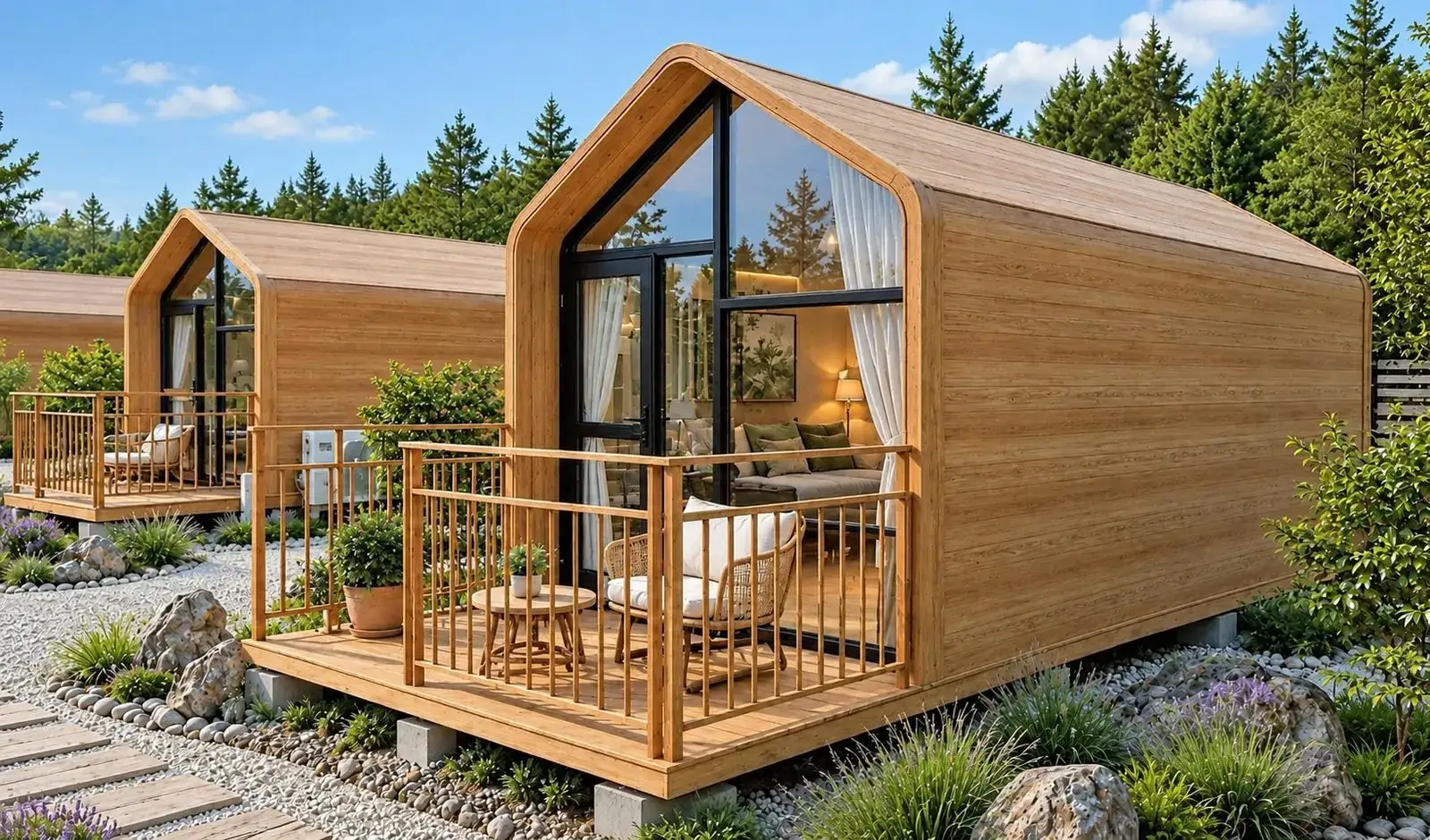
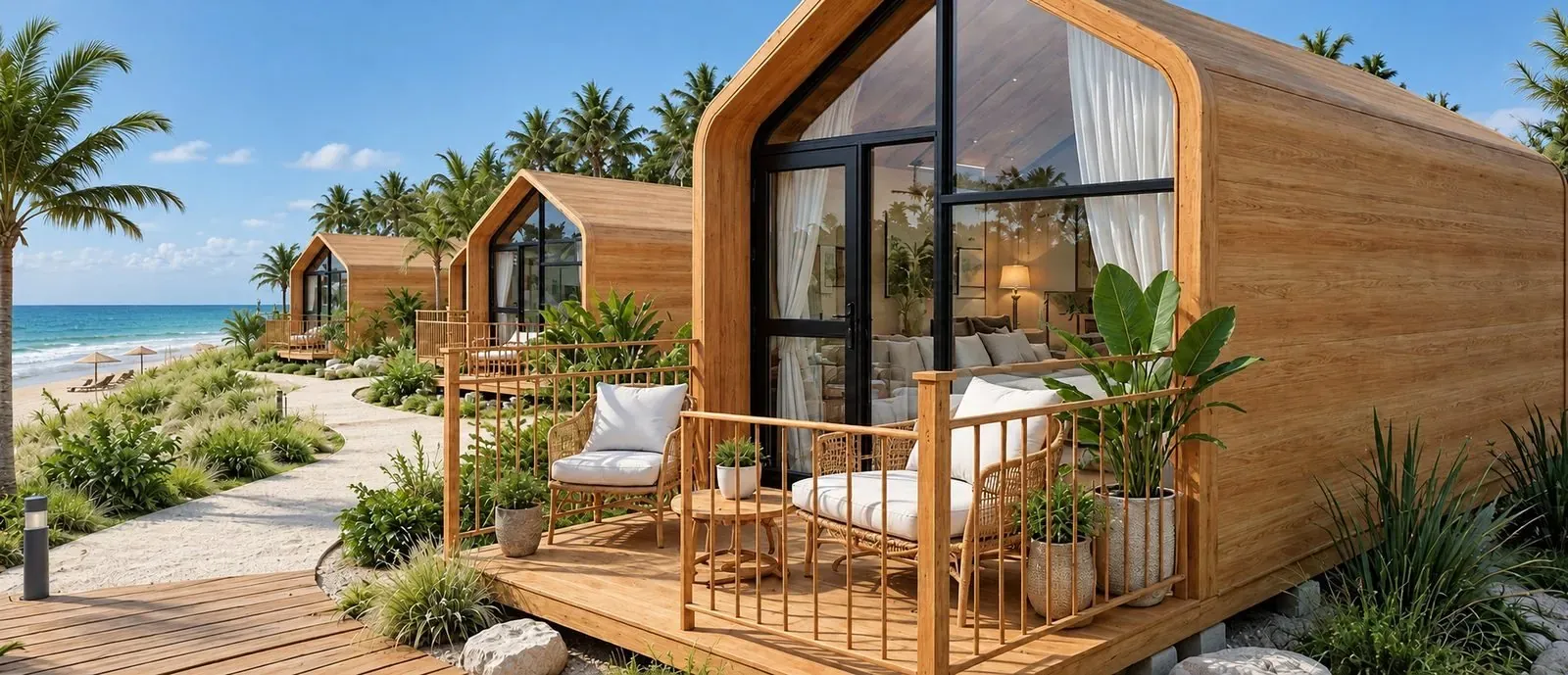
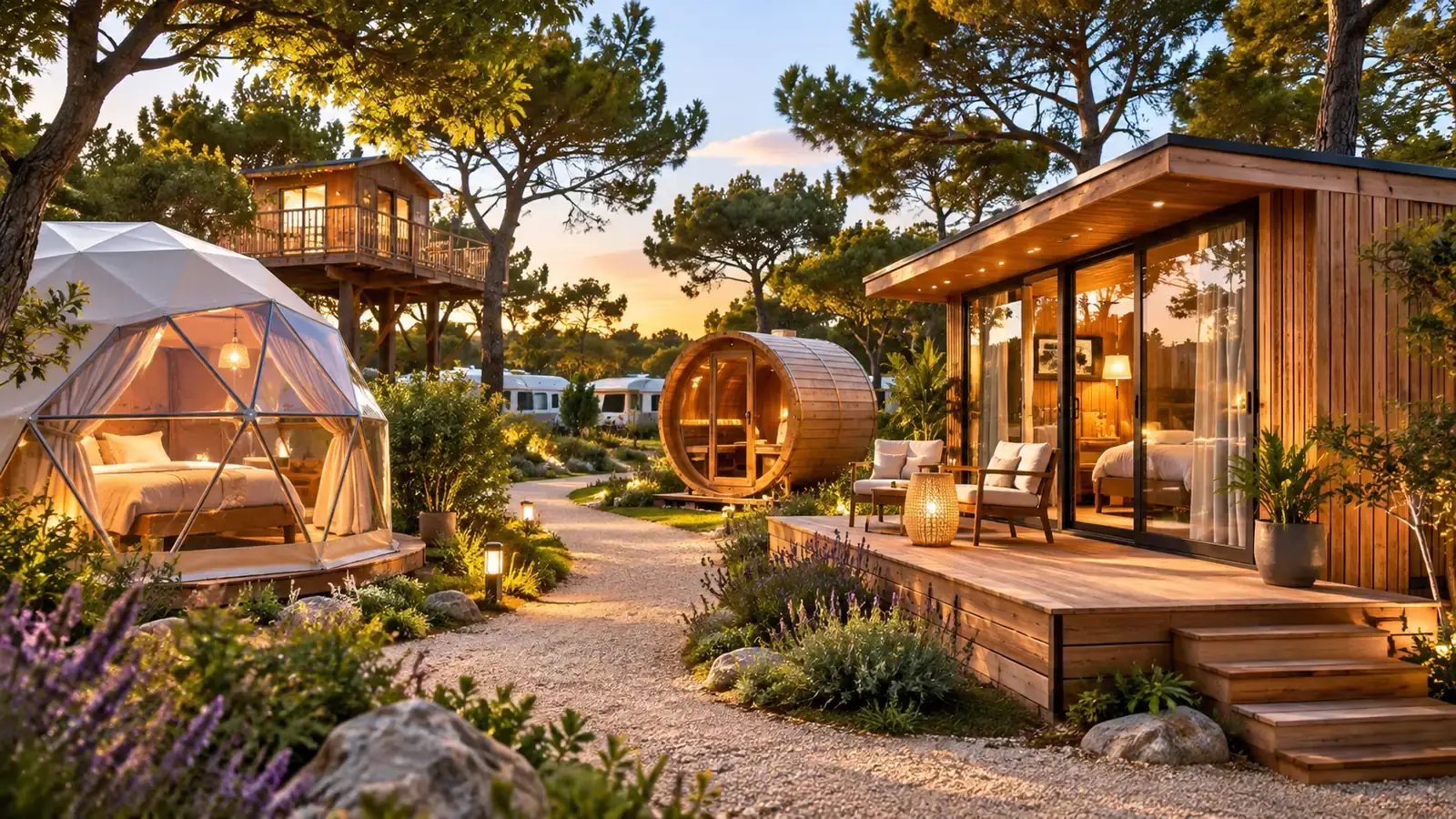
Six families come up in campsite projects: lodge tent, mobile home, wooden cabin or chalet, yurt, bubble and modular tiny house. Compare them first on opening season, thermal comfort, upkeep and planning regime, then on purchase price. The table gives qualitative benchmarks, without figures, to be confirmed with each supplier.
| Type | What sets it apart | Possible opening season | Point to watch |
|---|---|---|---|
| Lodge or safari tent | Canvas on a frame, nature image | Often short | Canvas wear, limited thermal comfort |
| Mobile home | Standard rental offer | Long possible, depending on insulation | Planning regime distinct from HLL, little differentiation |
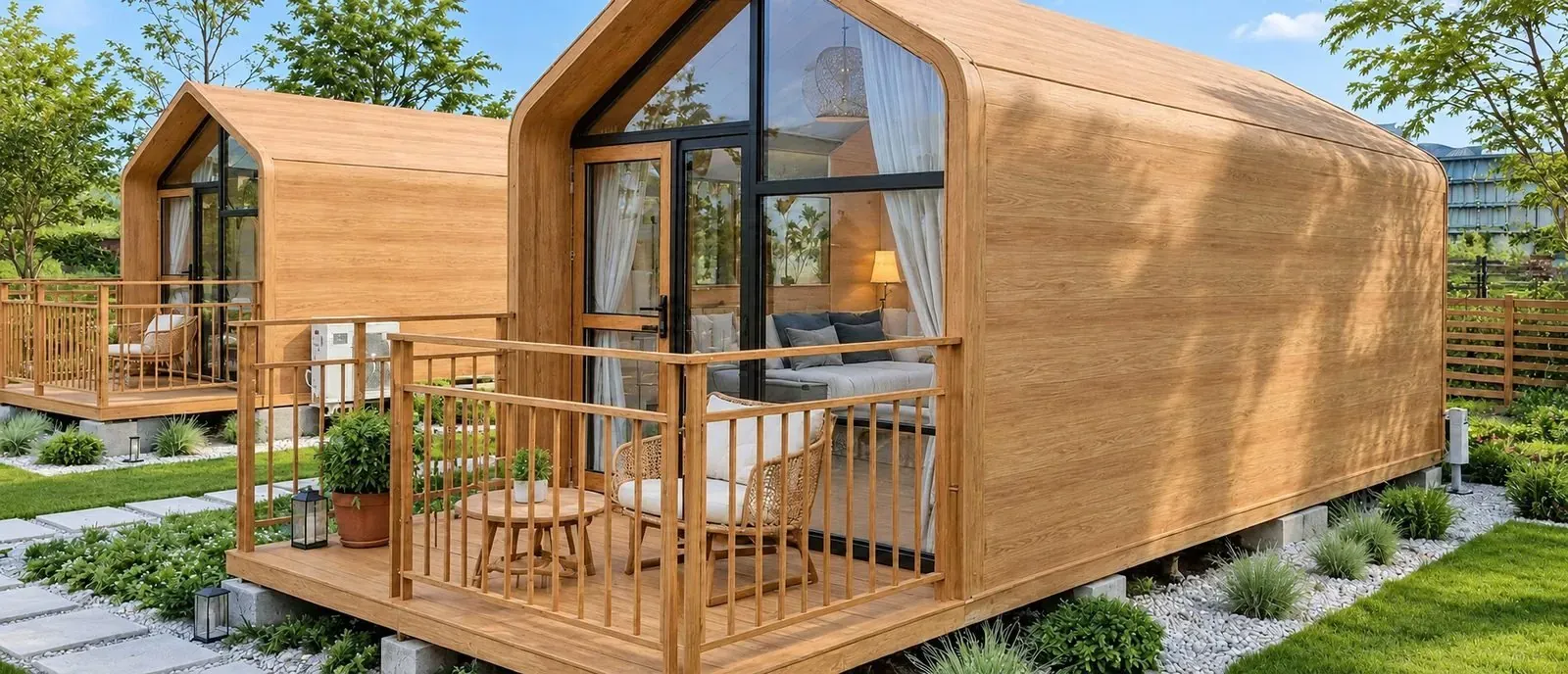
| Wooden cabin or chalet | Strong image, varied shapes | Varies with insulation | HLL status to check depending on the build |
| Yurt | Round volume, a sense of escape | Short to medium depending on version | Canvas upkeep, heating |
| Transparent bubble | A night under the stars | Varies with the model | Overheating in summer, heating in winter |
| Insulated modular tiny house | Built in a workshop, delivered habitable | Several seasons possible, depending on heating | Higher entry price, HLL classification to confirm |
Cabins weigh the most in the offer: 44% of professional unusual accommodation in 2022, according to the Observatoire de l'hébergement insolite, relayed by L'Officiel des terrains de camping (15 September 2022). Tiny houses were growing 350% in two years there, after being absent from the 2020 top 10. These data date from 2022, and the next edition is announced for 8 December 2026.
For the comparison with canvas, see tiny house or glamping. The effect of shape on demand is covered in the architecture of an accommodation.
What do official figures say about campsite occupancy?
Serviced pitches show 51.6% occupancy from April to September 2025, against 37.3% for bare pitches (Insee, published 23 July 2026). No public source gives occupancy by type of unusual accommodation. These figures are a benchmark, not a forecast.
| Indicator | Value | Source and period |
|---|---|---|
| Occupancy of serviced pitches | 51.6% | Insee, April to September 2025 |
| Occupancy of bare pitches | 37.3% | Insee, April to September 2025 |
| Occupancy of professional unusual accommodation | 63.1% | Observatoire de l'hébergement insolite, 2022, relayed by L'Officiel des terrains de camping |
| Average stay in unusual accommodation | 1.47 nights | Observatoire, 2022, relayed by L'Officiel |
| Unusual-stay sites with fewer than five units | 82% | Observatoire, 2022, relayed by L'Officiel |
| Campsite overnight stays, May to August 2026 | 126.5 million, up 1.1% | Insee, 29 September 2026, provisional data |
Data checked on 3 November 2026.
Two limits apply. The Observatoire covers all unusual-stay sites, not only campsites, and it dates from 2022 (figures relayed by L'Officiel des terrains de camping on 15 September 2022). Insee describes overall campsite demand, not the profitability of a type of unit.
The average stay of 1.47 nights points to a practical issue: every turnover costs cleaning and linen. A unit sold in short stays weighs more on margin than a unit let by the week.
How do you calculate what an unusual accommodation really earns?
Annual gross revenue is calculated by multiplying nights sold by the average price obtained. Costs are then deducted to give net revenue. The AIIA simulator uses, as an indication, 65% occupancy and costs at 30% of rental income.
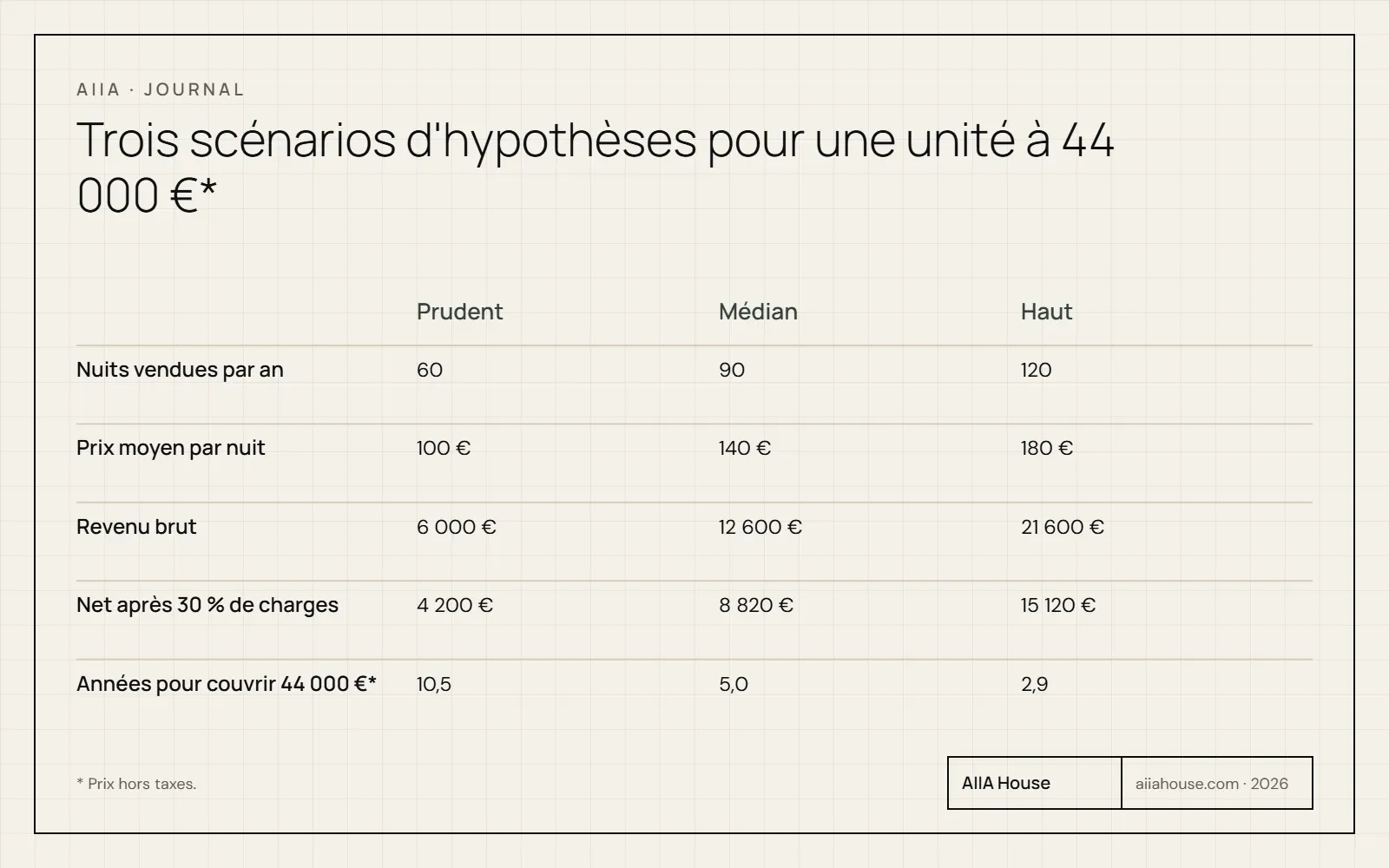
The three scenarios below are assumptions, not forecasts. They are set against the starting price of Frame, €44,000*, a 30 m² unit from the Resort Collection.
| Scenario (assumptions) | Nights sold per year | Average price per night | Gross revenue | Net revenue after 30% costs | Years to cover €44,000* |
|---|---|---|---|---|---|
| Cautious | 60 | €100 | €6,000 | €4,200 | 10.5 |
| Median | 90 | €140 | €12,600 | €8,820 | 5.0 |
| High | 120 | €180 | €21,600 | €15,120 | 2.9 |
\* Prices exclude tax. Starting price from the AIIA Edition 2026 catalogue, standard finish.
The median scenario is close to the Insee benchmark: 51.6% of 183 opening days, from April to September, gives about 94 nights (AIIA calculation). The average price remains an assumption, because neither Insee nor the Observatoire publishes it by type of accommodation.
According to feedback from the AIIA team, not guaranteed, one client lets their Glass on Airbnb at €345 a night. They already have 8 months of bookings ahead. This is an isolated case, outside a campsite, not an average.
This calculation excludes servicing, connections, the terrace, furniture, appliances, financing, tourist tax and income tax. It does not replace a forecast prepared with your accountant.
For a full method, see the profitability of a modular accommodation. To cost your own assumptions, open the Invest simulator or request a quote within 48 working hours via the contact page.
Which model earns the most per HLL place?
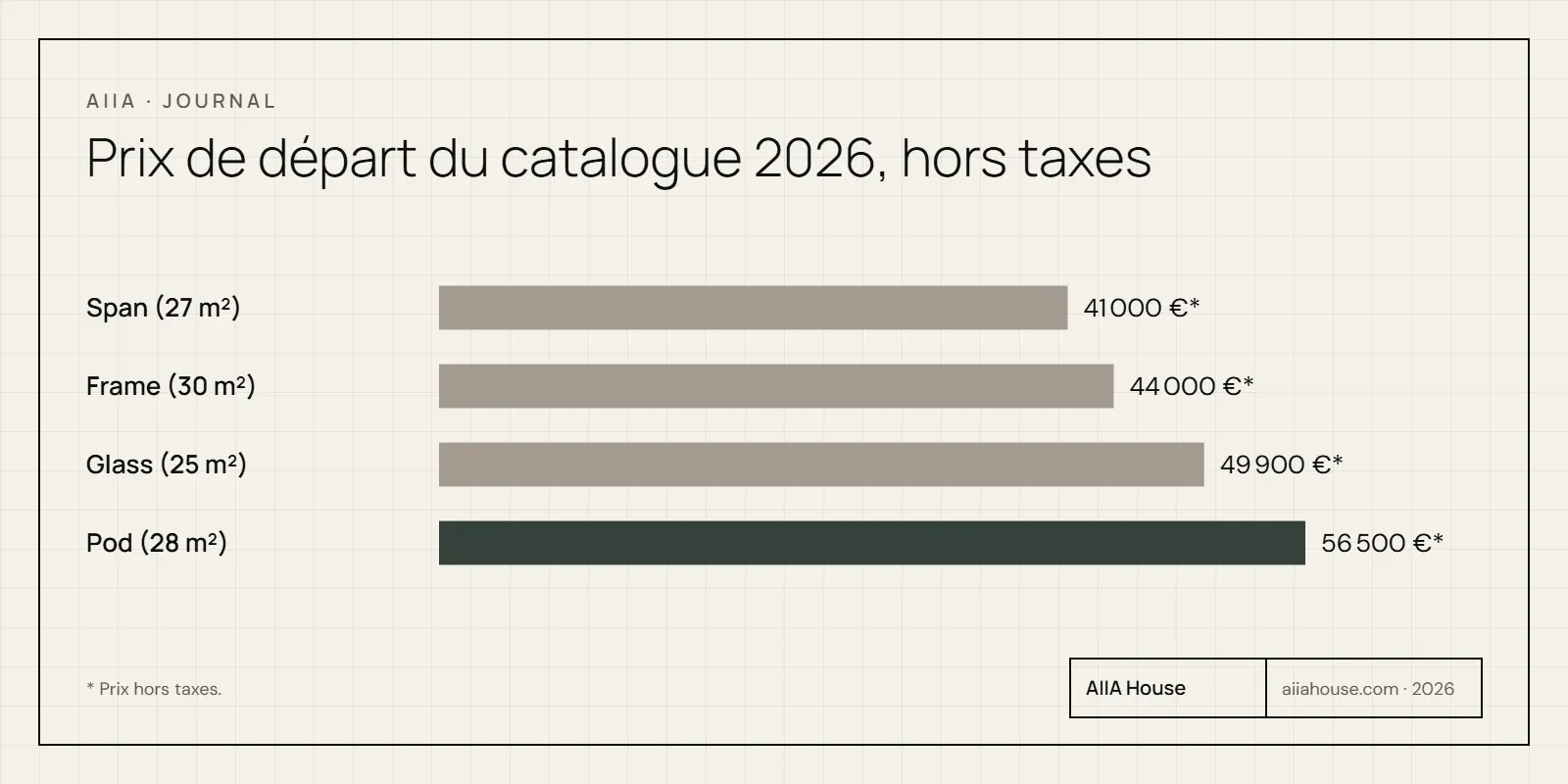
When the number of places is capped, the right measure is net revenue per place set against the unit's cost. A more expensive model is justified if it obtains a nightly price, or a season, high enough to cover the gap. Here are the four models shown to professionals on the AIIA site, whose prices also appear on the Pricing page.
| Model | Area | Starting price (2026 catalogue) | Price per m² (AIIA calculation) |
|---|---|---|---|
| Span | 27 m² | €41,000* | €1,519 |
| Frame | 30 m² | €44,000* | €1,467 |
| Glass | 25 m² | €49,900* | €1,996 |
| Pod | 28 m² | €56,500* | €2,018 |
Take the gap between Span and Pod: €15,500*. Over five years, at 90 nights sold a year, that is 450 nights. With 30% costs, Pod must earn about €49 more per night sold to pay back the gap (AIIA calculation assumptions).
This reasoning ignores the effect of the model on occupancy. A more distinctive shape may sell more nights, or open earlier in spring: only a test proves it. Starting with a first batch of two or three units lets you measure real price and occupancy before filling the HLL cap.
What costs come on top of the price of the accommodation?
The base price of an AIIA model covers turnkey delivery, habitable on delivery. It includes the galvanised steel structure, high-performance insulation, aluminium joinery with double glazing, and internal electrics and plumbing. Everything else must be planned for.
To plan for on top:
- the pitch, its servicing and the water and electricity connections, carried out with a local professional;
- the administrative procedures, which the town hall confirms according to the surface area and the campsite's regime;
- the options, which vary by model: wooden terrace, pergola, solar panels, rainwater harvesting, furniture pack, appliance pack, air conditioning, exterior blind.
In operation, also count platform commissions, cleaning and linen, energy, insurance, tourist tax and upkeep.
AIIA is neither a builder nor an installer. You use your own installer, and AIIA can put you in touch with installers.
Workshop manufacturing takes 6 to 8 weeks. The guarantees are 10 years on the structure, 5 years on waterproofing and 3 years on installations. They are carried by the manufacturer and relayed by AIIA.
To finance without tying up all your capital, AIIA offers professionals a 5-year lease, to be studied with a professional quote. New units are supplied after 3 years, under the terms of the contract.
Connections are never included. A site study is available on request, via the professionals page.
What mistakes should you avoid before choosing an unusual accommodation?
The costliest mistakes come from unchecked assumptions more than from the choice of type. Five traps come up in campsite projects.
- Copying a brochure occupancy rate. No public source establishes it by type. Start from the Insee benchmark of 51.6% and test lower scenarios.
- Ignoring the HLL cap. Ordering before the town hall has answered risks ending up with fewer units than planned.
- Multiplying types. Each type has its own upkeep and parts. A uniform fleet is simpler to maintain, as our article on maintaining a fleet of accommodations shows.
- Forgetting the season. A unit closed for four months sells no nights. Insulation and heating decide the opening period, see opening a modular accommodation in winter.
- Reasoning unit by unit. 82% of unusual-stay sites have fewer than five units (2022 Observatoire, relayed by L'Officiel): reception, cleaning and maintenance weigh on each unit. A campsite already has a reception and a team, which may work in its favour: to be costed.
Each of these points is fixed before the purchase, not after. That is why the table of assumptions comes first.
What should you do in practice to choose your accommodation?
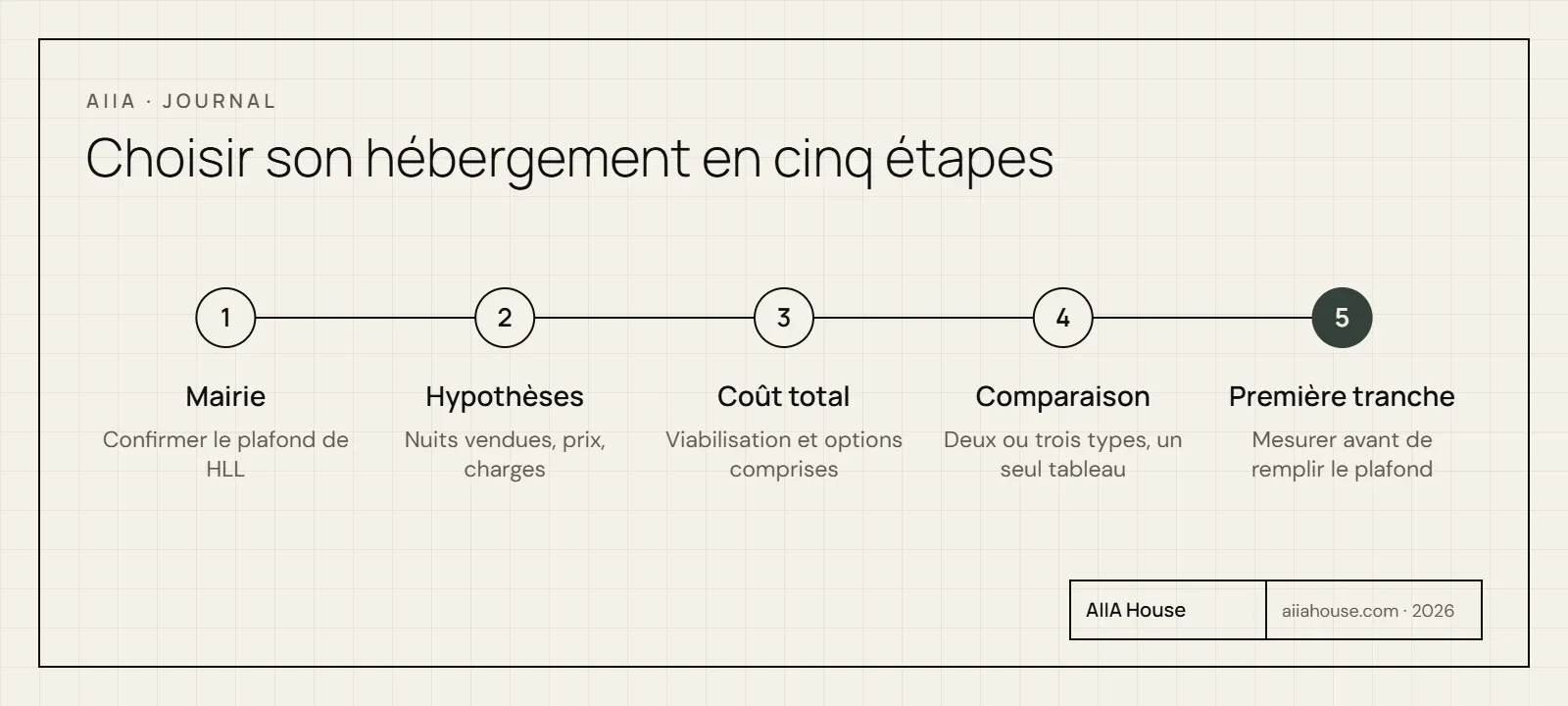
For a campsite, the approach comes down to five steps. The accommodation that earns the most is the one whose nights sold you can justify, not the one with the lowest purchase price.
- Have the town hall confirm the HLL cap and the classification of the units.
- Set your assumptions: nights sold, average price, costs.
- Cost the total, including servicing and options.
- Compare two or three types in the same table.
- Launch a first batch, then adjust before filling the cap.
To test your figures, use the simulator on the Invest page, whose default assumptions are indicative. For a professional quote, go through the professionals page or the contact page: the reply comes within 48 working hours. The complete guide to modular houses and tiny houses gives the general framework for a purchase.
AIIA's view
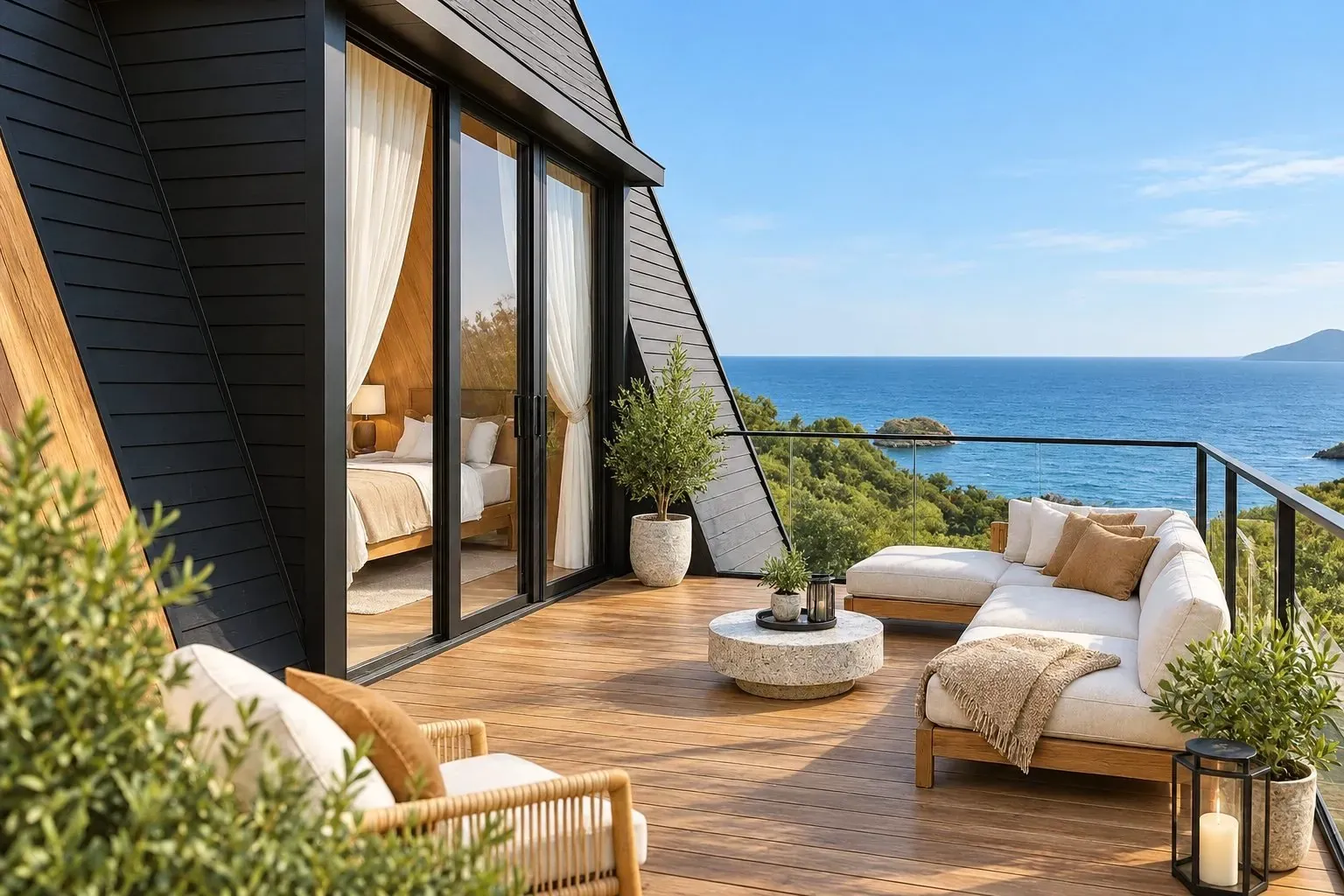
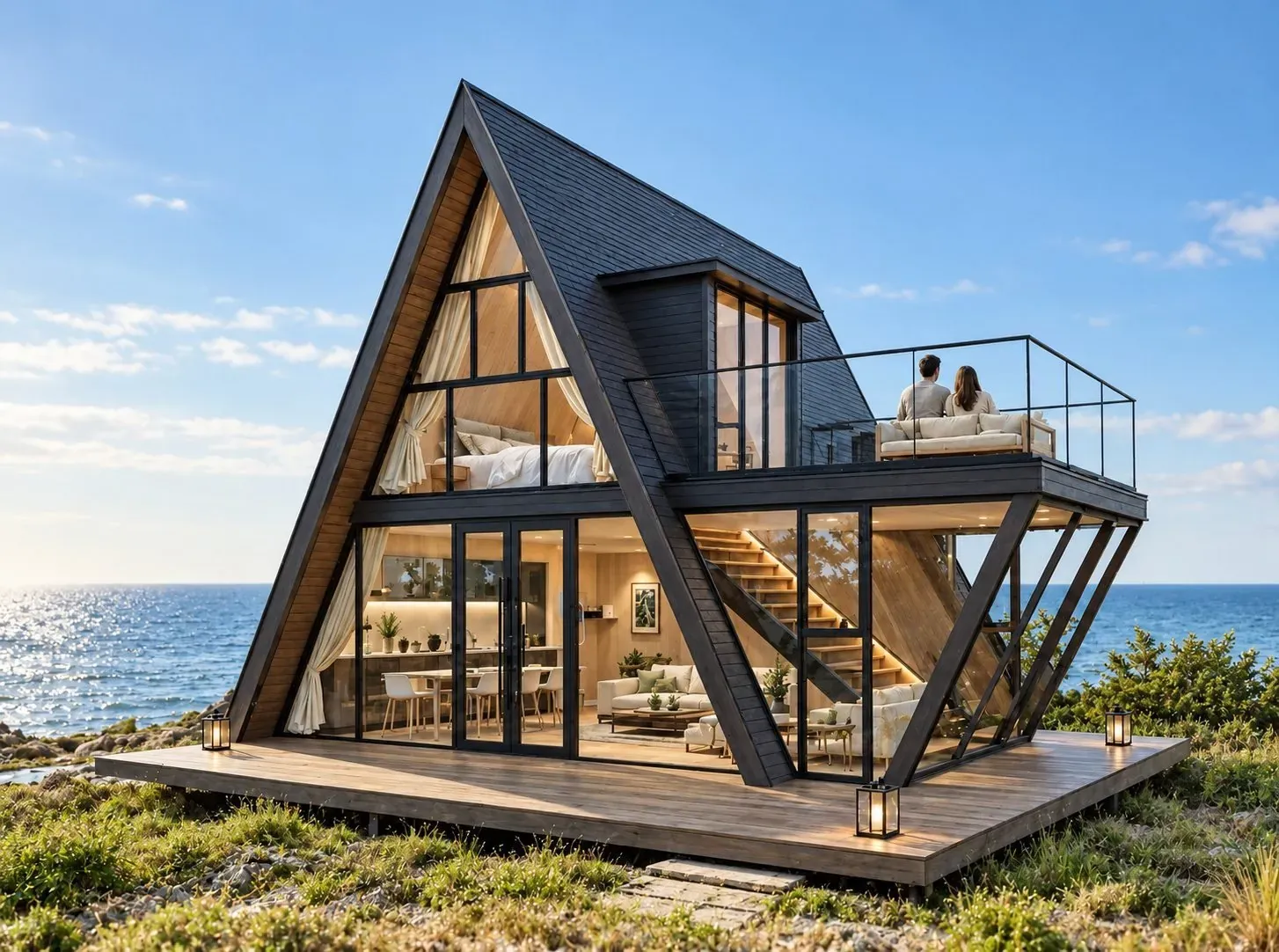
Our view: the right unusual accommodation is not the most original one, it is the one whose nights sold you can justify. AIIA designs tiny houses and modular homes, has them built in a workshop in 6 to 8 weeks and delivers them habitable to your land, anywhere in France.
We are neither a builder nor an installer: you use your own installer, and we can put you in touch. We promise neither an occupancy rate nor a return, because these figures depend on your site, your season and your price.
We prefer to discuss a table of assumptions before settling on a number of units. Connections remain outside our offer, and a site study is available on request.
- entreprises.gouv.fr/espace-entreprises/s-informer-sur-la-regleme…
- legifrance.gouv.fr/codes/section_lc/LEGITEXT000006074075/LEGISC…
- insee.fr/fr/statistiques/2015437
- insee.fr/fr/statistiques/9056644
- ot-campings.com/l-actualite/hebergement/l-hebergement-insoli…
- cabinetalliances.fr/2025/12/06/observatoire-national-de-lheberge…
Frequently asked questions
Is a mobile home more profitable than a tiny house on a campsite?
No public data settles this in general. The comparison rests on nights sold, average price and the total cost of each unit. A mobile home also falls under a planning regime distinct from HLL, to be checked with the town hall.
What occupancy rate should you aim for with an unusual accommodation?
The official benchmark is 51.6% for serviced pitches from April to September 2025 (Insee). The Observatoire de l'hébergement insolite recorded 63.1% in 2022 across all types of site. The AIIA simulator uses 65% as an indication: also test lower scenarios.
Does an AIIA tiny house count towards the HLL cap?
The classification of an AIIA unit is not publicly documented to date. It depends on the town hall and the campsite concerned. Have it confirmed before settling the number of units.
Should the accommodation open all year?
More opening days give more nights to sell, but heating and insulation then weigh on margin. Cost off-season opening separately before deciding on it.
How much does an AIIA accommodation cost for a campsite?
Starting prices in the 2026 catalogue run from €41,000* for Span to €56,500* for Pod, standard finish. Land, connections, procedures and options remain to be planned. The quote is returned within 48 working hours.
Can you finance it without paying cash?
AIIA offers professionals a 5-year lease, with new units after 3 years. The terms are set in the contract and vary with each file. Your accountant validates the tax effect. Yannick Akoka, co-founder of AIIA