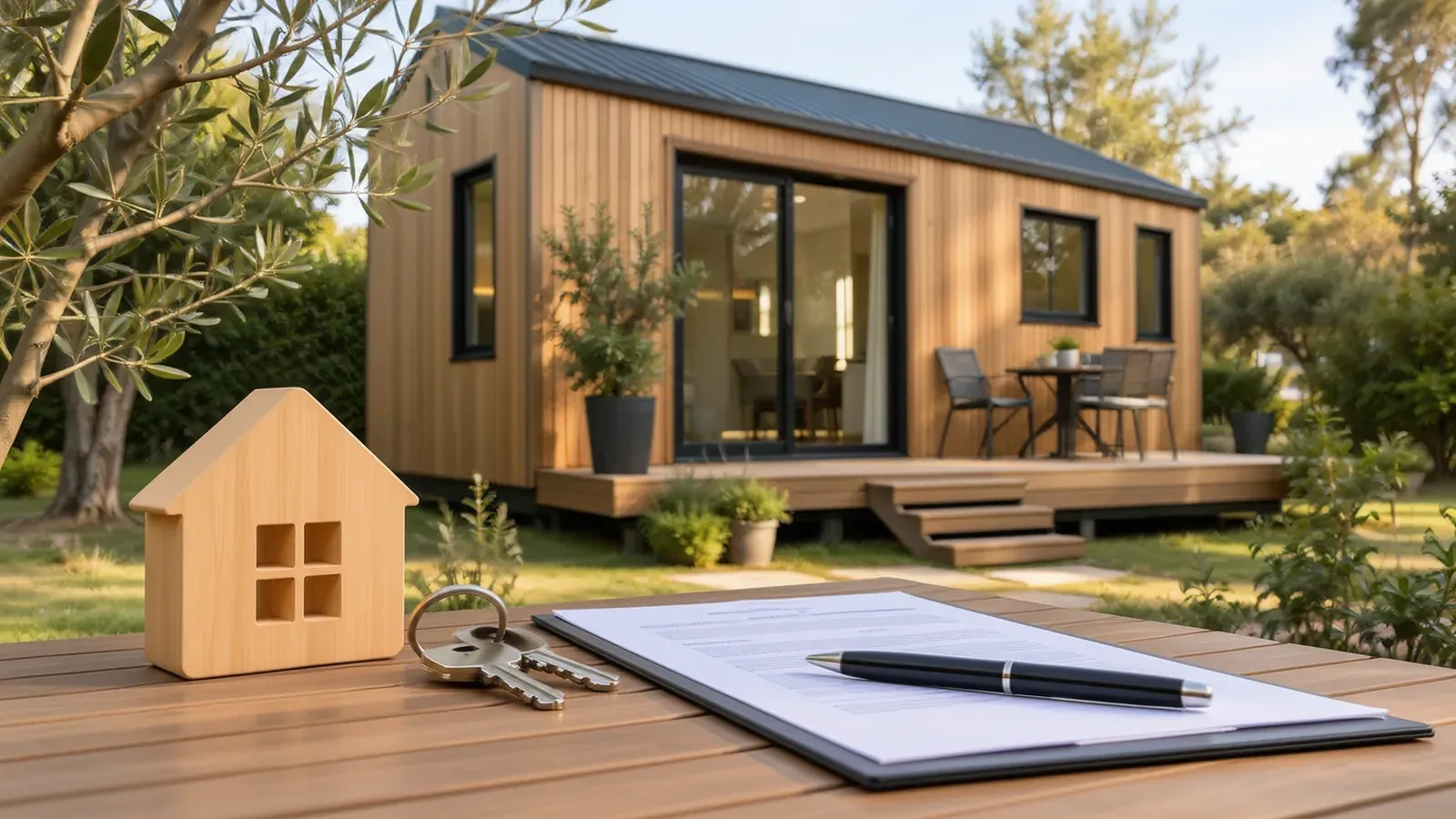
In shortInsurance for a rented tiny house: no law requires a specific policy, but service-public.gouv.fr calls insurance "strongly recommended" and states that a landlord (PNO) policy alone covers neither the guest's damage nor third parties. Combine cover for the building, public liability and your insurer's written agreement.
Key figures
- Up to €450: fine for failing to register a furnished tourist let with the town hall (entreprises.gouv.fr, page published 10 February 2025)
- Up to €5,000: civil fine where a registration number is required and missing (same page)
- USD 1 million: cap of Airbnb's host liability insurance (Airbnb help pages, consulted 9 November 2026)
- USD 3 million: cap of Airbnb's host damage protection, which "is not an insurance policy" (same pages)
*By Yannick Akoka, co-founder of AIIA · published 9 November 2026*
You plan to let your tiny house by the night and one question stops you: which insurance for a rented tiny house do you need, and which one really covers a guest who damages the property or injures a neighbour? The starting point is simple. French law does not impose a specific policy for a furnished tourist let, but the risks are real. A fire, a water leak or a fall on the terrace can cost a great deal. This article separates what official texts say, what insurers offer and what Airbnb takes on, then lists the questions to ask before the first night you let. The facts come from official, insurer and Airbnb pages opened on 9 November 2026; they do not replace your insurer's advice.
Is insurance compulsory to let a tiny house?
Not for the short-term let itself. The service-public.gouv.fr page on insuring a furnished tourist let says there is no legal obligation, but that insurance is "strongly recommended" for owner and guest alike (page checked on 10 March 2025). That silence in the law does not protect you: without a suitable policy, you may have to bear the cost of a loss yourself.
Two points matter. First, co-ownership: article 9-1 of the law of 10 July 1965 requires every co-owner, whether resident or not, to insure against the public liability risks they bear. If your tiny house sits on a co-owned plot or in a residence, that rule applies. Second, the lease or the site rules may themselves require insurance.
What is compulsory is registering the furnished tourist let with the town hall, unless it is your main home. The entreprises.gouv.fr page (published 10 February 2025) mentions a fine of up to €450 for failing to register, and a civil fine of up to €5,000 in towns that require a registration number. Insurance is a matter of prudence and of your contract.
Keep the distinction in mind: town hall registration is an obligation, insurance is an official recommendation, and the choice of cover depends on your risks and your contract.

Which insurance for a rented tiny house: which cover to combine?
A tiny house let to travellers is exposed to five risks, rarely combined in one policy: damage to the building, damage by the guest, damage to third parties, theft and loss of income. The table below shows who covers what according to the sources we read.
| Risk | What normally covers it | Watch point |
|---|---|---|
| Damage to the tiny house (fire, water leak, storm) | Multi-risk home policy or owner's policy | Exclusions possible: Crédit Agricole cites tornado or hurricane, for example |
| Damage caused by the guest | A policy taken "on behalf of whom it may concern", or waiver of recourse | A landlord (PNO) policy alone does not cover it (service-public.gouv.fr) |
| Damage to neighbours and third parties | Public liability, "villégiature" option | Check in the contract |
| Theft and vandalism | The policy's theft cover | A rarely occupied home is more exposed (MAIF) |
| Lost income if the home is unusable | None of the pages we read mentions it | Ask the insurer explicitly |
The facts come from service-public.gouv.fr, MAIF and Crédit Agricole; contracts vary by insurer. Always compare exclusions before premiums. To see what these items weigh in your project, test them in the simulator on the Invest page.
Is a PNO or a home insurance policy enough?
A PNO policy alone is not enough, according to service-public.gouv.fr, and a standard home policy covers short-term letting only if the contract says so. Insurers also disagree with each other. A PNO policy (non-occupying owner) covers the building but, according to service-public.gouv.fr, neither damage caused by the guest nor damage suffered by neighbours and third parties. Crédit Agricole says a PNO "can be taken out" if the property is mostly let short-term. MAIF writes the opposite: it is not aimed at short lets, and rather mentions a "seasonal let" extension.
service-public.gouv.fr lists several formulas that also protect the guest and third parties:
| Formula | What the official page says |
|---|---|
| PNO (non-occupying owner) | Covers the building, not damage caused by the guest nor damage suffered by neighbours and third parties |
| Policy "on behalf of whom it may concern" | Includes the guest and third parties |
| Waiver of recourse | More limited cover, without liability towards third parties |
| "Special holiday-let liability" | Option covering the owner's liability, including towards neighbours and third parties |
If you use the tiny house yourself part of the year, Crédit Agricole links it rather to a multi-risk home policy. In every case, ask the insurer for written agreement to the letting use: it is the only way not to discover an exclusion after a loss.
What does Airbnb's AirCover cover for hosts?
AirCover completes your insurance without replacing it. According to Airbnb help pages consulted on 9 November 2026, host damage protection is capped at USD 3 million and "is not an insurance policy"; host liability insurance is capped at USD 1 million and underwritten by third-party insurers. Airbnb itself invites hosts to take out personal insurance for damage outside the cover.
The limits of AirCover
These caps do not tell you what is excluded. The detailed terms sit in separate articles that we could not read in full: read them before relying on them. A MAIF page from January 2024 also notes that the host claim must be reported to Airbnb within 14 days after the guest leaves.
Two practical limits stand out. These covers are Airbnb's: check with your insurer what applies if you also let on other platforms or directly. And damage caused by the building itself, such as a falling roof tile, stays with you according to MAIF. Treat AirCover as a safety net, never as your main insurance.
Is a fixed tiny house insured like a tiny house on wheels?
No, and the distinction changes the contract. A towed tiny house is treated as a caravan according to MAIF, with liability through a motor policy while moving and its own registration document above 500 kg. Crédit Agricole writes the opposite: these homes "are not treated as a caravan", and it reserves trailer insurance for towed tiny houses. The two insurers differ: ask each how it classes your home.
Fixed tiny house
A fixed tiny house, set permanently on a plot, may fall under a home or owner's policy depending on the insurer: none of the pages we read settles it, so ask in writing. According to a feedback from the AIIA team, not guaranteed, AIIA tiny houses are real houses, without wheels. So tell the insurer the surface, materials, installation method and rental use: none of the pages we read says how each insurer classifies this kind of home.
Planning rules
On planning rules, a fixed installation generally falls under prior declaration or a permit depending on surface; the town hall confirms it for your project. Read the rules for installing on a plot before asking for an insurance quote: the town hall confirms which regime applies to your project.
Do the manufacturer's warranties replace insurance?
No. Manufacturer warranties protect against a product defect, not against a loss or against your guests. At AIIA they run 10 years on the structure, 5 years on waterproofing and 3 years on installations, backed by the manufacturer and relayed by AIIA. They are not insurance: they do not address a fire, a theft or a guest's fall on the terrace.
AIIA is neither a builder nor an installer: the Pricing page lists no insurance among its options, and water and electricity connections are done with a local professional. Cover for the building and rental liability therefore remain to be taken out with an insurer of your choice.
To understand what a warranty really covers, read the warranties of a modular home. The 2026 catalogue starting prices give the order of magnitude of what you insure: Mono, a 32 m² tiny house, starts at €41,500* and Glass, at 25 m², at €49,900*. The insured value should match the cost of replacement, furniture and equipment included.
\* Prices exclude tax.
Which questions should you ask the insurer before the first night?
Ask precise questions and keep the answers in writing. A phone call is not an agreement to cover. Here is the list to run through with each insurer:
- Does my contract explicitly cover short-term letting, and on which platforms?
- Is damage caused by a guest covered, and with what excess?
- Does my liability cover neighbours and third parties, including on the terrace and surroundings?
- Which exclusions apply: natural events, lack of maintenance, abnormal use, prolonged vacancy?
- Is lost income compensated if the tiny house is unusable?
- How does the insurer classify my home, fixed or on wheels, and at what value is it insured?
- Do I need to declare the number of nights let per year?
Ask for at least two quotes and compare exclusions as much as premiums. Keep each insurer's written answers in one file. For theft and vandalism, MAIF notes that a rarely occupied home is more exposed: tell the insurer about your measures, such as a keypad lock or a neighbour on call.
Finally, check that a smoke detector is fitted, which the entreprises.gouv.fr page lists among the obligations of a furnished tourist let: it is part of your guests' safety.

How do you build insurance into your profitability calculation?
Insurance is a fixed cost, counted before the first booking. AIIA's simulator, on the Invest page, uses costs of 30% of rental income, insurance included, on indicative default assumptions. That share is a simulation average, not a real premium: we found no official insurance price for a let tiny house.
A simple method is to ask for two or three quotes and enter them in your cost table, next to tourist tax, management, cleaning and maintenance. If insurance exceeds what your simulation assumed, correct the yield before buying, not after. Test your assumptions with a real premium rather than an average. Once you hold two quotes, test them in the simulator on the Invest page, then ask for a quote within 48 working hours to frame the property to insure.
According to a feedback from the AIIA team, not guaranteed: a Glass let on Airbnb at €345 a night already had 8 months of bookings ahead of it. That figure is an isolated observation, never an average or a promise. It mainly shows that a well-booked property carries a real loss of income if a claim occurs: hence the value of asking for loss-of-income cover.
Take the full method from the profitability of a modular accommodation and check furnished-let taxation. To choose between short-stay and long-term lets, compare with long-term or seasonal letting.

Where should you start to insure your let tiny house?
Start with three steps, in this order: register the letting with the town hall, get the insurer's written agreement to rental use, then enter the covers in your cost table. No law imposes a single contract, but cover for the building, public liability and guest damage form the base to assemble.
Keep this article's limits in mind. It relies on the official pages of service-public.gouv.fr and entreprises.gouv.fr (dated 2025), on the 1965 law for co-ownership and on insurers' pages from 2024 and 2025: the terms of your contract always prevail. It replaces neither your insurer nor legal advice.
The complete guide to modular homes and tiny houses gives the overall picture; the AIIA collection presents the models.
AIIA's view
AIIA offers tiny houses and modular homes, built in a workshop by its manufacturer and delivered to your plot; AIIA is neither a builder nor an installer. We do not sell insurance and we promise no cover: only your insurer can commit in writing. Our advice is to treat insurance as a line of the project, like the land and the connections, which are carried out with a local professional. Ask for two quotes, require written agreement to rental use, then enter the premiums in your cost table before ordering. To frame your project and get a quote within 48 working hours, go through the Contact page. A project whose profitability cannot withstand a real insurance premium deserves a rethink before the purchase, not after.
Sources
- Insuring a furnished tourist let (F2721), service-public.gouv.fr, checked 10 March 2025
- Furnished tourist lets, entreprises.gouv.fr, published 10 February 2025
- Law of 10 July 1965, article 9-1, Légifrance, in force since 27 March 2014
- AirCover for hosts, Airbnb, undated page, consulted 9 November 2026
- Insurance for tiny houses, MAIF, updated 21 July 2025
- Airbnb insurance, MAIF, updated 24 January 2024
- Insuring a mobile home or tiny house, Crédit Agricole, 13 November 2024
Sources checked on 9 November 2026.
- service-public.gouv.fr/particuliers/vosdroits/F2721
- entreprises.gouv.fr/espace-entreprises/s-informer-sur-la-regleme…
- legifrance.gouv.fr/loda/article_lc/LEGIARTI000028779136
- airbnb.fr/help/article/3733
- maif.fr/habitation/guide-assurance-habitation/tiny-h…
- maif.fr/habitation/guide-assurance-habitation/assura…
- credit-agricole.fr/particulier/conseils/magazine/tout-un-mag/co…
Frequently asked questions
Should you tell your insurer before letting your tiny house?
None of the pages we read requires a declaration to the insurer, but MAIF finds it "strongly advised" to insure a tiny house let short-term. Ask for written agreement on rental use, with the surface and installation method.
Is the guest's own insurance enough?
Not always. According to service-public.gouv.fr, the holiday-let cover of a standard home policy may be enough for the guest, otherwise a specific policy is needed. You can ask for a certificate, but it does not replace your own contract.
What happens if a guest starts a fire?
It depends on your contract. A PNO policy alone does not cover damage caused by the guest; a policy "on behalf of whom it may concern" or a waiver of recourse changes the position. Have this point set out in writing.
Is loss of income covered?
None of the pages we read deals with it. Ask your insurer whether it compensates lost income when the tiny house is unusable, and on what conditions.
Does AirCover replace my insurance?
No. Airbnb states that its damage protection "is not an insurance policy" and invites hosts to take out personal insurance for damage outside the cover. Treat AirCover as a complement.
What fine do you risk without town hall registration?
According to entreprises.gouv.fr, a fine of up to €450 for failing to register, and a civil fine of up to €5,000 for a missing registration number in the towns concerned. Check your town hall's rules.
How much does insurance for a let tiny house cost?
We found no official price. The premium depends on the contract, the insured value and rental use: compare at least two quotes before setting your budget.