In shortTo heat a tiny house in winter, cut demand first, then choose equipment that suits how you use the home: electric radiators, an air-to-air heat pump or a stove. Each degree lower saves about 7% (ADEME). Have a professional size the system and put the heater in writing in the quote.
Key figures
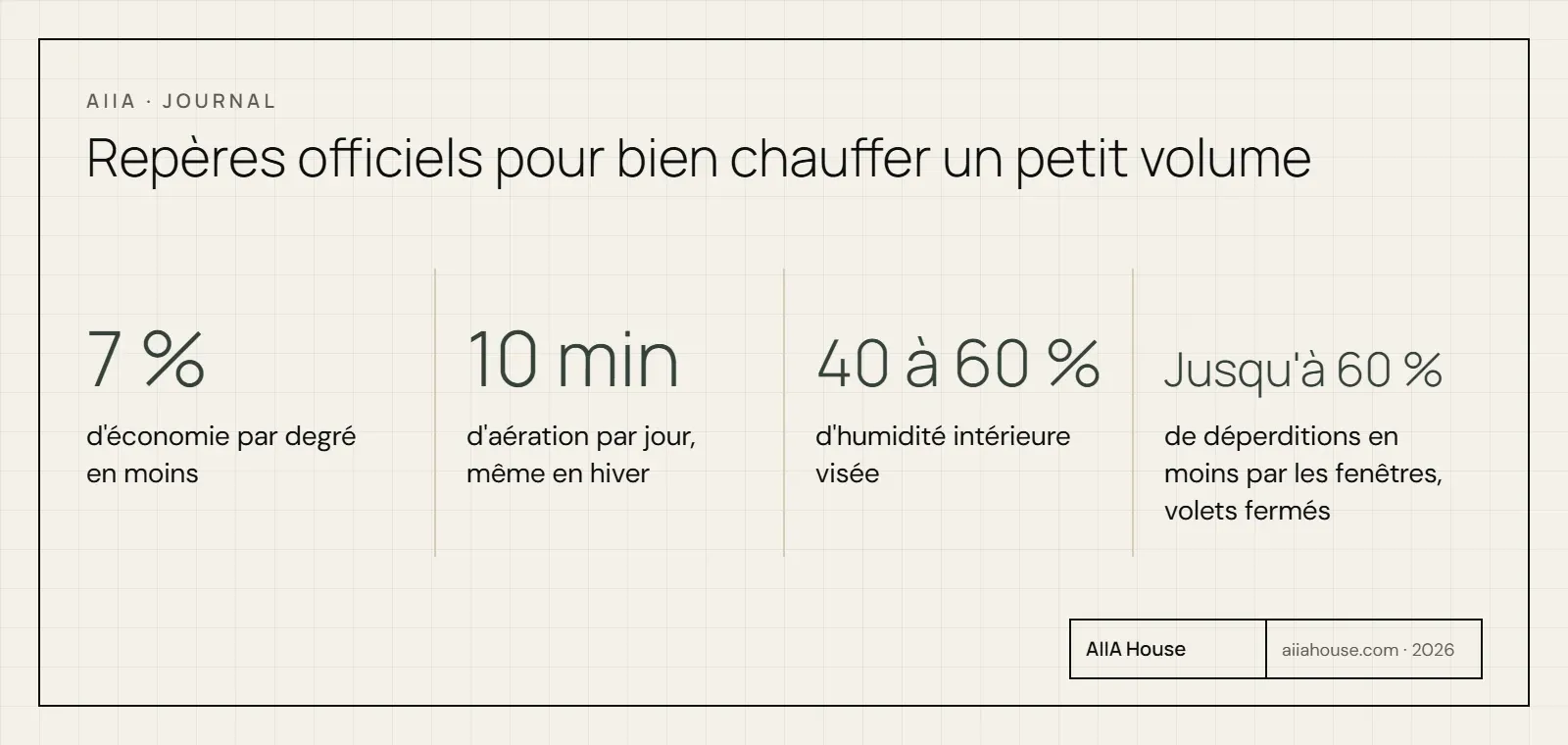
- 7% saving, roughly, for each degree of heating lowered (ADEME, guide Un hiver tout confort, October 2020)
- €0.2001 including tax per kWh: Bleu tariff, Base option, since 1 August 2026 (EDF)
- 10 minutes of airing a day, even in winter (ADEME, October 2020; info.gouv.fr, 3 November 2021)
- 40 to 60%: target indoor humidity (ADEME, October 2020)
- 15 years: minimum age of the home for most works eligible for MaPrimeRénov' (Service-Public, page checked on 1 September 2026)
*By Yannick Akoka, co-founder of AIIA · published 31 October 2026*
A winter in a tiny house is prepared before the order, not at the first cold snap. In a small volume everything shows quickly: heat builds fast, so does humidity, and a poor setting weighs on comfort and on the bill alike.
The method is simple: reduce demand, choose equipment that suits how you use the home, then have a professional size it.
This article compares the common options, works out a bill with visible assumptions and recalls the safety rules. It also says what the AIIA model sheets state, or leave out, about heating. It is written for a private buyer weighing up several models or several types of heating.
What is the best way to heat a tiny house in winter?
There is no single best heating system: the right choice combines low demand with equipment suited to your use. In a small volume, you gain first from how you run the heating (set-point, shutters, airing), then from the choice of heater.
The approach has four steps:
- Define the use: main home, second home or holiday let.
- Limit demand: a reasonable set-point, shutters, controlled ventilation.
- Choose the equipment: electric radiators, an air-to-air heat pump or a stove.
- Have a local professional size and install the system.
An AIIA model is delivered to your plot, and the connections are made with a local professional. To place heating within the whole project, read our guide to starting a tiny house project.
Why is a tiny house heated differently from a house?
Because its small volume reacts quickly: it warms up fast, but also cools fast if the envelope performs poorly. Details (glazing, doors, thermal bridges) weigh more than in a large home.
Three features matter:
- the volume of air is small: the power needed is modest, but not zero;
- showers, cooking and breathing humidify the air over a few square metres;
- there is little room for a large appliance or a fuel store.
Fact: heating accounts on average for 62% of a household's energy spending (ADEME, October 2020). That figure covers all homes, not tiny houses: no reliable public data isolates their case.
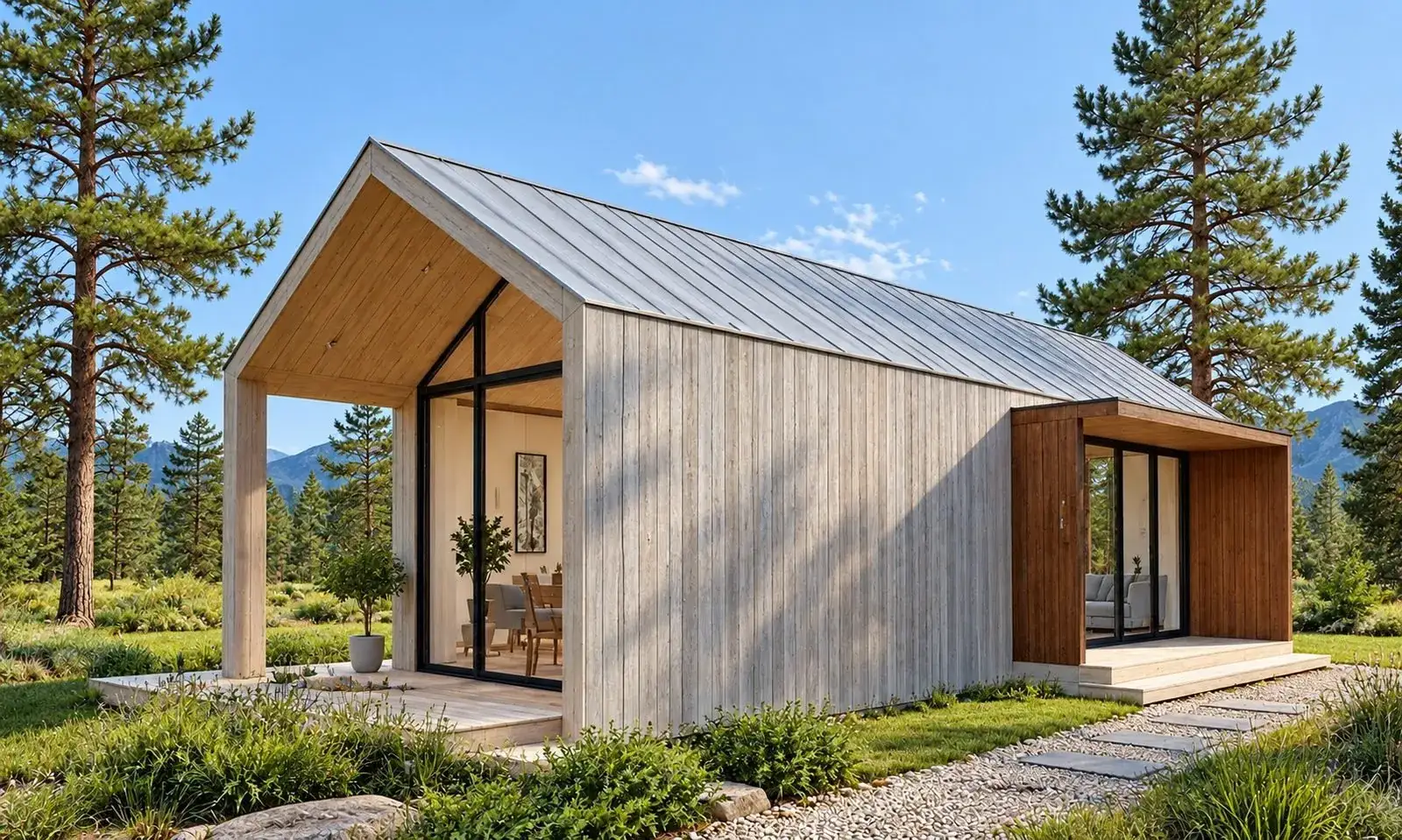
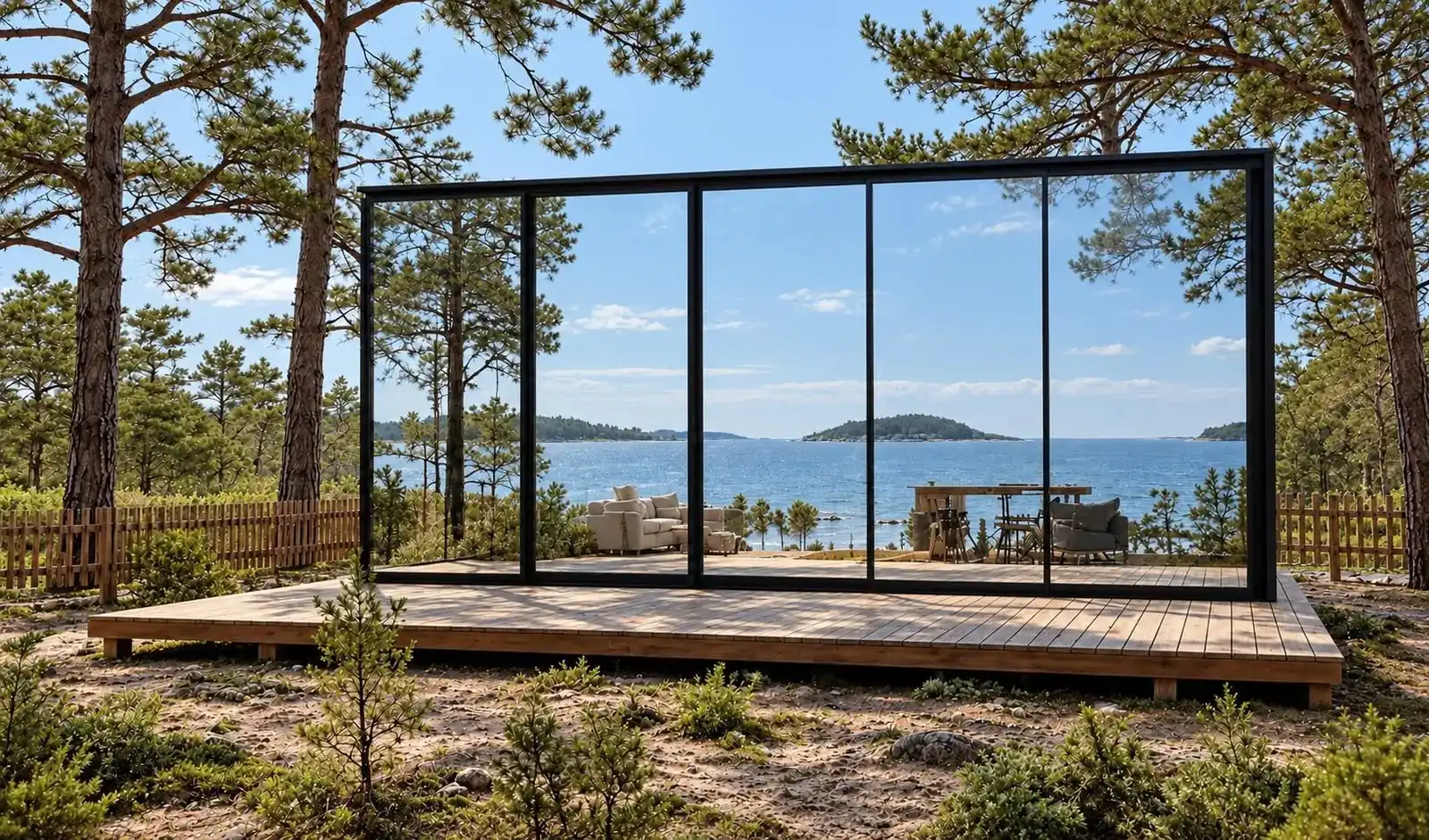
On the envelope, the AIIA pages state rock-wool or equivalent insulation and double-glazed joinery. Glass (25 m²) is fully glazed, according to its sheet, so its openings count in the thermal balance. For the effect of orientation, see choosing the orientation of your plot. For glazing, see wood, steel, glass: which materials, and for comfort in a small home, well-being in compact housing.
What heating power do you need?
There is no universal power rating: it depends on the local climate, insulation, openings and how you use the home. Only a professional (heating engineer or thermal consultancy) can calculate it for your project. Beware of rules of thumb read on forums.
| What changes the power needed | Why |
|---|---|
| Region and altitude | The harshness of winter weighs more than floor area |
| Orientation, wind, glazing | Winter sun gains, heat lost through glass |
| Joinery and insulation | They set the heat losses |
| How often the home is occupied | All year, weekends or short stays |
An under-sized heater leaves you uncomfortable on the coldest days. An over-sized one costs more and overheats a small volume. UFC-Que Choisir cites, for an over-powered stove, 25 to 30 °C in the main room against about 17 °C next door. For a heat pump, the CAPEB (July 2024) points out that over-sizing raises costs and can shorten the life of the appliance.
So ask for a written heat-loss calculation before approving a heater. AIIA designs its homes to meet RE2020, which has applied to new houses since 1 January 2022 (ecologie.gouv.fr). Compliance is shown project by project: see our article on what RE2020 changes for a modular home.
Which heating system should you choose: electric, heat pump or stove?
Four families come up most often: electric radiators, the air-to-air heat pump, the pellet stove and the wood stove. None is ideal everywhere: the choice depends on use, available space and local rules.
| System | Strengths | Points to watch | What to ask |
|---|---|---|---|
| Electric radiators or panels | No flue | The bill follows the price of electricity and the quality of the envelope; the subscription must be enough | Room-by-room control, programming |
| Air-to-air heat pump | Heats indoor air using the heat of outdoor air | Efficiency falls in hard frost, backup needed (France Rénov'); outdoor unit to site | Output suited to a small volume, noise level |
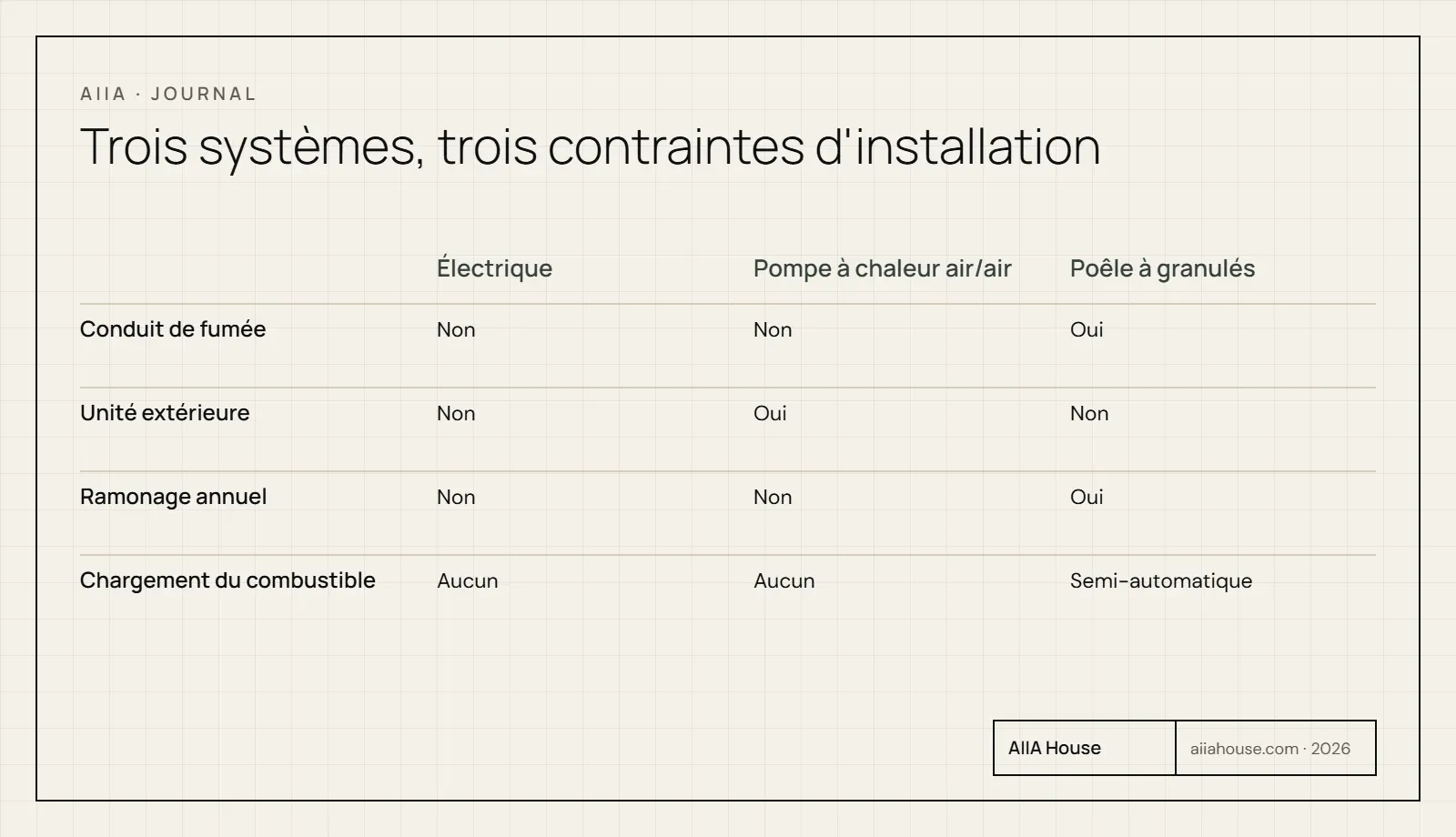
| Pellet stove | Semi-automatic loading, electronic control (France Rénov'); far less polluting than a log stove (Que Choisir) | Flue, pellet store, sweeping; usually no domestic hot water | Flue route, clearances to walls |
| Wood stove | Ambient warmth | A flue is compulsory, sweeping, local rules, risk of over-sizing | Minimum output, sweeping certificate |
France Rénov' states that the air-to-air heat pump, sometimes sold as reversible air conditioning, can stop producing heat when temperatures drop sharply. It considers it better suited to Mediterranean regions. In a cold climate, plan for a backup.
Pellet stove or air-to-air heat pump? The question comes up often on forums. Recommendation: the stove suits you if a flue is allowed and you accept loading and servicing the appliance. The heat pump suits you if you want to avoid a flue and winters stay mild or a backup exists.
Which system suits how you use the home?
The right system depends first on how often the home is occupied: a home lived in all year is not run like a let used a few weeks. What follows is a recommendation, not a rule: check it with your installer.
| Use | Priority | Option to study |
|---|---|---|
| Main home | Constant comfort, sobriety, fine control | Controlled electric or air-to-air heat pump; stove as a complement if a flue is allowed |
| Second home | Fast warm-up, frost protection from a distance | Programmable or remotely controlled heater |
| Holiday let | A warm home on arrival, simple for guests | An easy-to-set heater, stays programmed |
Working hypothesis for a let: programming the warm-up before each stay limits the risk of a lukewarm home on arrival, though we cannot put a figure on the effect.
For a main home, the difference comes from the set-point, airing and the annual check. If you aim to operate through winter on a tourist site, read opening a modular accommodation in winter. For the interior, see fitting out a tiny house.
What temperature should you heat to, to cut the bill?
ADEME's benchmarks (guide Un hiver tout confort, October 2020) are 20 to 21 °C in occupied living rooms and 16 to 17 °C when they are unoccupied. The bedroom manages with 17 °C at night. Each degree lower saves about 7%.
Fictional example, worked with that average rule: going from 21 to 19 °C cuts consumption by about 14% (2 × 7%). It is an indicative estimate, not a measurement on a tiny house.
The most effective measures, according to the same source, are:
- closing shutters and curtains in the evening: up to 60% less heat lost through windows;
- opening shutters on sunny days to benefit from the sun;
- fitting a programmable thermostat: up to 15% saving.
In a small volume, programming avoids heating an empty home while ensuring comfort on your return.
How much does it cost to heat a tiny house, and what aid exists?
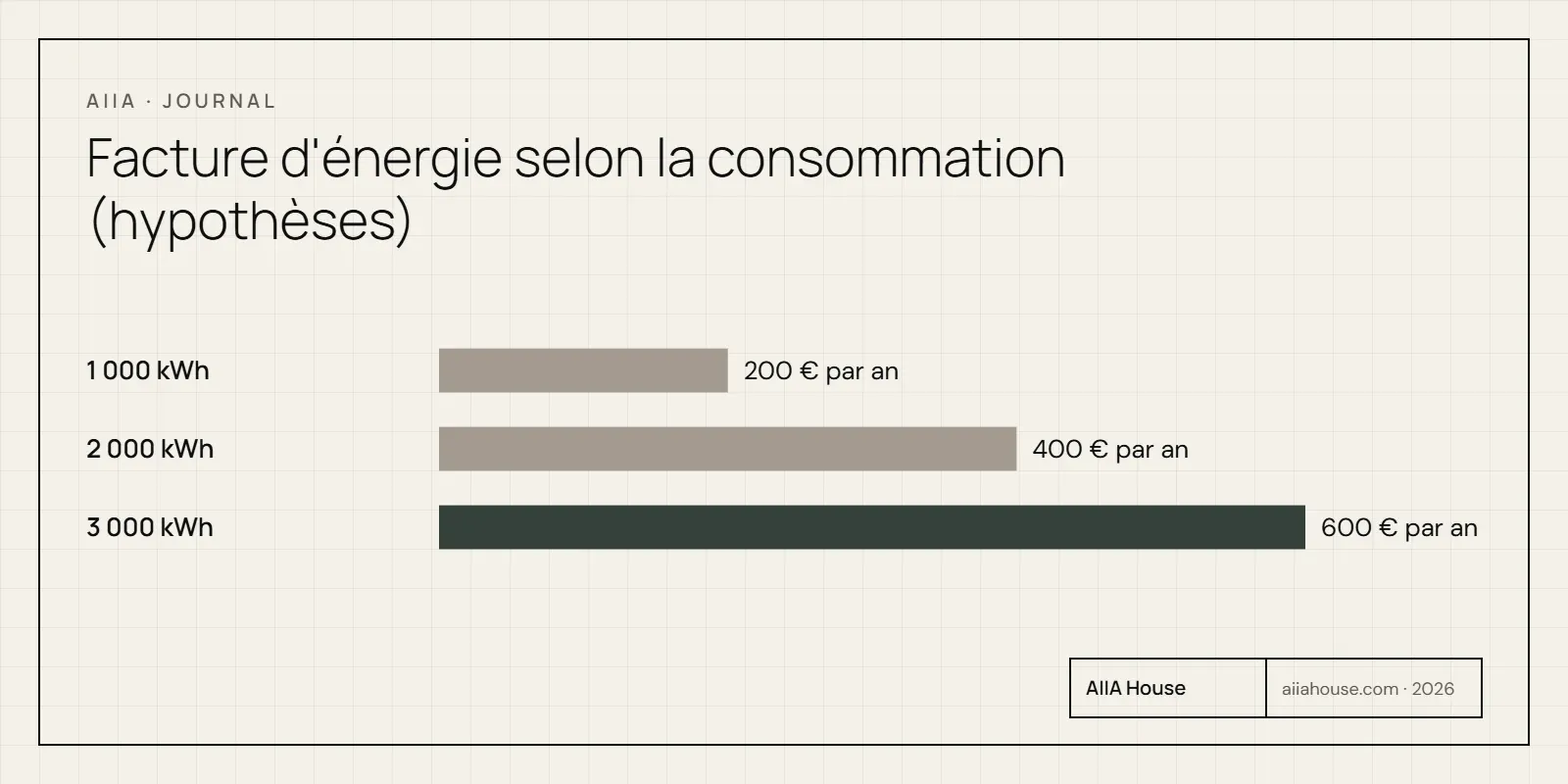
No reliable annual cost exists without a specific project, but you can work one out with visible assumptions. For direct electric heating, the energy bill is consumption in kWh multiplied by the price per kWh. EDF shows €0.2001 including tax per kWh for the Bleu tariff, Base option, since 1 August 2026. The 6 kVA subscription comes on top: €15.86 including tax a month.
| Assumed heating consumption | Energy at €0.2001 per kWh | With the set-point lowered by 2 °C (−14%) |
|---|---|---|
| 1,000 kWh a year | about €200 | about €172 |
| 2,000 kWh a year | about €400 | about €344 |
| 3,000 kWh a year | about €600 | about €516 |
These consumption figures are assumptions, not measurements on a tiny house. For scale, the CRE works out, for a typical customer using 4.5 MWh a year, €1,072 including tax a year after the average rise of 2.5% including tax planned for 1 August 2026. Its tariff assumptions may differ from the Base option above. A stove swaps electricity for pellets or wood, whose price varies by supplier: we give no figure for them.
Beyond energy, budget for the heater, its installation, a possible increase in the subscription and annual servicing. Connections are never included in the price of an AIIA model: read the price of a turnkey modular home. For a quote that names the heater and its output, contact AIIA.
On aid, a newly delivered module does not in principle qualify for MaPrimeRénov'. Most works require a home built at least 15 years ago, and two years for a few items such as an air-to-water heat pump (Service-Public, page checked on 1 September 2026). The scheme changes: check before you buy with a France Rénov' adviser on 0 808 800 700.
How do you avoid damp and the risks of a small volume?
Air the home for ten minutes a day, even in winter, and keep humidity between 40 and 60% (ADEME, October 2020). In a tiny house, showers, cooking and breathing humidify the air quickly: controlled ventilation protects comfort and the structure.
Three prevention rules:
- never block air inlets and outlets, and do not switch off a mechanical ventilation system;
- leave about 2 cm under doors so air can circulate, as the Ministry of Ecology's indoor-air leaflet recommends;
- monitor humidity and, if it is too high, check ventilation before buying a dehumidifier.
Safety matters just as much. Carbon monoxide causes about a hundred deaths a year in France (info.gouv.fr, 3 November 2021). The official measures: have heating and flues checked every year by a professional, never run a supplementary heater continuously, never heat with an oven, a brazier or a camping heater.
For a stove, sweeping is compulsory: at least once a year, twice in most départements, with a certificate to keep. The fine can reach €450 (Service-Public, page checked on 13 May 2026). Some municipalities also restrict wood burning: ask your town hall.
What does AIIA say about the heating of its models, and what should you ask before ordering?
At AIIA, heating depends on the model and is specified in the quote. According to the Tarifs page, the base price includes the galvanised steel structure, high-performance insulation, aluminium double-glazed joinery, and the interior electrics and plumbing. The sheets list heating on a line marked "depending on the model"; air conditioning is an option.
| Model | Area | Starting price | Heating on the sheet |
|---|---|---|---|
| Glass | 25 m² | €49,900* | "Depending on the model, specified in the quote" |
| Span | 27 m² | €41,000* | "Documented for this model" |
| Pod | 28 m² | €56,500* | "Documented for this model" |
| Line | 40 m² | €52,000* | "Documented for this model" |
| Vista | 46 m² | €61,500* | "Documented for this model" |
| Axis | 65 m² | €57,000* | Not mentioned: ask in the quote |
These sheets, read on 31 October 2026, name neither the heater nor its output. Prices are base prices, excluding land, connections and options. So ask in writing for:
- the planned heater and its output;
- how it is controlled;
- what is included in the price and what you pay for yourself;
- the electrical subscription power to plan for;
- the recommended annual servicing.
To compare offers, read what a turnkey modular home includes. The AIIA configurator gives areas and base prices. For permits and connections, see the regulations and installation page. For a quote that names the heater, book an appointment with AIIA.
What should you remember before choosing your heating?
Remember the essentials: cut demand first, choose equipment that suits your use, then have a professional size it. The best system is the one that matches how often you occupy the home and your municipality's rules.
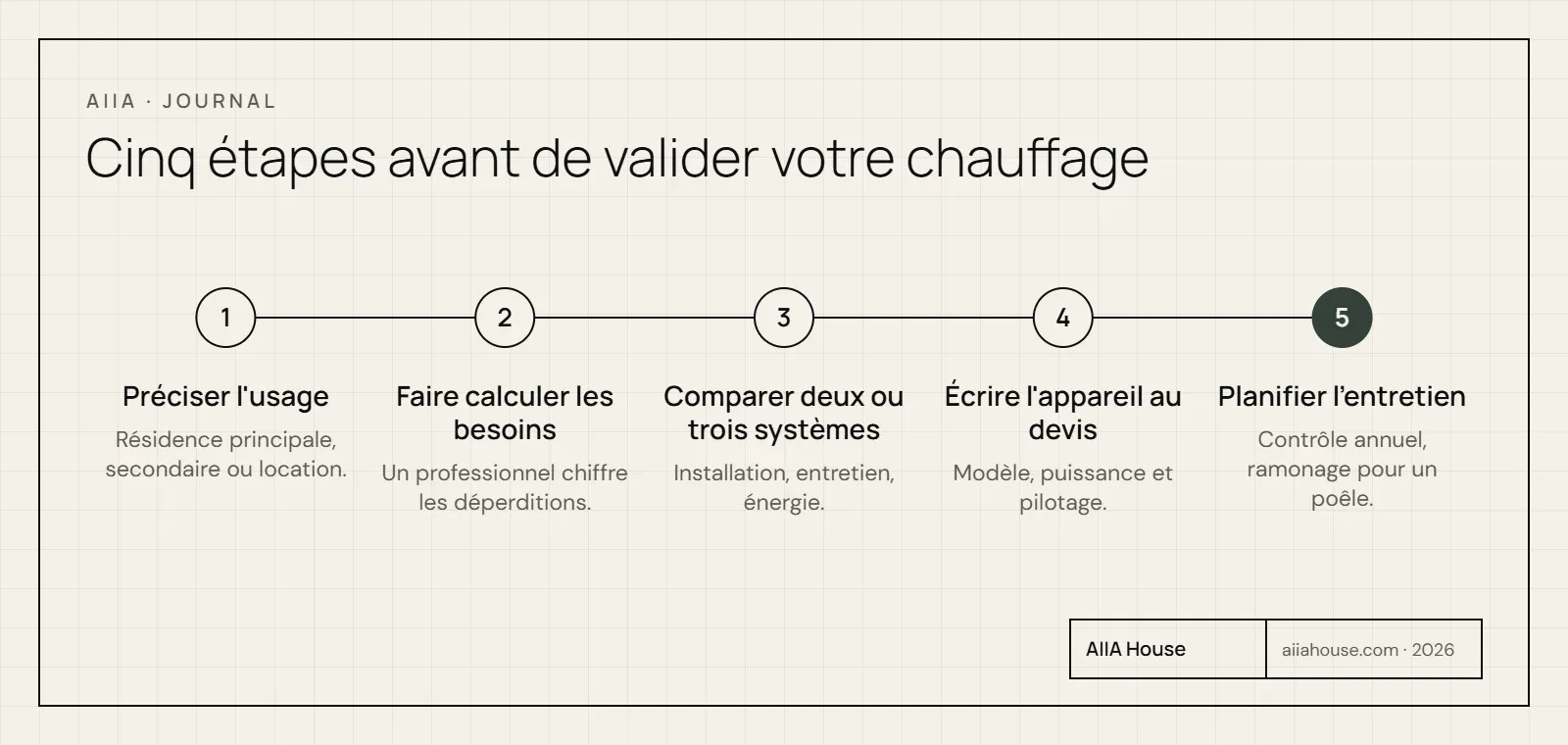
Here is the way forward:
- State your use and your region.
- Have the heating needs of your project calculated.
- Compare two or three systems on installation, servicing and energy.
- Have the heater and its output written into the quote.
- Plan annual servicing from commissioning.
To discuss your plot and your heating, contact AIIA: a site study is available on request. Base prices are also on the prices page. Sources consulted on 31 October 2026.
To place this topic in the whole journey, read the complete guide: modular homes and tiny houses: the complete guide.
Frequently asked questions
Can you heat a tiny house without a chimney flue?
Yes. Electric radiators and the air-to-air heat pump need no flue. A stove, wood or pellet, does: UFC-Que Choisir states that a simple ventilation duct is not enough.
Is a supplementary heater enough for the whole winter?
No. ADEME lists it among the equipment "to avoid", and info.gouv.fr says never to run it continuously. A winter is prepared with properly sized main equipment.
Does an air-to-air heat pump heat in hard frost?
Its efficiency falls when temperatures drop sharply, and it can stop producing heat (France Rénov'). In a cold climate, plan for a backup and have a professional size it.
Is a wood stove allowed in a tiny house?
It depends on your municipality and the installation. Service-Public notes that some municipalities restrict fireplaces and that sweeping is compulsory. Ask your town hall before buying.
Does MaPrimeRénov' fund the heating of a new tiny house?
In principle no: most works require a home built at least 15 years ago (Service-Public, 1 September 2026). Have your case checked by a France Rénov' adviser before buying.
Who installs the heating in an AIIA model?
A local professional of your choice. AIIA is neither builder nor installer, and connections are not included. AIIA can put you in touch with installers. Yannick Akoka, co-founder of AIIA, written and signed on 31 October 2026.