In shortThe acoustic insulation of a new modular home follows the French order of 30 June 1999 like any house: at least 30 dB of façade insulation, plus noise ceilings for ventilation and heating. Nothing is imposed between the rooms of a detached house. So ask in writing for the wall build-up and the sound level of the equipment.
Key figures
- 30 dB: minimum façade insulation against outdoor noise, main rooms and kitchens (order of 30 June 1999, article 7, Légifrance, text in force on 7 November 2026)
- 45 dB: the highest value the façade requirement can reach near noisy transport infrastructure (FFB, page viewed on 8 November 2026)
- 35 dB(A): maximum level for individual heating or air conditioning in main rooms (order of 30 June 1999, article 5)
- 30 dB(A): maximum level for mechanical ventilation at minimum flow in main rooms (order of 30 June 1999, article 6)
- 3 dB: the difference from which most people notice a change (FPInnovations and Cecobois, 2024, a Quebec reference)
*By Yannick Akoka, co-founder of AIIA · published 8 November 2026*
Are you worried about hearing the road, the rain or your neighbours in a modular home? The worry is fair, but acoustic insulation (or sound insulation) comes down to a few precise benchmarks. The regulation sets a minimum for outdoor noise and for equipment, and almost nothing for the partitions of a detached house. The rest depends on the wall build-up, glazing, ventilation and heating you choose. This article separates what the law requires, what it leaves to your own standard, and what to obtain in writing before signing a quote.
What does the law say about the acoustic insulation of a modular home?
A new modular home falls under the same acoustic regulation as a traditional house: the order of 30 June 1999 on the acoustic characteristics of residential buildings. The sound insulation of a modular home, the everyday term for acoustic insulation, falls under the same text. This text covers buildings whose building permit or works declaration was filed from 1 January 2000 (Légifrance, text in force on 7 November 2026).
The ministry in charge of ecology states that this framework covers airborne noise, impact noise and equipment noise. It adds that checking compliance requires acoustic measurements on site (page updated on 15 October 2026).
Three nuances matter for your project:
- the text does not define a "detached house": several requirements mainly concern the separation between two dwellings;
- it does not distinguish the construction method: modular, timber frame or masonry are judged on the result;
- it sets a minimum comfort. In a reply published in the Journal officiel on 15 January 2019, the Government speaks of minimum acoustic comfort and leaves higher levels to private labels.
This article extends the reference guide "modular home and tiny house", which puts acoustics back in the whole purchase. Energy requirements fall under another framework: see RE2020 in modular housing.
Method: thresholds checked on Légifrance (text in force on 7 November 2026), on the page of the ministry in charge of ecology (updated on 15 October 2026) and on the FFB website. AIIA is not an acoustic consultancy: have your case confirmed by an acoustician or the town hall.
Which thresholds apply to a new detached house?
For a new detached house, the figures mainly concern outdoor noise and equipment noise. Between the rooms of a detached house, the FFB says few requirements apply. The decibel (dB) measures insulation: the higher, the better. Façade insulation is technically noted DnT,A,tr: the standardised weighted acoustic insulation, measured between outdoors and the room. The dB(A) measures a sound level: the lower, the better. The table summarises the order of 30 June 1999; the 45 dB value comes from the FFB.
| Topic | Threshold (1999 order; FFB for the 45 dB) | In practice |
|---|---|---|
| Outdoor noise (main rooms and kitchens) | Façade insulation of at least 30 dB, up to 45 dB near noisy infrastructure | The higher the figure, the less road noise gets in |
| Individual heating or air conditioning | 35 dB(A) at most in a main room, 50 dB(A) in a kitchen | The lower the figure, the quieter the unit |
| Mechanical ventilation at minimum flow | 30 dB(A) at most in a main room, 35 dB(A) in a kitchen | Noise is measured at minimum speed |
| Airborne and impact noise between rooms | Not applicable to a detached house (FFB) | Partitions and floors are part of your own specification |
A difference of 3 dB or more is generally noticed by most people, according to a 2024 sheet by FPInnovations with Cecobois. The benchmark is from Quebec, but it gives an order of magnitude: 30 dB of façade insulation and 33 dB are not equivalent.
Near a classified road or railway, the required level can be higher. Classification is set by prefectural orders and can be found in the informative annexes of the local urban plan (PLU), according to the FFB. Take it into account when choosing the plot.

Does a modular home insulate less well against noise?
Not by nature: acoustic insulation depends on the build-up of the walls and on details, not on where the home is made. A light structure is, however, designed differently from a heavy wall.
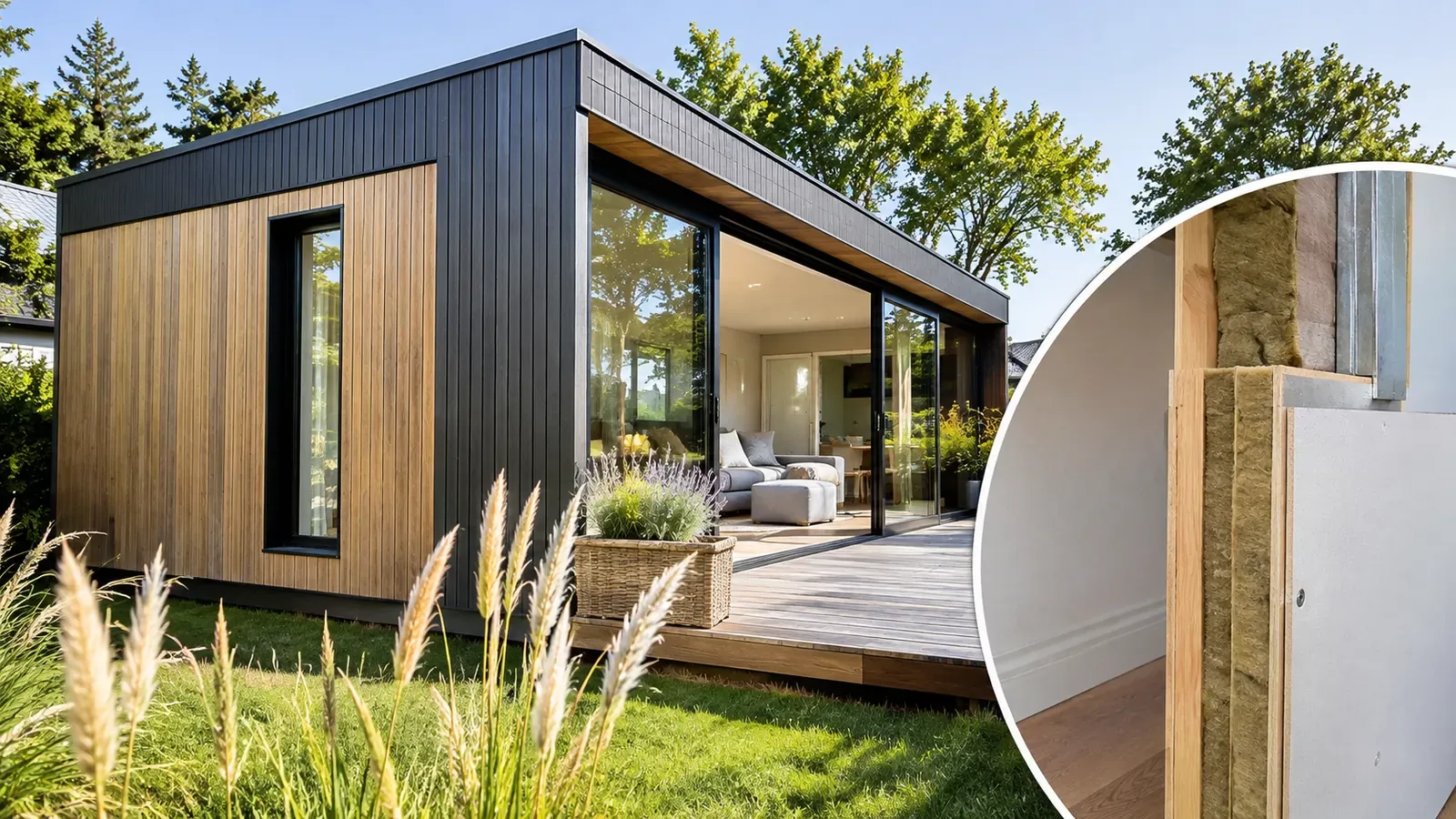
A sheet by FPInnovations with Cecobois (2024, for Quebec) ranks the levers of a light-frame wall. It rates as very important the decoupling between boards and studs, and the absorbent material in the cavity when studs are decoupled. Board thickness and number of layers are rated important. The indices are Canadian, but the principle holds for any light frame, including a tiny house.
On AIIA's side, the public pages describe a light steel structure fully prefabricated in the workshop, with rock wool or equivalent insulation (Our approach and FAQ pages, read on 8 November 2026). They give neither thickness nor acoustic performance. That point is settled by a written request, detailed below.
For façade materials and durability, see our article on wood, steel and glass.
Which weak points should you watch, from rain on the roof to seals?
Acoustic defects mostly come from details, rarely from the plain wall. Sheet G1 of the Agence Qualité Construction (January 2023 edition) lists frequent defects. It mainly covers insulation between rooms in collective housing, but several defects apply to any house:
- acoustic bridges, such as poorly made patches or rigid insulation in a lining;
- ventilation ducts, when grilles have too low a rating or no sound trap;
- electrical sockets placed back to back in the same partition;
- sealing defects in joinery: perimeter or threshold seal, sash adjustment, a gap under the front door.
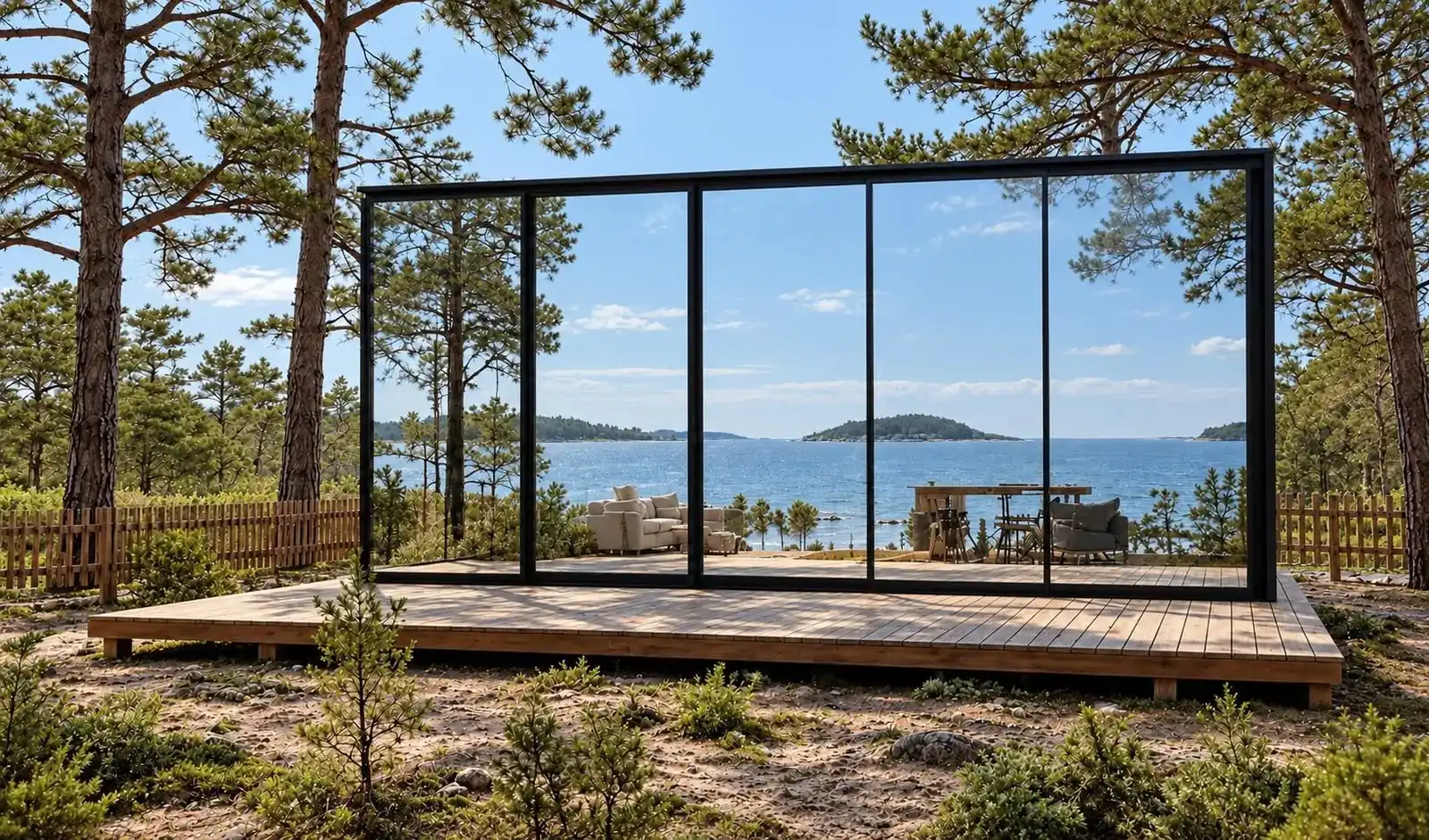
Glazing deserves particular attention on a very open model such as Glass. On Line or Vista, ask for the same build-up. AIIA's pages mention low-emissivity double glazing and aluminium joinery, with no acoustic value.
Rain on the roof is a question that comes up in construction forums. The 1999 order sets, in the articles we consulted (5 to 7), no dedicated threshold for rain: nothing protects you without a written commitment on the roof build-up.
What does AIIA provide, and what should you ask for in writing?
AIIA currently publishes materials, not acoustic performance. On the Pricing, Our approach, FAQ and collection pages read on 8 November 2026, no dB value appears. The base price includes high-performance insulation, aluminium joinery and double glazing (Pricing page). Heating is "depending on the model, specified in the quote" (Glass sheet).
You can therefore ask for these five items before signing:
| Ask in writing | Why |
|---|---|
| Build-up of walls, roof and floor | The pages cite rock wool or equivalent, without thickness |
| Glazing and joinery of your model | No acoustic performance is published |
| Heating, air conditioning, ventilation: unit and level in dB(A) | The limits are 35 and 30 dB(A) in a main room |
| Noise zone of the plot | Found in the PLU annexes, via the town hall |
| A commitment in dB, or a statement that there is none | What is not written is not guaranteed |
AIIA is neither a builder nor an installer: units are fitted with your local installer, who must know these ceilings. AIIA can put you in touch with installers. To compare heating options for a small floor area, see how to heat a tiny house in winter, then ask for the dB(A) level of the chosen unit.
Attach this list to your quote request: answer within 48 working hours.
How much does acoustics weigh in a modular home budget?
The catalogue does not price acoustics: it is settled in the quote, model by model. The 2026 catalogue starting prices (standard finish) give the starting point, excluding land, connections, formalities and options.
- Glass, 25 m²: from €49,900*;
- Line, 40 m²: from €52,000*;
- Axis, 65 m²: from €57,000*;
- Vista, 46 m²: from €61,500*.
Compare the four models with the same list of questions, in a quote request: answer within 48 working hours.
Layout matters too. A larger floor area, like that of Axis, lets you keep bedrooms away from the living room and equipment. A small model puts everything in one volume. This is a design recommendation, not a figure: any improvement to insulation is priced in the quote, and we have no amount to announce.
For the content and cost of a turnkey home, see what is included, how much it costs and the Pricing page.
- Prices exclude tax.

When does acoustics become a priority?
It becomes a priority as soon as the plot, the use or the neighbourhood amplifies the nuisance. Three situations come up.
Exposed plot. Near a classified road or railway, the façade requirement can reach 45 dB. Stricter requirements and an acoustic certificate may be added (FFB; Socotec, May 2024). The town hall or a professional confirms which rules apply. See also our article on choosing the plot and the regulations, the one on plot orientation and the site's Regulation page.
Outbuilding for a relative. An outbuilding at the bottom of the garden shares your sound environment: keep bedrooms away from your terrace and ask for the dB(A) level of the equipment. The article on housing a relative details the constraints.
Remote work. Place the office away from the ventilation and heating, whose dB(A) level appears in the quote. Our article on remote work covers acoustics.
Neighbourhood noise falls under another framework, cited by the ministry: decree no. 2006-1099 of 31 August 2006, codified in articles R. 1334-30 to 37 of the Public Health Code.
How do you check the acoustic insulation on delivery?
Check in three stages: before ordering, on delivery, then during the first nights. Only measurements on site prove compliance, according to the ministry. For operations of at least 10 dwellings, the certificate relies on end-of-works measurements: a detached house is not concerned, so if you want a measurement, it must appear in the quote.
Here is a suggested routine, presented as a recommendation:
- Have the items of the previous table written into the quote.
- Check the noise zone of the plot in the PLU before ordering.
- On delivery, inspect the joinery seals and the play of the sashes.
- Listen to the ventilation at minimum flow and to the heating, with the bedroom door closed.
- Report any defect in writing to the installer, then to AIIA via the Contact page.
The manufacturer's warranties (10 years structure, 5 years waterproofing, 3 years installations, relayed by AIIA) do not replace a commitment on sound level: see the article on warranties.

What should you remember before asking for a quote?
Remember that the law sets a minimum of 30 dB of façade insulation and noise ceilings for equipment, and leaves the rest to your specification. AIIA's pages do not publish acoustic performance: it is up to you to ask for the build-up of walls, glazing and equipment.
These choices are made before manufacturing, which takes 6 to 8 weeks. To combine acoustics and energy, read the article on RE2020 in modular housing and the one on heating a tiny house in winter. The reference guide modular home and tiny house puts the topic back in your project.
Next step: ask for a quote with the list of questions above (answer within 48 working hours) or build your model in the configurator.
The AIIA view
According to our public pages, AIIA designs tiny houses and modular homes, has them made in a workshop and delivers them to your plot. We do not currently publish a quantified acoustic performance, and we will not promise one unless it is written into the quote. Our advice: ask in writing for the build-up of the walls, the glazing and the equipment, and check the noise zone of your plot at the town hall. AIIA is neither a builder nor an installer: installation and connections are done with a local professional, and we can put you in touch with installers. Warranties are 10 years on the structure, 5 years on waterproofing and 3 years on installations.
- legifrance.gouv.fr/loda/id/JORFTEXT000000211449
- ecologie.gouv.fr/politiques-publiques/acoustique-batiment
- assemblee-nationale.fr/dyn/15/questions/QANR5L15QE10180.pdf
- ffbatiment.fr/techniques-batiment/reglementation-construct…
- socotec.fr/le-blog/attestation-acoustique-logements-neufs
- qualiteconstruction.com/wp-content/uploads/2024/05/Fiche-Qualite-Reg…
- cecobois.com/wp-content/uploads/2024/04/Fiche-BP-Controle…
Frequently asked questions
Is a modular home noisier than a traditional house?
Not by nature. The regulation applies the same thresholds to both, and the result depends on the walls, glazing and equipment. Ask for these items in writing to compare two quotes.
Can you hear rain on the roof of a modular home?
No dedicated threshold for rain in the 1999 order (articles 5 to 7 checked). For a light wall, the Cecobois sheet rates decoupling and absorbent material as very important; it covers walls, not precisely roofs. Ask for the roof build-up in writing.
Do you need an acoustic study before ordering?
Not systematically. If your plot is near a classified noisy infrastructure, stricter requirements and a certificate may apply. Check the classification in the PLU annexes, with the town hall.
Are interior partitions regulated in a detached house?
No, according to the FFB: airborne and impact noise requirements between rooms do not apply to a detached house. If calm between bedrooms matters to you, have it written into the quote.
Is thermal insulation enough for acoustics?
No. The two functions are not the same, even if cavity insulation can help. Cecobois and FPInnovations also stress the decoupling of walls, hence the value of asking for the full build-up.
What can you do about neighbourhood noise?
Neighbourhood noise falls under the decree of 31 August 2006, codified in articles R. 1334-30 to 37 of the Public Health Code. For your situation, contact the town hall or a professional.